40°42′54″N 74°0′13″W / 40.71500°N 74.00361°W
| United States Court of International Trade | |
|---|---|
| (Ct. Int'l Trade or CIT) | |
 |
|
| Location | James L. Watson Court of International Trade Building 1 Federal Plaza New York, NY 10278 United States |
| Appeals to | Federal Circuit |
| Established | December 18, 1980 |
| Authority | Article III court |
| Created by | 28 U.S.C. §§ 251–258 |
| Composition method | Presidential nomination with Senate advice and consent |
| Judges | 9 |
| Judge term length | Life tenure |
| Chief Judge | Mark A. Barnett |
| cit |
|
The United States Court of International Trade (case citations: Ct. Int'l Trade; also abbreviated as CIT)[1] is a United States federal court that adjudicates civil actions arising out of United States customs and international trade laws.[2] Seated in Lower Manhattan, New York City, the court exercises broad jurisdiction over most trade-related matters and is permitted to hear and adjudicate cases originating anywhere in the United States as well as internationally.[3]
The court originated with the Customs Administrative Act of 1890, which established the Board of General Appraisers as a quasi-judicial entity of the United States Department of the Treasury to hear disputes primarily concerning tariffs and import duties.[4] In 1926, Congress replaced the Board with the United States Customs Court, an administrative tribunal with greater judicial functions, which in 1930 was made independent of the Treasury Department. In 1956, the United States Customs Court was reconstituted by Congress as an Article III tribunal, giving it the status and privileges of a federal court. The Customs Courts Act of 1980 established the United States Court of International Trade in its current form, granting it jurisdiction over all trade matters and conferring its judges with life tenure.[4]
The court's subject matter jurisdiction is limited to particular questions in international trade and customs law, though it may also decide any civil action against the United States government, its officers, or its agencies arising out of any law connected to international trade. As an Article III tribunal, the United States Court of International Trade can decide controversies in both law and equity, and is thus allowed to grant relief in virtually all means available, including money judgments, writs of mandamus, and preliminary or permanent injunctions.
Led by a chief judge, the CIT is composed of nine judges appointed by the United States president and confirmed by the United States Senate. No more than five judges can be of the same political party.[5] Cases are typically heard by just one judge, although trials involving potential constitutional issues or broad legal implications for customs laws may be decided by a three-judge panel.[6] The court operates on procedures and protocols drawn heavily from the Federal Rules of Civil Procedure.
History
In 1890, the United States Congress passed legislation creating the Board of General Appraisers, a quasi-judicial administrative unit within the United States Department of the Treasury. The Board had nine members appointed by the President of the United States and empowered to review decisions of United States Customs officials concerning the amount of duties to be paid on importations.[7]
In 1926, Congress responded to the increasing number and complexity of customs cases by replacing the Board of General Appraisers with the United States Customs Court, an independent Article I tribunal, retaining the jurisdiction and powers of the Board of General Appraisers. In 1928, the United States Customs Court became the first federal tribunal in the United States to have a woman judge,[8] when President Calvin Coolidge nominated Genevieve R. Cline to the court.[9] Although many members of the United States Senate objected to Cline's appointment, both because of her sex, and because they believed she was self-taught and had no judicial experience, her supporters advocated strongly for her, including Katherine Pike, president of the National Association of Women Lawyers and a number of club-women. Cline won U.S. Senate confirmation on May 25, 1928, received her commission on May 26, 1928, and took her oath of office in the Cleveland Federal Building on June 5, 1928.[10]
On July 14, 1956, Congress made the United States Customs Court an Article III tribunal, again without changing its jurisdiction, powers, or procedures.[11] After making some procedural changes in the Customs Courts Act of 1970, Congress addressed substantive issues concerning the court's jurisdiction and remedial powers in the Customs Courts Act of 1980, which broadened the power of the court and renamed it the United States Court of International Trade.[7]
On May 28, 2025, a three-judge panel of the court ruled in V.O.S. Selections, Inc. v. United States that President Donald Trump overstepped his authority by using the 1977 International Emergency Economic Powers Act (IEEPA) to justify sweeping tariff hikes under his Liberation Day trade policy. The court held that the IEEPA does not grant presidents the power to impose such broad import taxes. The judges also struck down a separate set of tariffs the Trump administration had levied on China, Mexico, and Canada, which had been justified as a response to drug trafficking and illegal immigration. The court found that these measures exceeded executive authority.[12][13]
Courthouse

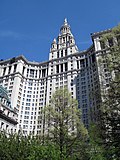
The James L. Watson Court of International Trade Building, located on Foley Square in lower Manhattan in New York City, houses the court. Also known as 1 Federal Plaza, it was built in 1968 adjacent to the Jacob K. Javits Federal Building.[14] In 2003, the building was named in honor of James L. Watson, a judge of the United States Customs Court from 1964 to 1980, and of the Court of International Trade from 1980 to 2001.[15]
Jurisdiction
The court possesses limited subject matter jurisdiction, meaning that it may hear only cases involving particular international trade and customs law questions. For example, the court hears disputes such as those involving protests filed with U.S. Customs and Border Protection, decisions regarding Trade Adjustment Assistance by the United States Department of Labor or United States Department of Agriculture, customs broker licensing, and disputes relating to determinations made by the United States International Trade Commission and the Department of Commerce's International Trade Administration regarding anti-dumping and countervailing duties.[16]
There is one notable exception to the court's jurisdiction. In cases involving antidumping and countervailing duties imposed on Canadian or Mexican merchandise, an interested party can request that the case be heard before a special ad hoc binational panel organized under Chapter 19 of the 1994 North American Free Trade Agreement.
Procedure
Most cases are heard by a single judge. If a case challenges the constitutionality of a U.S. law or has important implications regarding the administration or interpretation of the customs laws, then it may be heard by a three-judge panel. Many Judges of the Court of International Trade also regularly sit by designation on three-judge panels of the United States courts of appeals.[7]
Although the Court maintains its own rules of procedure, they are patterned for the most part on the Federal Rules of Civil Procedure. The court has held that decisions interpreting the Federal Rules of Civil Procedure are "instructive" in interpreting its own rules.[7]
Current composition of the court
As of July 8, 2025[update]:
| # | Title | Judge | Duty station | Born | Term of service | Appointed by | ||
|---|---|---|---|---|---|---|---|---|
| Active | Chief | Senior | ||||||
| 24 | Chief Judge | Mark A. Barnett | New York City | 1963 | 2013–present[Note 1] | 2021–present | — | Obama |
| 25 | Judge | Claire R. Kelly | New York City | 1965 | 2013–present | — | — | Obama |
| 26 | Judge | Jennifer Choe-Groves | New York City | 1969 | 2016–present | — | — | Obama |
| 27 | Judge | Gary Katzmann | New York City | 1953 | 2016–present | — | — | Obama |
| 28 | Judge | Timothy M. Reif | New York City | 1959 | 2019–present | — | — | Trump |
| 29 | Judge | M. Miller Baker | New York City | 1962 | 2019–present | — | — | Trump |
| 31 | Judge | Lisa Wang | New York City | 1980 | 2024–present | — | — | Biden |
| 32 | Judge | Joseph A. Laroski | New York City | 1971 | 2024–present | — | — | Biden |
| 33 | Judge | Vacant | New York City | – | – | — | — | – |
| 11 | Senior Judge | Jane A. Restani | New York City | 1948 | 1983–2015 | 2003–2010 | 2015–present | Reagan |
| 13 | Senior Judge | Thomas J. Aquilino | inactive | 1939 | 1985–2004 | — | 2004–present | Reagan |
| 19 | Senior Judge | Judith Barzilay | inactive | 1944 | 1998–2011 | — | 2011–present | Clinton |
| 20 | Senior Judge | Delissa A. Ridgway | inactive | 1955 | 1998–2019 | — | 2019–present | Clinton |
| 21 | Senior Judge | Richard K. Eaton | New York City | 1948 | 1999–2014 | — | 2014–present | Clinton |
| 22 | Senior Judge | Timothy C. Stanceu | New York City | 1951 | 2003–2021 | 2014–2021 | 2021–present | G.W. Bush |
| 23 | Senior Judge | Leo M. Gordon | New York City | 1952 | 2006–2019 | — | 2019–present | G.W. Bush |
- ^ By virtue of his seniority of age, Judge Barnett holds seniority over Judge Kelly despite their identical commission dates.
Vacancies and pending nominations
| Seat | Prior Judge's Duty Station | Seat last held by | Vacancy reason | Date of vacancy | Nominee | Date of nomination |
|---|---|---|---|---|---|---|
| 9 | New York City | Stephen Vaden | Resignation | July 7, 2025 | Kara Westercamp | March 2, 2026 |
Former judges of the United States Court of International Trade
| # | Judge | Born–died | Active service | Chief Judge | Senior status | Appointed by | Reason for termination |
|---|---|---|---|---|---|---|---|
| — | Samuel Rosenstein | 1909–1995 | — | — | 1980–1995[Note 1] | L. Johnson / Operation of law | death |
| 1 | Paul Peter Rao | 1899–1988 | 1980–1988[Note 1] | — | — | Truman / Operation of law | death |
| 2 | Morgan Ford | 1911–1992 | 1980–1985[Note 1] | — | 1985–1992 | Truman / Operation of law | death |
| 3 | Scovel Richardson | 1912–1982 | 1980–1982[Note 1] | — | — | Eisenhower / Operation of law | death |
| 4 | Frederick Landis Jr. | 1912–1990 | 1980–1983[Note 1] | — | 1983–1990 | L. Johnson / Operation of law | death |
| 5 | James Lopez Watson | 1922–2001 | 1980–1991[Note 1] | — | 1991–2001 | L. Johnson / Operation of law | death |
| 6 | Herbert N. Maletz | 1913–2002 | 1980–1982[Note 1] | — | 1982–2002 | L. Johnson / Operation of law | death |
| 7 | Bernard Newman | 1907–1999 | 1980–1983[Note 1] | — | 1983–1999 | L. Johnson / Operation of law | death |
| 8 | Edward D. Re | 1920–2006 | 1980–1991[Note 1] | 1980–1991 | — | L. Johnson / Operation of law | retirement |
| 9 | Nils Boe | 1913–1992 | 1980–1984[Note 1] | — | 1984–1992 | Nixon / Operation of law | death |
| 10 | Gregory W. Carman | 1937–2020 | 1983–2014 | 1996–2003 | 2014–2020 | Reagan | death |
| 12 | Dominick L. DiCarlo | 1928–1999 | 1984–1996 | 1991–1996 | 1996–1999 | Reagan | death |
| 14 | Nicholas Tsoucalas | 1926–2018 | 1986–1996 | — | 1996–2018 | Reagan | death |
| 15 | R. Kenton Musgrave | 1927–2023 | 1987–1997 | — | 1997–2023 | Reagan | death |
| 16 | Richard W. Goldberg | 1927–2023 | 1991–2001 | — | 2001–2023 | G.H.W. Bush | death |
| 17 | Donald C. Pogue | 1947–2016 | 1995–2014 | 2010–2014 | 2014–2016 | Clinton | death |
| 18 | Evan Wallach | 1949–present | 1995–2011 | — | — | Clinton | elevation |
| 30 | Stephen Vaden | 1982–present | 2020–2025 | — | — | Trump | resignation |
Former judges of the United States Customs Court
| # | Judge | Born–died | Active service | Chief Judge | Senior status | Appointed by | Reason for termination |
|---|---|---|---|---|---|---|---|
| 1 | William Barberie Howell | 1865–1927 | 1926–1927[Note 1] | 1926–1927 | — | McKinley / Operation of law | death |
| 2 | Israel F. Fischer | 1858–1940 | 1926–1932[Note 1] | 1927–1932 | — | McKinley / Operation of law | retirement |
| 3 | Byron Sylvester Waite | 1852–1930 | 1926–1930[Note 1] | — | — | T. Roosevelt / Operation of law | retirement |
| 4 | Charles Paul McClelland | 1854–1944 | 1926–1939[Note 1] | 1934–1939 | — | T. Roosevelt / Operation of law | retirement |
| 5 | Jerry Sullivan | 1859–1948 | 1926–1939[Note 1] | — | — | Wilson / Operation of law | retirement |
| 6 | George Stewart Brown | 1871–1941 | 1926–1941[Note 1] | 1939–1940 | — | Wilson / Operation of law | retirement |
| 7 | William C. Adamson | 1854–1929 | 1926–1928[Note 1] | — | — | Wilson / Operation of law | retirement |
| 8 | George Emery Weller | 1857–1932 | 1926–1930[Note 1] | — | — | Wilson / Operation of law | retirement |
| 9 | George M. Young | 1870–1932 | 1926–1932[Note 1] | 1932 | — | Coolidge / Operation of law | death |
| 10 | William Josiah Tilson | 1871–1949 | 1928–1949 | 1932–1934 | — | Coolidge | death |
| 11 | Genevieve R. Cline | 1877–1959 | 1928–1953 | — | — | Coolidge | retirement |
| 12 | David Hayes Kincheloe | 1877–1950 | 1930–1948[Note 2] | — | — | Hoover | retirement |
| 13 | Walter Howard Evans | 1870–1959 | 1931–1941 | — | — | Hoover | retirement |
| 14 | Frederick W. Dallinger | 1871–1955 | 1932–1942 | — | — | Hoover | retirement |
| 15 | William John Keefe | 1873–1955 | 1933–1947 | — | — | F. Roosevelt | retirement |
| 16 | Thomas Joseph Walker | 1877–1945 | 1940–1945 | — | — | F. Roosevelt | death |
| 17 | Webster Oliver | 1888–1969 | 1940–1967 | 1940–1965 | 1967–1969 | F. Roosevelt | death |
| 18 | William A. Ekwall | 1887–1956 | 1942–1956 | — | — | F. Roosevelt | death |
| 19 | William Purington Cole Jr. | 1889–1957 | 1942–1952 | — | — | F. Roosevelt | elevation |
| 20 | Charles Lawrence | 1878–1975 | 1943–1965 | — | 1965–1975 | F. Roosevelt | death |
| 21 | Irvin Charles Mollison | 1898–1962 | 1945–1962 | — | — | Truman | death |
| 22 | Jed Johnson | 1888–1963 | 1947–1963 | — | — | Truman | death |
| 23 | Paul Peter Rao | 1899–1988 | 1948–1980[Note 3] | 1965–1971 | — | Truman | reassignment |
| 24 | Morgan Ford | 1911–1992 | 1949–1980 | — | — | Truman | reassignment |
| 25 | David John Wilson | 1887–1976 | 1954–1966 | — | 1966–1976 | Eisenhower | death |
| 26 | Mary Donlon Alger | 1893–1977 | 1955–1966 | — | 1966–1977 | Eisenhower | death |
| 27 | Scovel Richardson | 1912–1982 | 1957–1980 | — | — | Eisenhower | reassignment |
| 28 | Philip Nichols Jr. | 1907–1990 | 1964–1966 | — | — | L. Johnson | elevation |
| 29 | Frederick Landis Jr. | 1912–1990 | 1965–1980 | — | — | L. Johnson | reassignment |
| 30 | James Lopez Watson | 1922–2001 | 1966–1980 | — | — | L. Johnson | reassignment |
| 31 | Lindley Beckworth | 1913–1984 | 1967–1968 | — | — | L. Johnson | resignation |
| 32 | Herbert N. Maletz | 1913–2002 | 1967–1980 | — | — | L. Johnson | reassignment |
| 33 | Bernard Newman | 1907–1999 | 1968–1980 | — | — | L. Johnson | reassignment |
| 34 | Samuel Rosenstein | 1909–1995 | 1968–1970 | — | 1970–1980 | L. Johnson | reassignment |
| 35 | Edward D. Re | 1920–2006 | 1968–1980 | 1977–1980 | — | L. Johnson | reassignment |
| 36 | Nils Boe | 1913–1992 | 1971–1980 | 1971–1977 | — | Nixon | reassignment |
- ^ a b c d e f g h i Reassigned from the Board of General Appraisers.
- ^ Recess appointment; formally nominated on December 4, 1930, confirmed by the United States Senate on January 22, 1931, and received commission on January 29, 1931.
- ^ Recess appointment; formally nominated on June 22, 1948, confirmed by the Senate on January 31, 1949, and received commission on February 2, 1948.
Former members of the Board of General Appraisers
| # | Member | Born/Died | Active service | President | Senior status | Appointed by | Reason for termination |
|---|---|---|---|---|---|---|---|
| 1 | Charles H. Ham | 1831–1902 | 1890–1902 | 1897–1902 | — | B. Harrison | resignation |
| 2 | George C. Tichenor | 1838–1902 | 1890–1902 | 1890–1897 | — | B. Harrison | death |
| 3 | Joseph Biddle Wilkinson Jr. | 1845–1915 | 1890–1899 | — | — | B. Harrison | resignation |
| 4 | James A. Jewell | c. 1840–1912 | 1890–1903 | — | — | B. Harrison | resignation |
| 5 | Henderson M. Somerville | 1837–1915 | 1890–1915 | 1910–1914 | — | B. Harrison | death |
| 6 | Ferdinand N. Shurtleff | 1837–1903 | 1890–1899 | — | — | B. Harrison | removal[Note 1] |
| 7 | Joseph Lewis Stackpole | 1838–1904 | 1890–1890 | — | — | B. Harrison | resignation |
| 8 | Thaddeus S. Sharretts | 1850–1926 | 1890–1913 | — | — | B. Harrison | removal[Note 2] |
| 9 | George H. Sharpe | 1828–1900 | 1890–1899 | — | — | B. Harrison | resignation |
| 10 | Wilbur Fisk Lunt | 1848–1908 | 1891–1908 | — | — | B. Harrison | death |
| 11 | William Barberie Howell | 1865–1927 | 1899–1926 | 1925–1926 | — | McKinley | reassignment |
| 12 | Israel F. Fischer | 1858–1940 | 1899–1926[Note 3] | 1902–1905 | — | McKinley | reassignment |
| 13 | Marion De Vries | 1865–1939 | 1900–1910[Note 4] | 1906–1910 | — | McKinley | elevation |
| 14 | Byron Sylvester Waite | 1852–1930 | 1902–1926 | — | — | T. Roosevelt | reassignment |
| 15 | Charles P. McClelland | 1854–1944 | 1903–1926[Note 5] | — | — | T. Roosevelt | reassignment |
| 16 | Eugene Gano Hay | 1853–1933 | 1903–1923[Note 6] | — | — | T. Roosevelt | retirement |
| 17 | Roy Chamberlain | 1861–1953 | 1908–1913[Note 7] | — | — | T. Roosevelt | removal[Note 2] |
| 18 | Samuel B. Cooper | 1850–1918 | 1910–1918 | — | — | Taft | death |
| 19 | Jerry Bartholomew Sullivan | 1859–1948 | 1913–1926 | 1914–1925 | — | Wilson | reassignment |
| 20 | George Stewart Brown | 1871–1941 | 1913–1926 | — | — | Wilson | reassignment |
| 21 | William C. Adamson | 1854–1929 | 1917–1926 | — | — | Wilson | reassignment |
| 22 | George Emery Weller | 1857–1932 | 1919–1926 | — | — | Wilson | reassignment |
| 23 | George M. Young | 1870–1932 | 1924–1926 | — | — | Coolidge | reassignment |
- ^ Removed from office by William McKinley.
- ^ a b Removed from office by William Howard Taft.
- ^ Recess appointment; formally nominated on December 15, 1899, confirmed by the United States Senate on January 17, 1900, and received commission on January 22, 1900.
- ^ Recess appointment; formally nominated on December 5, 1900, confirmed by the Senate on December 10, 1900, date of commission is unknown.
- ^ Recess appointment; formally nominated on November 10, 1903, confirmed by the Senate on December 7, 1903, and received commission on December 8, 1903.
- ^ Recess appointment; formally nominated on November 10, 1903, confirmed by the Senate on November 24, 1903, and received commission on November 25, 1903.
- ^ Recess appointment; formally nominated on December 8, 1908, confirmed by the Senate on January 11, 1909, and received commission on January 15, 1909.
Chief judges
|
|
|
|||||||||||||||||||||||||||||||||||||||||||||||||||||||||||||
Chief judges have administrative responsibilities with respect to the Court of International Trade, and preside over any panel on which they serve unless circuit judges are also on the panel.[7] Unlike the Supreme Court, where one justice is specifically nominated to be chief, the office of chief judge rotates among the court judges. To be chief, a judge must have been in active service on the court for at least one year, be under the age of 65, and have not previously served as chief judge. A vacancy is filled by the judge highest in seniority among the group of qualified judges. The chief judge serves for a term of seven years or until age 70, whichever occurs first. The age restrictions are waived if no members of the court would otherwise be qualified for the position.
Under the Board of General Appraisers, the position of Chief Judge was entitled "President". When the office was created in 1948, the chief judge was the longest-serving judge who had not elected to retire on what has since 1958 been known as senior status or declined to serve as chief judge. After August 6, 1959, judges could not become or remain chief after turning 70 years old. The current rules have been in operation since October 1, 1982.
Succession of seats
|
|
|
|
|||||||||||||||||||||||||||||||||||||||||||||||||||||||||||||||||||||||||||||||||||||||||||||||
|
|
|
|
|||||||||||||||||||||||||||||||||||||||||||||||||||||||||||||||||||||||||||||||||||||||||||||||||||||
|
|||||||||||||||||||||||||||
See also
- V.O.S. Selections, Inc. v. United States
References
- ^ "What is the Court of International Trade? Learn more about the judges who blocked Trump's tariffs. - CBS News". www.cbsnews.com. May 29, 2025. Retrieved May 29, 2025.
- ^ "About the Court". Court of International Trade. Retrieved March 12, 2021.
- ^ "About the Court". Court of International Trade. Jurisdiction of the Court. Retrieved March 12, 2021.
- ^ a b Patrick C. Reed, The Origins and Creation of the Board of General Appraisers, pp. 92-92.
- ^ "28 U.S. Code § 251 - Appointment and number of judges; offices".
- ^ "28 USC Ch. 11: COURT OF INTERNATIONAL TRADE". uscode.house.gov. Retrieved May 29, 2025.
- ^ a b c d e History of the United States Court of International Trade.
- ^ Jo Freeman, A Room at a Time: How Women Entered Party Politics, 2002: Rowman and Littlefield, p. 216 ( ISBN 084769805X)
- ^ "The Coolidge Week", Time, May 14, 1928
- ^ William Ganson Rose, Cleveland: the Making of a City, 1990: Kent State Univ. Press, p. 854 ( ISBN 0873384288)
- ^ "U.S. Customs Court: Legislative History – Federal Judicial Center". www.fjc.gov.
- ^ Romm, Tony; Swanson, Ana (May 28, 2025). "Trump Tariffs Blocked by U.S. Court of International Trade". The New York Times. ISSN 0362-4331. Retrieved May 29, 2025.
- ^ "US trade court blocks Trump's sweeping tariffs in blow to trade policies". www.bbc.com. May 29, 2025. Retrieved May 29, 2025.
- ^ Casey Nelson Blake, "Tilted Arc, and the Crisis of Public Art" in The Power of Culture: Critical Essays in American History (eds. Richard Wightman Fox & T. J. Jackson Lears), pp. 260–61, 278.
- ^ Public Law 108-70, 108th United States Congress.
- ^ Gregory W. Carman, Jurisdiction and the Court of International Trade: Remarks of the Honorable Gregory W. Carman at the Conference on International Business Practice Presented by the Center for Dispute Resolution on February 27–28, 1992, 13 Nw. J. Int'l L. & Bus. 245 (1992-1993). Retrieved from https://scholarlycommons.law.northwestern.edu/cgi/viewcontent.cgi?article=1357&context=njilb.
External links

- United States Court of International Trade, official site
- History of the court from the Federal Judicial Center
|
Law of the United States
|
|||||
|---|---|---|---|---|---|
| Constitutional law and legislation |
|

|
|||
| Courts of the United States |
|
||||
| Education |
|
||||
| Types of law |
|
||||
|
Civic Center
|
|||||
|---|---|---|---|---|---|
|
Manhattan, New York City
|
|||||
| Government buildings |
|
|
|||
| Non-government buildings |
|
||||
| Other spaces |
|
||||
| Education |
|
||||
| Transport |
|
||||
|
See also: Manhattan Community Board 1
|
|||||
|
Authority control databases
|
|
|---|---|
| International | |
| National | |
| Academics | |
