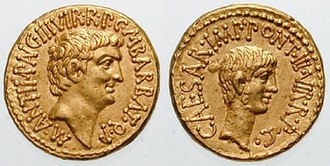

A triumvirate (Latin: triumvirātus) or a triarchy is a political institution ruled or dominated by three individuals, known as triumvirs (Latin: triumviri). The arrangement can be formal or informal. Though the three leaders in a triumvirate are notionally equal, the actual distribution of power may vary.
Informally, the term "triumvirate" may be used for any association of three.[1]
Under the influence of the Soviet Union, the term troika (Russian: for "group of three") may be used for "triumvirate".[2][3]
Pre-modern triumvirates
Biblical
In the Bible, triumvirates occurred at some notable events in both the Hebrew Bible (Old Testament) and New Testament. In the Book of Exodus, Moses, his brother Aaron and their nephew or brother-in-law, Hur,[4] acted this way during the Battle of Refidim against the Amalekites.[5][6] Later in Exodus 24, when Moses was away on Mount Sinai, Aaron and Hur were left in charge of all the Israelites.[7]
In the Gospels, Peter, James, and his brother John were a leading trio among the Twelve Apostles on three specific occasions during the public ministry of Jesus: at the resurrection of the daughter of Jairus,[8] the transfiguration of Jesus,[9] and his agony in the Garden in Gethsemane.[10] Later, in the time of the early Church, the triumvirate of the leading apostles changed slightly after the former James's death: it became composed of Peter, John, and James, brother of Jesus, known collectively also as the three Pillars of the Church.[11][12]
-
 Moses (in the centre) along with Aaron and Hur at the Battle of Rephidim
 -
 Peter (sitting in the centre) along with John and his brother James, son of Zebedee (sitting L-R) at the Transfiguration of Jesus


Ancient China
During the Han dynasty of Imperial China, the Three Excellencies—including the Grand chancellor, Grand Secretariat, and irregularly, the Grand Commandant—represented the most senior ministerial positions of state. This triumvirate was supported by the economic technocrat and imperial secretary Sang Hongyang (d. 80 BCE), their political ally. The acting chancellor, Tian Qianqiu, was also easily swayed by the decisions of the triumvirate.[13]
The Three Excellencies existed during Western Han (202 BCE – 9 CE) as the Grand Chancellor, Grand Secretariat, and Grand Commandant, but the Grand Chancellor was viewed as senior to the Grand Secretariat while the post of Grand Commandant was vacant for most of the dynasty. After Emperor Guangwu established the Eastern Han (25–220 CE), the Grand Commandant was made a permanent official while the Minister over the Masses replaced the Grand Chancellor and the Minister of Works replaced the Grand Secretariat. Unlike the three high officials in Western Han when the Grand Chancellor was senior to all, these new three senior officials had equal censorial and advisory powers. When a young or weak-minded emperor ascended to the throne, these Three Excellencies could dominate state affairs. There were also other types of triumvirates during the Eastern Han; for example, at the onset of the reign of Emperor Ling of Han (r. 168–189), the General-in-chief Dou Wu (d. 168), the Grand Tutor Chen Fan (d. 168), and another prominent statesman Hu Guang (91–172) formed a triumvirate nominally in charge of the Privy Secretariat, when in fact it was a regent triumvirate that was overseeing the affairs of state and Emperor Ling.[14]
Hinduism
In Hinduism, the gods Brahma, Vishnu, and Shiva form the theological triumvirate of the Trimurti, representing the balanced forces of creation, preservation, and destruction, respectively.[15] Their female counterparts and consorts, the goddesses Saraswati, Lakshmi and Parvati, make up the parallel Tridevi.
Pagaruyuang
Triumvirates during the Pagaruyung era in the Minangkabau Highlands were known as Rajo Tigo Selo, or "the three reigning kings." The Rajo Tigo Selo was descended from the same line in the same dynasty and ruled at the same reigning time. It consisted of three kings, the Rajo Alam who ruled the government and diplomatic affairs, the Rajo Adaik who ruled the customs and the Rajo Ibadaik who acted as a Grand Mufti.[16]
Ancient Rome
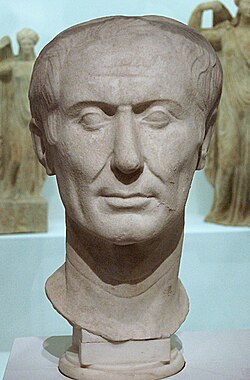


During the Roman Republic, triumviri (or tresviri) were special commissions of three men appointed for specific administrative tasks apart from the regular duties of Roman magistrates.
The term triumvirate is most commonly used by historians of ancient Rome to refer to two political alliances during the crisis of the Roman Republic:
- The First Triumvirate of Julius Caesar, Pompey the Great, and Marcus Licinius Crassus, formed in 60 BCE or 59 BCE as an alliance among three prominent politicians and lasting until the death of Crassus in the Battle of Carrhae in 53 BCE.[17]
- The Second Triumvirate (the Tresviri reipublicae constituendae) of Octavian (later Caesar Augustus), Mark Antony, and Lepidus, formed in 43 BCE as an official, legally established institution, formally recognized by the Roman Senate in the Lex Titia and lasted de facto until the fall of Lepidus in 36 BCE, de jure until 32 BCE.[18]
Tamil
The Three Crowned Kings refers to the triumvirate of Chola, Chera, and Pandya who dominated the politics of the ancient Tamil country. Sivaperuman, Murugan, and Agatiyar are considered the triumvirate of the Tamil language and Sangam literature.[19]
Rum Seljuks

In 1246, Rum Seljuk sultan Kaykaus II was invited to Güyük Khan's coronation. Instead, he sent Kilij Arslan IV, who went to Karakorum with a delegation. Two years later, he was accompanied by a Mongolian military unit of 2000 soldiers and returned to Anatolia with a jarlig given by Guyuk declaring him sultan. He was recognized as sultan in Sivas, Erzincan, Diyarbakır, Malatya, Harput. Later, a meeting was held, resulting in an accord where the three brothers (Kaykaus, Kilij, and Kayqubad) would share the throne. A khutbah was read on their behalf, and coins were struck in their names. However, influenced by some emirs, Kilij Arslan did not accept this and went into conflict with Kaykaus but suffered an unexpected defeat. On 14 June 1249, he was caught and brought to his brother. However, he was well received and returned together to Konya. Both were enthroned alongside Kayqubad II. Thus a period of joint rule began from 1249 until 1254.[20] Kaykaus controlled the capital, Konya, and everything further west, and the coast at Antalya, up to Ankara. Kilij Arslan was allocated everything to the east of Konya up to Erzurum. Kayqubad was granted minor estates on a scale sufficient for his personal expenses.[21][page needed]
Modern triumvirates
Ottoman Empire

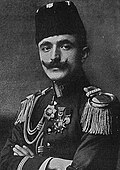

Talaat Pasha (left), Enver Pasha (middle), Djemal Pasha (right)
The Three Pashas also known as Ottoman Triumvirate effectively ruled the Ottoman Empire during World War I: Mehmed Talaat Pasha (1874–1921), the Grand Vizier (prime minister) and Minister of the Interior; Ismail Enver Pasha (1881–1922), the Minister of War; and Ahmed Djemal Pasha (1872–1922), the Minister of the Navy.
Early modern and modern France

During the French Revolution, many commentators referred to the National Convention headed by Robespierre as both a dictatorship and a triumvirate.[22]
Prior to Napoleon and during the Terror from 1793 to 1794 Maximilien Robespierre, Louis Antoine de Saint-Just, and Georges Couthon, as members of the governing Committee of Public Safety, were accused by their political opponents of forming an unofficial triumvirate, pointing out the First Triumvirate of Julius Caesar, Pompey, and Crassus which led to the end of the Roman Republic. Although officially all members of the committee shared equal power the three men's friendship and close ideological base led their detractors to declaim them as triumvirs which was used against them in the coup of 9 Thermidor (27 July 1794).[23]
Czechoslovakia

The Czechoslovak National Council, an organization founded in Paris in 1916 by Czech and Slovak émigrés during World War I to liberate their homeland from Austria-Hungary, consisted of the triumvirate[24] of Tomáš Garrigue Masaryk as a chairman, Edvard Beneš, who joined Masaryk in exile in 1915, as the organization's general secretary, and Milan Rastislav Štefánik, a Slovak who was an aviator in the French Army, designating to represent Slovak interests in the national council. During the closing weeks of the war, the Czechoslovak National Council was formally upgraded to a provisional government and its members were designated to hold top offices in the First Czechoslovak Republic.
Modern Israel
- 2008–2009: Then Prime Minister Ehud Olmert, Defense Minister Ehud Barak, and Minister of Foreign Affairs Tzipi Livni were sometimes referred to as a triumvirate.[25][26][27]
- 2012: The leadership of Shas, the ultra-orthodox Sepharadi political party of Israel, was given by its spiritual leader, Rabbi Ovadia Yosef and the Council of Torah Sages, to a triumvirate formed by the convicted Aryeh Deri, who decided to return to politics after a thirteen-year hiatus, the former party leader Eli Yishai and Ariel Atias.
Benin
- 13 April 1970 until 26 October 1972: After the contentious 1970 presidential elections, the country of Benin (then known as the Republic of Dahomey) adopted a Presidential Council which included the three main political figures in the country: Hubert Maga, Justin Ahomadégbé-Tomêtin, and Sourou-Migan Apithy. In addition, the formal office of President would rotate between the three of them beginning with Hubert Maga. After one successful change of leadership, military leader Mathieu Kérékou staged a coup and overthrew the Presidential Council becoming the leader of the country until 1991.[28]
Soviet Union
- See also List of Troikas in the Soviet Union
In the context of the Soviet Union, the term troika (Russian: for "group of three") is used for "triumvirate".[3]
- May 1922 – April 1925: When Vladimir Lenin suffered his first stroke in May 1922, a Troika was established to govern the country in his place, although Lenin briefly returned to the leadership from 2 October 1922 until a severe stroke on 9 March 1923 ended his political career. The Troika consisted of Joseph Stalin, Lev Kamenev, and Grigory Zinoviev. The Troika broke up in April 1925, when Kamenev and Zinoviev found themselves in a minority over their belief that socialism could only be achieved internationally. Zinoviev and Kamenev joined forces with Leon Trotsky's Left Opposition in early 1926.[29] Later, Kamenev, Zinoviev and Trotsky would all be murdered on Stalin's orders.
- 13 March – 26 June 1953: After the death of Joseph Stalin in March 1953, power was shared between Georgy Malenkov, Lavrenty Beria, and Vyacheslav Molotov.
- 14 October 1964 – 16 June 1977: After the removal of Nikita Khrushchev in October 1964, the Soviet Union went through a period of collective leadership. Power was initially shared between General Secretary (until 1966 First Secretary) Leonid Brezhnev, Premier Alexei Kosygin, and Chairman of the Presidium of the Supreme Soviet (nominal de jure head of state) Anastas Mikoyan. Mikoyan was replaced by Nikolai Podgorny in 1965.

Modern Italy
In the Roman Republic (1849), the title of two sets of three joint chiefs of state in the year 1849:
- 29 March – 1 July 1849: Carlo Armellini (1777–1863), Giuseppe Mazzini (1805–1872), and Conte Aurelio Saffi (1819–1890)
- 1–4 July 1849: Aurelio Saffi (again), Alessandro Calandrelli (1805–1888), and Livio Mariani (1793–1855)
Almost immediately following the Roman Republic, the Red Triumvirate governed the restored Papal States from 1849 to 1850:[30][31]
- 1 August 1849 – 12 April 1850: Cardinals Gabriele della Genga Sermattei (1801–1861), Lodovico Altieri (1805–1867), and Luigi Vannicelli Casoni (1801–1877)
Brazil
Throughout Brazilian history, there have been 4 triumvirates:
- 7 April – 17 June 1831: Emperor Pedro I of Brazil abdicates the throne, and his son, Pedro II of Brazil, cannot assume it due to his age. Thus, the Provisional Triune Regency is formed. The rulers of the Triumvirate were Francisco de Lima e Silva, Campos Vergueiro, and Carneiro de Campos.
- 17 June 1831 – 1835: The Permanent Triune Regency, composed of Francisco de Lima e Silva (again), José da Costa Carvalho and João Bráulio Muniz, assumes power.
- 24 October – 3 November 1930: Following the Revolution of 1930 and the deposition of Washington Luís, a provisional military junta assumed power. The regents were Augusto Tasso Fragoso, José Isaías de Noronha and João de Deus Mena Barreto. After this period of military rule, Getúlio Vargas was sworn in as president of Brazil.
- 31 August – 30 October 1969: A military junta assumed power after Artur da Costa e Silva was removed from the presidency due to health problems. The rulers of the Triumvirate were Augusto Rademaker, Aurélio de Lira Tavares and Márcio Melo. Pedro Aleixo, Costa e Silva's civilian vice-president, should have become interim president under the Brazilian Constitution of 1967, but was prevented from assuming the position.
Paraguay
Paraguay had four brief triumvirates after the Paraguay campaign, with only the penultimate lasting more than a year:
- Shared Governorate, 16 May – 17 June 1811[32]
- Bernardo de Velasco
- José Gaspar Rodríguez de Francia
- Juan Valeriano de Zevallos
- Liberal Triumvirate, 21 January – 9 February 1841[33]
- Juan José Medina
- José Gabriel Benítez
- José Domingo Ocampos
- Postwar Triumvirate, 15 August 1869 – 31 August 1870[34]
- Cirilo Antonio Rivarola
- Carlos Loizaga
- José Díaz de Bedoya
- Triumvirate of the 1911 Civil War, 14 January 1912 – 17 January 1912[35]
Unofficial triumvirates
The term has been used as a term of convenience, though not an official title, also for other groups of three in a similar position:
- Great Triumvirate (19th-century American politics – Henry Clay, Daniel Webster, and John C. Calhoun)

- Mao Zedong, Zhou Enlai, and Zhu De as the three principal founders of the People's Republic of China in 1949 and leading members of the first generation of the Chinese communist leaders. They all died in 1976 while holding the highest party and state offices Chairman of the Chinese Communist Party (Mao), Premier of the State Council (Zhou) and Chairman of the Standing Committee of the National People's Congress, the nominal head of state (Zhu).[36][37]
- Bourbon Triumvirate (19th-century American politics – Joseph E. Brown, Alfred H. Colquitt, and John Brown Gordon)
- After the Lisbon Treaty came into force from 1 December 2009:
- President of the European Council – António Costa
- President of the European Commission – Ursula von der Leyen
- High Representative of the Union for Foreign Affairs and Security Policy – Kaja Kallas
- Great Triumvirate (early 20th-century golf – Harry Vardon, James Braid, and J.H. Taylor)
- Eric Schmidt, former CEO of Google has referred to himself, along with founders Larry Page and Sergey Brin as part of a triumvirate, stating, "This triumvirate has made an informal deal to stick together for at least 20 years".[38]
- Weimar Triangle, regional alliance of France, Germany, and Poland created in 1991
See also
- Constitution of the Roman Republic
- Council of Three (disambiguation)
- Decemvirate
- Diarchy
- Duumviri
- European troika
- Monarchy
- Septemvir
- Tetrarchy
Notes
- ^ "Definition of "triumvirate"". www.merriam-webster.com. Retrieved 17 July 2022.
- ^ "International Negotiations on Ending Nuclear Weapon Tests: September 1961-September 1962". 1962.
- ^ a b "Definition of TROIKA". www.merriam-webster.com. Retrieved 17 July 2022.
- ^ "Antiquities of the Jews - Book III". sacred-texts.com.
- ^ Exodus 17:10
- ^ Magill, Frank Northen (2003). Dictionary of World Biography. Taylor & Francis. ISBN 978-1579580407. Retrieved 18 August 2015.
- ^ Exodus 24:14
- ^ Mark 5:37
- ^ Matthew 17:1
- ^ Matthew 26:37
- ^ Galatians 2:9
- ^ "Galatians 2:9 And recognizing the grace that I had been given, James, Cephas, and John – those reputed to be pillars – gave me and Barnabas the right hand of fellowship, so that we should go to the Gentiles and they to the Jews". biblehub.com.
- ^ Loewe (1986), 178.
- ^ Beck (1986), 319.
- ^ For a definition of the Trimurti, see Matchett, Freda. "The Purāṇas", in: Flood (2003), p. 139.
- ^ "BAB III. Rajo Tigo Selo". 11 March 2008.
- ^ Goldsworthy, Adrian (11 August 2020). Caesar: Life of a Colossus. Yale University Press. ISBN 978-0-300-13919-8.
- ^ Everitt, Anthony (9 October 2007). Augustus: The Life of Rome's First Emperor. Random House Publishing. ISBN 978-0-8129-7058-6.
- ^ "Three Crowned Kings of Tamilakam".
- ^ "Kilicarslan IV (ö. 664/1266) Anadolu Selçuklu sultanı (1249–1254, 1257–1266).". TDV Encyclopedia of Islam (44+2 vols.) (in Turkish). Istanbul: Presidency of Religious Affairs, Centre for Islamic Studies. 1988–2016.
- ^ Thomas Sinclair (2019). Eastern Trade and the Mediterranean in the Middle Ages. Routledge. ISBN 978-1000752670.
- ^ De Wilde, Marc (2021). "Roman dictatorship in the French Revolution". History of European Ideas. 47: 140–157. doi:10.1080/01916599.2020.1790023.
- ^ Colin Jones (2021). The Fall of Robespierre: 24 Hours in Revolutionary Paris. Oxford University Press. p. 223. ISBN 978-0-19-871595-5.
- ^ Rob Humphreys, Susie Lunt (2002). Czech and Slovak Republics. Rough Guides. p. 453. ISBN 1-85828-904-1.
- ^ Ladies and gentlemen, your next government, By Amir Oren, Published: 13 January 2009, Haaretz Daily Newspaper. Archived from the original 25 January 2009
- ^ Diplomacy: Endgame politics, By Herb Keinon, 8 January 2009, Jerusalem Post
- ^ Israel launches PR blitz ahead of Gaza operation, Roni Sofer, Published: 21 December 2008, Ynetnews
- ^ Decalo, Samuel (1973). "Regionalism, Politics, and the Military in Dahomey". The Journal of Developing Areas. 7 (3): 449–478.
- ^ Rappaport, Helen (1999). Joseph Stalin: A Biographical Companion. ABC-CLIO. pp. 141, 326. ISBN 978-1576070840.
- ^ Coppa, Frank J. (1990). Cardinal Giacomo Antonelli and Papal Politics in European Affairs. Albany: State University of New York. p. 71. ISBN 978-0-791-40185-9.
- ^ Glueckert, Leopold G. (1989). Between Two Amnesties: Former Political Prisoners and Exiles in the Roman Revolution of 1848 (PhD). Loyola University Chicago. p. 128.
- ^ Ramos, R. A. (2016). La Independencia del Paraguay y el Imperio del Brasil [The Independence of Paraguay and the Empire of Brazil] (PDF). FUNAG. pp. 98, 147–148. ISBN 978-85-7631-582-7.
- ^ Souto, Cíntia (2016). AS RELAÇÕES BILATERAIS E A COOPERAÇÃO MILITAR ENTRE BRASIL E PARAGUAI DE 1939 A 1948 [The bilateral relations and military cooperation among Brazil and Paraguay between 1939 and 1948] (PhD thesis) (in Portuguese). UFRGS. p. 41.
- ^ Whigham, Thomas L. (2015). "Silva Paranhos e as origens de um Paraguai pós-López (1869)". Diálogos. 19 (13): 1088–1099. doi:10.4025/dialogos.v19i3.1144. Retrieved 24 October 2022.
- ^ Luis Verón (20 April 2013). "Esperando al número 52". ABC Color. Retrieved 19 January 2026.
- ^ Jinghan Zeng (22 October 2015). The_Chinese Communist Party´s Capacity To Rule. Springer. ISBN 978-1-137-53368-5. Retrieved 26 October 2024.
- ^
Angela P. Cheater, Department of Sociology, University of Zimbabwe (29 June 1989). "Managing Culture en Route to Socialism: The Problem of Culture 'Answering Back'" (PDF). msu.edu. Michigan State University. Retrieved 4 December 2016.
{{cite web}}: CS1 maint: multiple names: authors list (link) - ^ Tim Weber (4 September 2008), A decade on: Google's internet economy, BBC News, retrieved 10 February 2013
References
- Beck, Mansvelt. (1986). "The Fall of Han," in The Cambridge History of China: Volume I: the Ch'in and Han Empires, 221 B.C. – A.D. 220. Edited by Denis Twitchett and Michael Loewe. Cambridge: Cambridge University Press. ISBN 0-521-24327-0.
- Flood, Gavin, ed. (2003). The Blackwell Companion to Hinduism. Malden, MA: Blackwell Publishing Ltd. ISBN 1-4051-3251-5.
- Loewe, Michael. (1986). "The Former Han Dynasty," in The Cambridge History of China: Volume I: the Ch'in and Han Empires, 221 B.C. – A.D. 220, 103–222. Edited by Denis Twitchett and Michael Loewe. Cambridge: Cambridge University Press. ISBN 0-521-24327-0.
- Etymology on line
- World Statesmen here Greece – see under each present country
External links

- Livius.org: Triumvir Archived 2013-01-20 at the Wayback Machine