| وزارة الخارجية | |
 |
|
 Faisal bin Farhan, the current Minister of Foreign Affairs since 23 October 2019 |
|
| Agency overview | |
|---|---|
| Formed | December 19, 1930 |
| Preceding agency |
|
| Jurisdiction | Government of Saudi Arabia |
| Headquarters | Riyadh |
| Minister responsible |
|
| Child agency |
|
| Website | Official English Site |
|
Politics of Saudi Arabia
|
|---|
 |
|
|
| Basic Law |
 Saudi Arabia portal Saudi Arabia portal
|

The Ministry of Foreign Affairs (Arabic: وزارة الخارجية) is a government ministry in Saudi Arabia responsible for managing the Kingdom’s foreign policy and international relations. It oversees the diplomatic, political, cultural, and economic relations[1] with other countries and international organizations.[2][3]
History
During the consolidation of the newly formed Kingdom of Hejaz and Nejd, King Abdulaziz established foreign diplomatic relations by sending representatives abroad.[2] A branch of the Directorate of Foreign Affairs was also opened in Jeddah.[2] The first Director General of Foreign Affairs was Abdullah Al-Damluji, who also served as ruler of the Hejaz at the time.[4]
In 1930, a royal decree elevated the Directorate General of Foreign Affairs to the Ministry of Foreign Affairs.[5] King Abdulaziz appointed his son, Prince Faisal, who later became King and prime minister Faisal, as the first foreign minister.[4] The Kingdom of Saudi Arabia was formally established in 1932.
Initially, the ministry consisted of five departments: the private office and the departments of oriental affairs, administrative affairs, political affairs, and consular affairs.[2] The ministry subsequently began establishing diplomatic missions abroad. The first mission was opened in Cairo in 1926, followed by another in London in 1930.[2] The number of missions increased from five in 1936 to 18 in 1951 and continued to expand thereafter.
Prince Faisal continued to serve as foreign minister after ascending the throne as King. Following his assassination in 1975, he was succeeded as foreign minister by his son, Saud Al-Faisal.[4] Prince Saud was the longest-serving foreign minister of any country in modern times.[6]
The ministry launched its magazine, The Diplomat, in 2007.[7] In 2010, it was reported that Turki Al-Faisal was expected to succeed Saud Al-Faisal upon his retirement; however, this did not occur.[8]
Senior officials
The senior officials in the ministry are as follows:
| Official | Rank |
|---|---|
| Faisal bin Farhan | Minister of Foreign Affairs |
| Waleed A. Elkhereiji | Deputy Minister of Foreign Affairs |
| Sara Al-Sayyid | Deputy Minister of Foreign Affairs for Public Diplomacy |
| Adel al-Jubeir | Minister of State for Foreign Affairs |
List of ministers
| No. | Portrait | Minister | Took office | Left office | Time in office |
|---|---|---|---|---|---|
| 1 |  |
Faisal bin Abdulaziz | 19 December 1930 | 22 December 1960 | 30 years, 3 days |
| 2 | 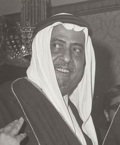 |
Ibrahim Al-Suweil | 22 December 1960 | 16 March 1962 | 1 year, 84 days |
| 3 | |
Faisal bin Abdulaziz | 16 March 1962 | 25 March 1975 | 13 years, 9 days |
| 4 |  |
Saud Al-Faisal | 13 October 1975 | 29 April 2015 | 39 years, 198 days |
| 5 |  |
Adel al-Jubeir | 29 April 2015 | 27 December 2018 | 3 years, 242 days |
| 6 |  |
Ibrahim Al-Assaf | 27 December 2018 | 23 October 2019 | 300 days |
| 7 |  |
Faisal bin Farhan | 23 October 2019 | Incumbent | 6 years, 134 days |
List of ministers of state for foreign affairs
| No. | Portrait | Minister | Took office | Left office | Time in office |
|---|---|---|---|---|---|
| 1 |  |
Omar Al-Saqqaf | 1 April 1968 | 14 November 1974 | 6 years, 227 days |
| 2 | |
Mohammad Ibrahim Massoud[9] | 14 November 1974 | 29 March 1975 | 135 days |
| 3 | |
Saud Al-Faisal | 29 March 1975 | 13 October 1975 | 198 days |
| Vacant (14 October 1975 – 28 August 2005) | |||||
| 4 |  |
Nizar Madani | 29 August 2005[4] | 27 December 2018 | 13 years, 120 days |
| 5 | |
Adel al-Jubeir | 27 December 2018 | Incumbent | 7 years, 69 days |
Building
The building of the ministry is in Riyadh and was designed by Henning Larsen.[10] It blends both vernacular and monumental styles of Islamic architecture.[11] Larsen received the Aga Khan Award for Architecture in 1989 for his work on the building.[11][12]
Built in 1984, the building consists of meeting, conference and prayer rooms, a library and a banquet hall.[11] Externally, the building appears as a fortress that was carved out of a single piece of stone.[12]
See also
- Ministries of Saudi Arabia
- Foreign relations of Saudi Arabia
- Politics of Saudi Arabia
References
- ^ "Brief History". Ministry of Foreign Affairs (Saudi Arabia). 5 May 2005. Retrieved 30 April 2011.
- ^ a b c d e Mansour Alsharidah (July 2020). Merchants without Borders: Qusman Traders in the Arabian Gulf and Indian Ocean, c. 1850-1950 (PhD) (Thesis). University of Arkansas, Fayetteville. p. 227. Retrieved 13 March 2021.
- ^ "Ministry Addresses". Royal Embassy of Saudi Arabia, Washington, DC. Archived from the original on 26 April 2011. Retrieved 30 April 2011.
- ^ a b c d "History of Saudi Foreign Ministry". Retrieved 17 April 2012.
- ^ Steffen Hertog (2007). "Shaping the Saudi state: Human agency's shifting role in the rentier state formation" (PDF). International Journal of Middle East Studies. 39 (4): 539–563. doi:10.1017/S0020743807071073. S2CID 145139112. Retrieved 17 April 2012.
- ^ Michael Slackman (9 December 2009). "A Legacy of Regret for a Saudi Diplomat". The New York Times. Retrieved 6 May 2011.
- ^ "Diplomat". Arab Media Company. Retrieved 21 May 2012.
- ^ Simon Henderson (22 October 2010). "Foreign Policy: A Prince's Mysterious Disappearance". NPR. Retrieved 30 April 2011.
- ^ "New Saudi Arabia King Picks Deputy Premiers". Sarasota Herald-Tribune. United Press International. 30 March 1975. Retrieved 6 November 2022.
- ^ Sama AlMalik (2017). Improving the city image of Riyadh. Through storefront and street signage redesign (PDF) (MA thesis). University of Barcelona. Retrieved 7 October 2020.
- ^ a b c "Ministry of Foreign Affairs". ArchNet. Archived from the original on 19 June 2010. Retrieved 30 April 2011.
- ^ a b Paul Rivas. "Islamic architecture personified by Ministry of Foreign Affairs in Riyadh". The Saudi Gazette. Archived from the original on 13 September 2012. Retrieved 30 April 2011.