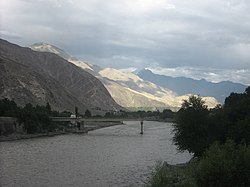
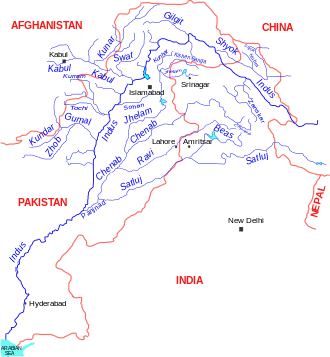
The Gilgit River (Urdu: دریائے گلگت) is a tributary of the Indus River, flowing through various districts of Pakistan's Gilgit-Baltistan region, including Gupis-Yasin, Ghizer and Gilgit. The Gilgit River originates from Shandur Lake[1] and proceeds to join the Indus River near the towns of Juglot and Bunji. This confluence is believed to mark the meeting point of three prominent mountain ranges: the Hindu Kush, the Himalayas, and the Karakoram.[2][3]
Gilgit river has a vital role in the irrigation of Gilgit Baltistan.
The upper sections of the Gilgit River are referred to as the Gupis River and Ghizer River.
The Gilgit River is a tributary of the Indus River
^
Handy, Norman (2017). K2, The Savage Mountain: Travels in Northern Pakistan. novum pro Verlag. ISBN9783990487174.
^
Dani, Ahmad Hasan; Masson, Vadim Mikhaĭlovich (2003). History of Civilizations of Central Asia: Development in contrast : from the sixteenth to the mid-nineteenth century. UNESCO. ISBN9789231038761.
Wikimedia Commons has media related to Gilgit River.
v
t
e
Hydrography of the Indian subcontinent
Inland rivers
Bagmati
Beas
Betwa
Bhagirathi
Brahmaputra
Chambal
Chenab
Damodar
Godavari
Gandaki
Ganges
Ghaghara
Indus
Jhelum
Kali
Kaveri
Kosi
Krishna
Luni
Mahanadi
Mahananda
Mahaweli
Meghna
Narmada
Padma
Ravi
Sarasvati
Sankosh
Sharda
Son
Sutlej
Tapti
Yamuna
Inland lakes, deltas, etc.
Ganges Basin
Ganges Delta
Indus Delta
Dal Lake
Pookode Lake
Skeleton Lake
Chilika Lake
Lake Powai
Borith Lake
Saiful Muluk
Gosaikunda
Nizam Sagar
Red Hills Lake
Malampuzha
Kerala backwaters
Pulicat Lake
Coastal
Indian Ocean
Arabian Sea
Bay of Bengal
Gulf of Kutch
Gulf of Khambhat
Gulf of Mannar
Laccadive Sea
Palk Bay
Palk Strait
Categories
Lakes of Bangladesh / India / Nepal / Pakistan / Sri Lanka
Reservoirs and dams in India / Sri Lanka
Rivers of Bangladesh / Bhutan / India / Nepal / Pakistan / Sri Lanka