|
Sonny Rollins
|
|
|---|---|

Rollins in 1974
|
|
| Background information | |
| Born |
Walter Theodore Rollins
September 7, 1930
New York City, U.S.
|
| Died | May 25, 2026 (aged 95)
Woodstock, New York, U.S.
|
| Genres |
|
| Occupations |
|
| Instruments |
|
| Years active | 1947–2014 |
| Labels |
|
|
Spouse
|
Dawn Finney
(m. 1957; div. 1957)
Lucille Pearson
(m. 1965; died 2004) |
| Website | sonnyrollins |
Walter Theodore "Sonny" Rollins (September 7, 1930 – May 25, 2026) was an American jazz tenor saxophonist who is widely recognized as one of the most important and influential jazz musicians.
In a seven-decade career, Rollins recorded more than 60 albums as a leader. His 1956 album Saxophone Colossus was selected for preservation by the National Recording Registry of the Library of Congress in 2016. A number of his compositions, including "St. Thomas", "Oleo", "Doxy", and "Airegin", have become jazz standards. Rollins was often called "the greatest living improviser". Rollins was the last survivor of the 57 jazz musicians depicted in the 1958 photograph A Great Day in Harlem.
Throughout his career, Rollins was nicknamed the "saxophone colossus". He was awarded a lifetime Grammy Award and was honored with the Kennedy Center Honors in 2011. He was credited as a defining figure of the jazz genre.[1][2]
Early life
Walter Theodore Rollins[3][4] was born on September 7, 1930,[5] in New York City to parents – Walter, a naval steward, and Valborg (nee Solomon)[6] – who were from the Virgin Islands.[7] The youngest of three siblings, he grew up in central Harlem and its Sugar Hill[8] in a musical family: his father played the clarinet, his sister played piano, and his older brother played violin.[9] He was nicknamed Sonny by his grandmother. One of his mentors was jazz pianist Thelonious Monk.[10]
He attended Edward W. Stitt Junior High School and graduated from Benjamin Franklin High School in East Harlem.[11] Rollins began taking piano lessons at the age of nine but switched to the alto saxophone at age eleven after being inspired by Louis Jordan.[3] In 1946, he switched to the tenor saxophone, influenced by his idol Coleman Hawkins, which ultimately became his signature instrument.
Largely self-taught, Rollins played in a band during his high school years alongside other future jazz legends, including Jackie McLean, Kenny Drew, and Art Taylor.[12]
Career
1949–1956
After graduating from high school in 1948,[13] Rollins began performing professionally; he made his first recordings in early 1949 as a sideman with the bebop singer Babs Gonzales (trombonist J. J. Johnson was the arranger of the group).[14] Within the next few months, he began to make a name for himself, recording with Johnson and appearing under the leadership of pianist Bud Powell, alongside trumpeter Fats Navarro and drummer Roy Haynes, on a seminal "hard bop" session, the basis for recordings of Powell's compositions "Bouncing with Bud" and "Dance of the Infidels".[15]
In early 1950, Rollins was arrested for armed robbery and spent ten months in Rikers Island jail before being released on parole; in 1952, he was re-arrested for violating the terms of his parole by using heroin.[16] Between 1951 and 1953, he recorded with Miles Davis, the Modern Jazz Quartet, Charlie Parker, and Thelonious Monk.[17][18] A breakthrough arrived in 1954, when Rollins recorded his famous compositions "Oleo", "Airegin", and "Doxy" with a quintet led by Davis that also featured pianist Horace Silver, Percy Heath, and Kenny Clarke. These recordings appear on the album Miles Davis with Sonny Rollins. In Sonny Rollins: The Definitive Musical Guide, Peter Niklas Wilson says of the recording: "This probably represents a singular achievement for a musician officially hired as a sideman: he [Rollins] brings three compositions to a colleague's recording session, all three are recorded, and all three immediately become jazz standards."[19]
In 1955, Rollins entered the Federal Medical Center, Lexington.[20] While there, he volunteered for then-experimental methadone therapy and was able to break his heroin habit, after which he lived for a time in Chicago, briefly rooming with the trumpeter Booker Little.[21] Rollins initially feared sobriety would impair his musicianship, but then went on to greater success.[22]
Rollins briefly joined the Miles Davis Quintet in the summer of 1955.[23][24] Later that year, he joined the Clifford Brown–Max Roach quintet. The studio albums Clifford Brown and Max Roach at Basin Street and Sonny Rollins Plus 4 document his time in that band. After the deaths of Brown and band pianist Richie Powell in a June 1956 automobile accident, Rollins continued playing with Roach and began releasing albums under his own name on Prestige Records, Blue Note, Riverside, and the Los Angeles label Contemporary.[22]
His widely acclaimed album Saxophone Colossus was recorded on June 22, 1956, at Rudy Van Gelder's studio in New Jersey, with Tommy Flanagan on piano, former Jazz Messengers bassist Doug Watkins, and his favorite drummer, Roach. This was Rollins's sixth recording as a leader and it included his best-known composition "St. Thomas", a Caribbean calypso based on "Sponger Money" a tune sung to him by his mother in his childhood, as well as the fast bebop number "Strode Rode", and "Moritat" (the Kurt Weill composition also known as "Mack the Knife").[5] A long blues solo on Saxophone Colossus, "Blue 7", was analyzed in depth by the composer and critic Gunther Schuller in a 1958 article.[25]

In the solo for "St. Thomas", Rollins used repetition of a rhythmic pattern, and variations of that pattern, covering only a few tones in a tight range, and employing staccato and semi-detached notes. This is interrupted by a sudden flourish, utilizing a much wider range before returning to the former pattern. (Listen to the music sample.) In his book The Jazz Style of Sonny Rollins, David N. Baker explains that Rollins "very often uses rhythm for its own sake. He will sometimes improvise on a rhythmic pattern instead of on the melody or changes."[26]
From his recording of "St. Thomas" onwards, Rollins's use of calypso rhythms was one of his signature contributions to jazz; he often performed traditional Caribbean tunes such as "Hold 'Em Joe" and "Don't Stop the Carnival", and wrote many original calypso-influenced compositions, among them "Duke of Iron", "The Everywhere Calypso", and "Global Warming".[27][28] The album was selected for preservation by the National Recording Registry of the Library of Congress in 2016.[29]
In 1956, Rollins recorded Tenor Madness, using Davis's group – pianist Red Garland, bassist Paul Chambers, and drummer Philly Joe Jones. The title track is the only recording of Rollins with John Coltrane, who was also a member of Davis's group.[5]
At the end of the year, Rollins appeared as a sideman on Thelonious Monk's album Brilliant Corners and also recorded his own first album for Blue Note Records, entitled Sonny Rollins, Volume 1, with Donald Byrd on trumpet, Wynton Kelly on piano, Gene Ramey on bass, and Roach on drums.[30]
1957–spring 1959
In 1957, he married his first wife, actress and model Dawn Finney.[8] He separated from Finney later that same year and proposed to another woman, Shirley Carter, before he moved in with Lucille Pearson two years later.[31]
That year, Rollins pioneered the use of bass and drums, without piano, as accompaniment for his saxophone solos,[32] a texture that came to be known as "strolling". Two early tenor/bass/drums trio recordings are Way Out West and A Night at the "Village Vanguard", both recorded in 1957. Way Out West was so named because it was recorded for California-based Contemporary Records (with Los Angeles drummer Shelly Manne), and because it included country and western songs such as "Wagon Wheels" and "I'm an Old Cowhand".[33] The Village Vanguard album consists of two sets, a matinee with bassist Donald Bailey and drummer Pete LaRoca and an evening set with bassist Wilbur Ware and drummer Elvin Jones. Rollins used the trio format intermittently throughout his career, sometimes taking the unusual step of using his sax as a rhythm section instrument during bass and drum solos. Lew Tabackin cited Rollins's pianoless trio as an inspiration to lead his own.[32] Joe Henderson, David S. Ware, Joe Lovano, Branford Marsalis, and Joshua Redman led pianoless sax trios.[32]
While in Los Angeles in 1957, Rollins met alto saxophonist Ornette Coleman and they practiced together.[34] Coleman, a pioneer of free jazz, stopped using a pianist in his own band two years later. By this time, Rollins had become well-known for improvising based on relatively banal or unconventional songs, among them "There's No Business Like Show Business" on Work Time (1956), "Toot, Toot, Tootsie" on The Sound of Sonny (1957),[35] and later "Sweet Leilani" on the Grammy-winning album This Is What I Do (2000).[36]
Rollins acquired the nickname "Newk" because of his facial resemblance to Brooklyn Dodgers star pitcher Don Newcombe.[37]

In 1957, Rollins made his Carnegie Hall debut,[38] and recorded again for Blue Note with J. J. Johnson on trombone, Horace Silver or Monk on piano, and drummer Art Blakey (released as Sonny Rollins, Volume Two). That December, Rollins and fellow tenor saxophonist Sonny Stitt were featured together on Dizzy Gillespie's album Sonny Side Up. In 1958, Rollins appeared in Art Kane's A Great Day in Harlem photograph of jazz musicians in New York;[39] he was the last surviving musician from the photo.[40]
The same year, Rollins recorded another landmark piece for saxophone, bass, and drums trio: Freedom Suite. His original sleeve notes said: "How ironic that the Negro, who more than any other people can claim America's culture as his own, is being persecuted and repressed; that the Negro, who has exemplified the humanities in his very existence, is being rewarded with inhumanity."[41] The title track is a 19-minute improvised bluesy suite; the other side of the album features hard bop workouts of popular show tunes. Oscar Pettiford and Max Roach provided bass and drums, respectively. The LP was available only briefly in its original form, before the record company repackaged it as part of Shadow Waltz, the title of another piece on the record.[42]
Following Sonny Rollins and the Big Brass (Sonny Rollins Brass/Sonny Rollins Trio), Rollins made one more studio album in 1958, Sonny Rollins and the Contemporary Leaders, before taking a three-year break from recording. This was a session for Contemporary Records and saw Rollins recording an esoteric mixture of tunes, including "Rock-a-Bye Your Baby with a Dixie Melody" with a West Coast group made up of pianist Hampton Hawes, guitarist Barney Kessel, bassist Leroy Vinnegar, and drummer Shelly Manne.[43]
In 1959, Rollins toured Europe for the first time, performing in Sweden, the Netherlands, Germany, Italy, and France.[44]
Summer 1959–fall 1961: The bridge
By 1959, Rollins had become frustrated with what he perceived as his own musical limitations and took the first – and most famous – of his musical sabbaticals.[45] While living on the Lower East Side of Manhattan, he ventured to the pedestrian walkway of the Williamsburg Bridge to practice, in order to avoid disturbing a neighboring expectant mother.[46] Today, a 15-story apartment building named "The Rollins"[47] stands on the Grand Street site where he lived.[48] Almost every day from the summer of 1959 through the end of 1961, Rollins practiced on the bridge, next to the subway tracks.[49] Rollins admitted that he would often practice for 15 or 16 hours a day, no matter what season.[50] In the summer of 1961, the journalist Ralph Berton happened to pass by the saxophonist on the bridge one day and published an article in Metronome magazine about the occurrence.[51] During this period, Rollins became a dedicated practitioner of yoga.[52]
Rollins ended his sabbatical in November 1961. He later said: "I could have probably spent the rest of my life just going up on the bridge. I realized, no, I have to get back into the real world."[53] In 2016, a campaign was initiated that sought to have the bridge renamed in Rollins's honor.[49]
Winter 1961–1969: Musical explorations
In November 1961, Rollins returned to the jazz scene with a residency at the Jazz Gallery in Greenwich Village; in March 1962, he appeared on Ralph Gleason's television series Jazz Casual.[54] During the 1960s, Rollins lived on Willoughby Street in Brooklyn, New York.[55]
He named his 1962 "comeback" album The Bridge at the start of a contract with RCA Victor. Produced by George Avakian, the disc was recorded with a quartet featuring guitarist Jim Hall, Ben Riley on drums, and bassist Bob Cranshaw.[56] This became one of Rollins's best-selling records; in 2015, it was inducted into the Grammy Hall of Fame.[57]
Rollins's contract with RCA Victor lasted through 1964. Each album he recorded differed radically from the previous one. The 1962 disc What's New? explored Latin rhythms. On the album Our Man in Jazz, recorded live at The Village Gate, he explored avant-garde playing with a quartet that featured Cranshaw on bass, Billy Higgins on drums, and Don Cherry on cornet. He also played with a tenor saxophone hero, Coleman Hawkins, and free jazz pianist Paul Bley on Sonny Meets Hawk! (1963), and he re-examined jazz standards and Great American Songbook melodies in 1964 on Now's the Time and The Standard Sonny Rollins (which featured pianist Herbie Hancock).[1]
In 1963, Rollins made the first of many tours of Japan.[28]
In 1965, he married Lucille Pearson, born on July 25, 1928, in Kansas City, Missouri. She eventually became his manager and producer. They moved (partially, then completely) from New York City to Germantown, New York, where she died on November 27, 2004.[58]
In 2007, recordings from a 1965 residency at Ronnie Scott's Jazz Club were released by the Harkit label as Live in London; they offer a very different picture of Rollins's playing from the studio albums of the period.[59]
Upon signing with Impulse! Records, he recorded a soundtrack to the 1966 film Alfie, as well as the live album There Will Never Be Another You and Sonny Rollins on Impulse! (1965). After East Broadway Run Down (1966), which featured trumpeter Freddie Hubbard, bassist Jimmy Garrison, and drummer Elvin Jones, Rollins did not release another studio album for six years.[1]
In 1968, he was the subject of a television documentary entitled Who is Sonny Rollins? (in the series Creative Persons), directed by Dick Fontaine.[60]

1969–1971: Second sabbatical
In 1969, Rollins took another two-year sabbatical from public performance. During this period, he visited Jamaica for the first time and spent several months studying yoga, meditation, and Eastern philosophies at an ashram in Powai, India, a district of Mumbai.[61]
1971–2000: Career resurgence
He returned from his second sabbatical with a performance in Kongsberg, Norway, in 1971.[62] Reviewing a March 1972 performance at New York's Village Vanguard night club, The New Yorker critic Whitney Balliett wrote that Rollins "had changed again. He had become a whirlwind. His runs roared, and there were jarring staccato passages and furious double-time spurts. He seemed to be shouting and gesticulating on his horn, as if he were waving his audience into battle."[63] The same year, he released Next Album and moved to Germantown, New York.[64] Also in 1972, he was awarded a Guggenheim Fellowship in composition.[65]
During the 1970s and 1980s, he also became drawn to R&B, pop, and funk rhythms. Some of his bands during this period featured electric guitar, electric bass, and usually more pop- or funk-oriented drummers.[1]
In 1974, Rollins added jazz bagpiper Rufus Harley to his band;[66] the group was filmed performing live at Ronnie Scott's in London.[67] For most of this period, Rollins was recorded by producer Orrin Keepnews for Milestone Records (the compilation Silver City: A Celebration of 25 Years on Milestone contains a selection from these years).[68] In 1978, Rollins toured together with McCoy Tyner, Ron Carter and Al Foster as the Milestone Jazzstars.[69] In June of that year, Rollins joined many other major jazz artists in a performance for President Jimmy Carter on the South Lawn of the White House.[70]
It was also during this period that Rollins's passion for unaccompanied saxophone solos came to the fore. In 1979, he played unaccompanied on The Tonight Show[71] and in 1985 he released The Solo Album, recorded live at the Museum of Modern Art in New York.[72] He also frequently played long, extemporaneous unaccompanied cadenzas during performances with his band; a prime example is his introduction to the tune "Autumn Nocturne" on the 1978 album Don't Stop the Carnival.[73]
By the 1980s, Rollins had stopped playing small nightclubs and was appearing mainly in concert halls or outdoor arenas; through the late 1990s he occasionally performed at large New York rock clubs such as Tramps and The Bottom Line. He added (uncredited) sax improvisations to three tracks by the Rolling Stones for their 1981 album Tattoo You, including the single "Waiting on a Friend"[74] and the long jam "Slave". That November, he led a saxophone masterclass on French television.[75] In 1983, he was honored as a "Jazz Master" by the National Endowment for the Arts.[76]
In 1986, documentary filmmaker Robert Mugge released a film titled Saxophone Colossus.[77] It featured two Rollins performances: a quintet concert at Opus 40 in upstate New York and a performance with the Yomiuri Nippon Symphony Orchestra in Japan of his Concerto for Saxophone and Symphony, a work composed in collaboration with the Finnish pianist and composer Heikki Sarmanto.[78]
In 1993, the University of Pittsburgh Sonny Rollins International Jazz Archives opened, established by Nathan Davis.[79][80][81]
New York City Hall proclaimed November 13, 1995, to be "Sonny Rollins Day".[82] Several days later, Rollins gave a performance at New York City's Beacon Theatre that reunited him with musicians with whom he had played as a teenager, including McLean, Walter Bishop Jr., Percy Heath, Connie Henry, and Gil Coggins.[83]
In 1997, he was voted "Jazz Artist of the Year" in the DownBeat magazine critics' poll.[84] The following year, Rollins, a dedicated advocate of environmentalism, released an album entitled Global Warming.[85]
2001–2014: Later career and retirement

Critics such as Gary Giddins and Stanley Crouch have noted the disparity between Rollins the recording artist, and Rollins the concert artist. In a May 2005 New Yorker profile, Crouch wrote of Rollins the concert artist:
Over and over, decade after decade, from the late seventies through the eighties and nineties, there he is, Sonny Rollins, the saxophone colossus, playing somewhere in the world, some afternoon or some eight o'clock somewhere, pursuing the combination of emotion, memory, thought, and aesthetic design with a command that allows him to achieve spontaneous grandiloquence. With its brass body, its pearl-button keys, its mouthpiece, and its cane reed, the horn becomes the vessel for the epic of Rollins's talent and the undimmed power and lore of his jazz ancestors.[86]
Rollins won a 2001 Grammy Award for Best Jazz Instrumental Album for This Is What I Do (2000).[87] On September 11, 2001, the 71-year-old Rollins heard the World Trade Center collapse from his Greenwich Street apartment only a few blocks away, and was forced to evacuate with only his saxophone in hand.[88] Although he was shaken by the incident, he traveled to Boston five days later to play a concert at the Berklee School of Music. The live recording of that performance was released on CD in 2005 as Without a Song: The 9/11 Concert, from which Rollins's performance of "Why Was I Born?" won the 2006 Grammy Award for Jazz Instrumental Solo.[87]
Rollins was presented with a Grammy Award for lifetime achievement in 2004;[87] that year also saw the death of his wife, Lucille.[89]
In 2006, Rollins went on to complete a DownBeat Readers Poll triple win for: "Jazzman of the Year", "No. 1 Tenor Sax Player", and "Recording of the Year" for the CD Without a Song: The 9/11 Concert. The band that year featured his nephew, trombonist Clifton Anderson, and included bassist Cranshaw, pianist Stephen Scott, percussionist Kimati Dinizulu, and drummer Perry Wilson.[1][90]
After a successful Japanese tour, Rollins returned to the recording studio for the first time in five years to record the Grammy-nominated CD Sonny, Please (2006). The CD's title is derived from one of his wife's favorite phrases that she used to express exasperation.[91][92] The album was released on Rollins's own label, Doxy Records, following his departure from Milestone Records after many years and was produced by Anderson. Rollins's band at this time, and on this album, included Cranshaw, guitarist Bobby Broom, drummer Steve Jordan, and Dinizulu.[93]
During these years, Rollins regularly toured worldwide, playing major venues throughout Europe, South America, the Far East, and Australasia; he is estimated to have sometimes earned as much as $100,000 per performance.[94] On September 18, 2007, he performed at Carnegie Hall in commemoration of the fiftieth anniversary of his first performance there. Appearing with him were Anderson (trombone), Bobby Broom (guitar), Cranshaw (bass), Dinizulu (percussion), Roy Haynes (drums), and Christian McBride (bass).[95]
Around 2000, Rollins began recording many of his live performances; after that he archived recordings of more than 250 concerts.[96] To date, four albums have been released from these archives on Doxy Records and Okeh Records: Road Shows, Vol. 1; Road Shows, Vol. 2 (with four tracks documenting his 80th birthday concert, which included Rollins's first ever recorded appearance with Ornette Coleman on the twenty-minute "Sonnymoon for Two"); Road Shows, Vol. 3; and Holding the Stage, Road Shows, Vol. 4, released in April 2016.[97]

In 2010, Rollins was awarded the National Medal of Arts[98] and the Edward MacDowell Medal;[99] in the fall of the same year he celebrated his 80th birthday with a concert at New York's Beacon Theatre that included a guest appearance by Ornette Coleman.[100] The following year, Rollins was a Kennedy Center Honoree in a class with Meryl Streep, Yo Yo Ma, Barbara Cook, and Neil Diamond.[101] The following year, Rollins was the subject of another documentary by Dick Fontaine, entitled Beyond the Notes,[102] which premiered on the BBC Four television series Arena in February 2012.[103]
Rollins did not publicly perform after 2012,[104][105] due to recurring respiratory issues caused by pulmonary fibrosis.[106][107][108] He announced his retirement in 2014.[1][107]
Other activities
In 2013, Rollins made a guest television appearance on The Simpsons in "Whiskey Business"[109] and received an honorary Doctor of Music degree from the Juilliard School in New York City.[110]
In 2014, he was the subject of a Dutch television documentary, Sonny Rollins-Morgen Speel Ik Beter (transl: Tomorrow I'll Play Better).[111] He made a public appearance in June of that year introducing saxophonist Ornette Coleman at an all-star tribute performance to Coleman in Brooklyn, New York.[112] In October 2015, Rollins received the Jazz Foundation of America's lifetime achievement award.[97]
In the spring of 2017, Rollins donated his personal archive to the Schomburg Center for Research in Black Culture, one of the research centers of New York Public Library.[113][114][115] The collection includes correspondence, diaries, recordings of practice sessions, photographs, and other material, documenting Rollinns's life and career from the 1950s.[116]
Later in 2017, he endowed the Sonny Rollins Jazz Ensemble Fund at Oberlin College, in what journalist Erich Burnett described as "recognition of the institution's long legacy of access and social justice advocacy."[117][118] Aligned with his belief in giving back,[117] Rollins wanted to make a major gift to one of the institutions that had awarded him honorary doctorates, and his choice followed correspondence with writer and musician James McBride, a 1979 graduate of Oberlin.[119] The "Sonny scholars" accepted for the ensemble also undeertake work with some community service project; Rollins stated: "You have to live by the Golden Rule. Let's say these Oberlin students repay wherever they got this great musical gift from, that's what I always wanted to do. ... They're not just going to have a successful life just playing music and being exceptional players. That's not enough. This is how I would like the world to be like this and there’s no reason it can't be like this."[117]
In February 2023, Rollins sold his music catalogue to Reservoir Media.[120] In April 2024, New York Review Books published The Notebooks of Sonny Rollins (edited and with an introduction by Sam V. H. Reese), derived from notebooks Rollins maintained from 1959 onwards.[121][122]
Personal life and death
Rollins was married twice. He was briefly married to Dawn Finney in 1957.[90] He met his next wife, Lucille Pearson, that same year, and they married in 1965. They remained together until her death in 2004.[90]
He lived in New York City, six blocks from the World Trade Center. During the September 11 attacks, they were evacuated to upstate New York with Rollins carrying only his saxophone.[90] In 2013, Rollins moved to Woodstock, New York.[64]
Rollins died at his home in Woodstock on May 25, 2026, at the age of 95.[1][123] He had been experiencing several health issues including pulmonary fibrosis.[124][1]
Influence, artistry and legacy
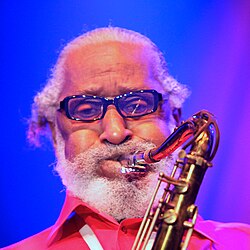
Rollins is widely recognized as one of the most important and influential jazz musicians.[5][125] A number of his compositions, including "St. Thomas", "Oleo", "Doxy", and "Airegin", have become jazz standards. Rollins was often called "the greatest living improviser".[126]
In performance Rollins was noted for long solos. He told PBS: "Improvising on it, that I leave completely to the forces", he said. "Sometimes I'm surprised by what comes out."[10]
Rollins played, at various times, a Selmer Mark VI[127] tenor saxophone and a Buescher Aristocrat.[128] During the 1970s, he recorded on soprano saxophone for the album Easy Living. His preferred mouthpieces were made by Otto Link and Berg Larsen.[129] He used Frederick Hemke medium reeds.[127]
Rollins's tone has been described as "biting and clear".[130] As a saxophonist, he had initially been attracted to the jump and R&B sounds of performers such as Louis Jordan, but soon became drawn into the mainstream tenor saxophone tradition. The German critic Joachim-Ernst Berendt described this tradition as sitting between the two poles of the strong sonority of Coleman Hawkins and the light flexible phrasing of Lester Young, which did so much to inspire the fleet improvisation of bebop in the 1950s.[131] His other tenor saxophone influences include Ben Webster and Don Byas. By his mid-teens, Rollins became heavily influenced by alto saxophonist Charlie Parker.[132] During his high school years, he was mentored by the pianist and composer Thelonious Monk, often rehearsing at Monk's apartment.[133]
In 2011, President Barack Obama presented Rollins with the 2010 National Medal of Arts. Obama said Rollins had inspired him to "take risks that I might not otherwise have taken". Fellow saxophonist Branford Marsalis described Rollins, alongside Louis Armstrong, as "the greatest improviser in the history of jazz".[134]
Following his death, Rollins was noted for his impact in jazz music. PBS called Rollins the "restless genius of jazz".[124] The New York Times in their obituary of Rollins credited him as the "Giant of the Jazz Saxophone" and said that his "forceful and imaginative approach" to the tenor saxophone made him one of the "dominant jazz musicians of the post-World War II era".[1] Throughout his career, he was called the "saxophone colossus".[135] The BBC noted his long musical solos and considered Rollins among the best improvisers in the music industry.[135] Rolling Stone magazine said that Rollins "redefined the language of the [jazz] genre" with his improvisational skills.[2] Rollins was called a "groundbreaking" voice of jazz in Variety magazine's obituary of him.[123]
Discography
Honors and awards
- Elected to the DownBeat Jazz Hall of Fame (1973)[136]
- Honorary Doctor of Arts from Bard College (1992)[137]
- Honorary Doctor of Music from Wesleyan University (1998)[138]
- Honorary Doctor of Music from Long Island University (1998)[139]
- Honorary Doctor of Music from Duke University (1999)[140]
- Honorary Doctor of Music from New England Conservatory of Music (2002)[141]
- Honorary Doctor of Music from Berklee College of Music (2003)[142]
- Grammy Award for lifetime achievement (2004)[143]
- Golden Plate Award of the American Academy of Achievement presented by Awards Council member Kareem Abdul-Jabbar (2006)[144][145]
- Minneapolis City Council in Minnesota passed an official resolution, on October 31, 2006, naming Rollins in honor of his achievements and contributions to the world of jazz[146]
- Polar Music Prize "for over 50 years one of the most powerful and personal voices in jazz" (2007)[147][148]
- Honorary Doctor of Music from Colby College (2007)[149]
- Austrian Cross of Honour for Science and Art, 1st class (2009)[150]
- Honorary Doctor of Music from Rutgers University (2009)[151]
- National Medal of Arts (2010)[152]
- Miles Davis Award at the Montreal Jazz Festival (2010)[153]
- Elected to the American Academy of Arts and Sciences (2010)[154]
- Edward MacDowell Medal (2010)[155]
- Kennedy Center Honors on his 81st birthday (September 7, 2011)[1]
- Honorary Doctor of Music from the Juilliard School (May 2013)[110]
- Honorary Doctor of Music from the University of Hartford (2015)[156]
References
- ^ a b c d e f g h i j Keepnews, Peter (May 25, 2026). "Sonny Rollins, Giant of the Jazz Saxophone, Is Dead at 95". The New York Times. ISSN 0362-4331. Retrieved May 26, 2026.
- ^ a b Kreps, Daniel (May 25, 2026). "Sonny Rollins, Jazz's Saxophone Colossus and Greatest Improvisor, Dead at 95". Rolling Stone. Retrieved May 25, 2026.
- ^ a b Appelbaum, Larry (February 23, 2013). "Interview with Sonny Rollins Pt. 1". larryappelbaum.wordpress.com. Archived from the original on April 22, 2019. Retrieved May 20, 2016.
- ^ "Sonny Rollins". Concord Music Group. September 7, 1930. Archived from the original on November 3, 2017. Retrieved May 20, 2016.
- ^ a b c d Nastos, Michael G. (September 7, 1930). "Sonny Rollins: Biography". AllMusic. Archived from the original on June 19, 2019. Retrieved July 28, 2015.
- ^ Fordham, John (May 26, 2026). "Sonny Rollins obituary". The Guardian. Retrieved May 27, 2026.
- ^ Taylor, Larry (March 26, 2008). "Sonny Rollins: Touring, Life Today and the Future". All About Jazz. Archived from the original on May 27, 2022. Retrieved January 31, 2013.
- ^ a b Goodman, George W. (July 1, 1999). "Sonny Rollins At Sixty-Eight - 99.07". The Atlantic. Archived from the original on November 17, 2015. Retrieved November 13, 2015.
- ^ Brown, Jeffrey; Davenport, Anne Azzi (May 26, 2026). "Sonny Rollins, saxophonist and restless genius of jazz, dead at 95". pbs.org. PBS News. Retrieved May 27, 2026.
- ^ a b Mann, Toby (May 26, 2026). "Sonny Rollins: 'Saxophone colossus' jazz legend dies aged 95". BBC News. Archived from the original on May 26, 2026. Retrieved May 26, 2026.
- ^ Myers, Marc (September 3, 2010). "Sonny Rollins Takes a Ride Uptown". The Wall Street Journal. Archived from the original on June 28, 2015. Retrieved July 28, 2015.
- ^
Crouch, Stanley (2021). "The Colossus". The Matter of Black Lives: Writing from The New Yorker (First ed.). New York: Ecco. p. 485. ISBN 9780063017597.
Having switched to tenor saxophone in the early forties, Rollins then led a band with some other young men from the Hill: the alto saxophonist Jackie McLean, the drummer Art Taylor, and the pianist Kenny Drew. They played 'cocktail sips' in the early evening for working people...
- ^ "1948 High School Yearbook Benjamin Franklin High School". Classmates.com. Retrieved July 16, 2023.
- ^ "Babs Gonzales: Weird Lullaby". Sonny Rollins.
- ^ "Powell, Bud 1924–1966". encyclopedia.com. June 8, 2018. Archived from the original on March 18, 2025. Retrieved May 26, 2026.
- ^ Kapusta, John (May 19, 2026). Self-Realization Nation: How Artists of the Creative Counterculture Made a New America. University of California Press. p. 33. ISBN 978-0520-4272-97. Retrieved May 26, 2026.
- ^ "Sonny Rollins With The Modern Jazz Quartet (LP)". Craft Recordings. Archived from the original on May 26, 2026. Retrieved May 26, 2026.
- ^ The Virgin Encyclopedia of Jazz. Virgin. 2004. ISBN 978-1-85227-183-1.
- ^ "Jazz Standards Songs and Instrumentals (Oleo)". www.jazzstandards.com. 2005–2020. Archived from the original on December 27, 2023. Retrieved May 26, 2026.
- ^ Choi, Charles Q. (October 24, 2008). "Reaping a Sad Harvest: A "Narcotic Farm" That Tried to Grow Recovery [Slide Show]". Scientific American. Archived from the original on November 13, 2015. Retrieved November 13, 2015.
- ^ Isaacs, Deanna. "How Sonny Defeated the Dragon". Chicago Reader. Archived from the original on July 7, 2015. Retrieved July 28, 2015.
- ^ a b "Sonny Rollins: Saxophone Colossus". American Academy of Achievement. 1996–2026. Retrieved May 26, 2026.
- ^ Cook, Richard. It's About That Time: Miles Davis on and off Record. New York: Oxford University Press, 2005, ISBN 978-0-19-532266-8; p. 45.
- ^ Lewis Porter. John Coltrane: His Life and Music. Ann Arbor: The University of Michigan Press, 1999, ISBN 0-472-10161-7; p. 98.
- ^ Schuller, Gunther. "Sonny Rollins and the Challenge of Thematic Improvisation" (PDF). Jazzstudiesonline.org. Retrieved July 28, 2015.
- ^ Baker, David N. (1983). The Jazz Style of Sonny Rollins: A Musical and Historical Perspective. Alfred Music (Van Nuys, CA). ISBN 978-0769230740. p. 14.
- ^ Shteamer, Hank (May 26, 2026). "Sonny Rollins: 12 Essential Albums". The New York Times – via NYTimes.com.
- ^ a b Palmer, Richard (January 1, 2004). Sonny Rollins: The Cutting Edge - Richard Palmer - Google Books. A&C Black. ISBN 9780826469168. Retrieved July 28, 2015.
- ^ "2016 National Recording Registry selections". Library of Congress. Retrieved May 26, 2026.
- ^ Mathieson, Kenny (2012). Giant Steps: Bebop And The Creators Of Modern Jazz, 1945–65. Canongate Books. pp. 176–177. ISBN 978-0857866172. Retrieved May 26, 2026.
- ^ Beuttler, Bill (February 21, 2023). "Review: Documenting Sonny". DownBeat. Retrieved May 28, 2026.
- ^ a b c Ratliff, Ben. "Sonny Rollins Strips for Action", The New York Times, Late Edition (East Coast). September 16, 2007. ProQuest. August 13, 2014.
- ^ Jarrett, Michael (1994). "The tenor's vehicle: Readingway out west". Lit: Literature Interpretation Theory. 5 (3–4): 227–246. doi:10.1080/10436929408580139. S2CID 162073386.
- ^ Schermer, Victor L. (November 28, 2006). "Sonny Rollins: Hardy Perennial". Allaboutjazz.com. Archived from the original on July 8, 2015. Retrieved July 28, 2015.
- ^ Kofsky, Frank (May 19, 2022). "JJ 05/62: The Return Of Sonny Rollins". Jazz Journal. Archived from the original on February 9, 2026. Retrieved May 27, 2026.
- ^ Myers, Cornelius (April 28, 2024). "Sonny Rollins: Ideas Are Important". JazzTimes. Retrieved May 27, 2026.
- ^ Liner notes Nucleus (1975).
- ^ Gans, Charles J. (September 17, 2007). "Long-Lost Tape Inspires Sonny Rollins". Washingtonpost.com. Archived from the original on October 17, 2015. Retrieved July 28, 2015.
- ^ "A Great Day in Harlem | The musicians". A-great-day-in-harlem.com. Archived from the original on February 23, 2015. Retrieved July 28, 2015.
- ^ Mitchell, Matt (May 26, 2026). "R.I.P. Sonny Rollins: Titan saxophonist dead at 95". Paste Magazine. Archived from the original on May 26, 2026. Retrieved May 26, 2026.
- ^ Bowden, Marshall. "Freedom Suite Revisited". Archived from the original on April 13, 2007. Retrieved July 23, 2007.
- ^ "Shadow Waltz". jazzmessengers.com. Archived from the original on March 25, 2025. Retrieved May 27, 2026.
- ^ "Billboard". August 31, 1959. Archived from the original on November 7, 2025. Retrieved May 26, 2026.
- ^ Fordham, John (November 8, 2012). "Sonny Rollins Trio: Live in Europe 1959 – review". The Guardian. Retrieved November 13, 2015.
- ^ Balliett, Whitney (November 18, 1961). "Sabbatical". The New Yorker. Archived from the original on October 28, 2017. Retrieved October 27, 2017.
- ^ Litvak, Ed (July 9, 2015). "From Sonny Rollins to Ruby the Fruit Man: A Tribute to the People of 400 Grand St". thelodownny.com. The Lo-Down. Archived from the original on July 9, 2015. Retrieved October 27, 2017.
- ^ "Home". Therollinsnyc.com. Archived from the original on June 15, 2019. Retrieved June 15, 2019.
- ^ Kaysen, Ronda (December 12, 2017). "New Rental Tower Rises Where Sonny Rollins Once Lived". The New York Times. Archived from the original on December 17, 2017. Retrieved December 17, 2017.
- ^ a b Petrusich, Amanda (April 5, 2017). "A Quest to Rename the Williamsburg Bridge for Sonny Rollins". The New Yorker. Retrieved July 21, 2017.
- ^ "Sonny Rollins died at 95, bridge practice reshaped his jazz legacy". Ukraine news. May 27, 2026. Retrieved May 28, 2026.
- ^ Chadbourne, Eugene. "Ralph Berton: Biography". AllMusic. Archived from the original on October 17, 2015. Retrieved July 28, 2015.
- ^ Jones, Josh (October 8, 2015). "Sonny Rollins Describes How 50 Years of Practicing Yoga Made Him a Better Musician". Open Culture. Retrieved November 13, 2015.
- ^ Richards, Chris (December 2, 2011). "Sonny Rollins: A jazz mind in pursuit of improvisational heaven". The Washington Post. Retrieved October 27, 2017.
- ^ "Jazz Casual: Sonny Rollins - Sonny Rollins | Songs, Reviews, Credits". AllMusic. October 19, 1999. Archived from the original on November 17, 2015. Retrieved November 13, 2015.
- ^ Gottlieb, Robert (February 19, 2014). Reading Jazz: A Gathering of Autobiography, Reportage, and Criticism from 1919 to Now. Knopf Doubleday Publishing. ISBN 9780307797278.
- ^ Watrous, Peter (April 12, 1991). "Pop/Jazz - Sonny Rollins and Pals In a Carnegie Reunion". NYTimes.com. Archived from the original on May 25, 2015. Retrieved July 28, 2015.
- ^ "Sonny Rollins "The Bridge" included in 2015 Grammy Hall of Fame". OKeh Records. February 18, 2015. Archived from the original on September 8, 2015. Retrieved July 28, 2015.
- ^ Levy, Aidan. "Saxophone Colossus: The Life and Music of Sonny Rollins". aidan-levy.com. Retrieved February 26, 2025.
- ^ Brent, David (May 5, 2007). "Sonny Rollins: Live in London | Night Lights Classic Jazz - WFIU Public Radio". Indiana Public Media. Retrieved November 13, 2015.
- ^ Ruggiero, Bob (June 19, 2014). "Jazz on Film: Sixties Jazz Films by Dick Fontaine". Houston Press. Archived from the original on September 24, 2015. Retrieved July 28, 2015.
- ^ "Saxophone colossus Sonny Rollins in Powai". Taj Mahal Foxtrot. June 3, 2015. Retrieved July 28, 2015.
- ^ "NRK TV - Sonny Rollins i Kongsberg - 05.08.1971". Tv.nrk.no. April 14, 2015. Retrieved July 28, 2015.
- ^ Balliett, Whitney (2001), Collected Works: A Journal of Jazz 1954–2001, St. Martin's Press, p. 762.
- ^ a b Myers, Marc (April 25, 2013). "Home, in the Key of E". Wall Street Journal. Archived from the original on October 27, 2015. Retrieved November 13, 2015.
- ^ "Sonny Rollins". Gf.org. October 31, 2015. Archived from the original on July 4, 2017. Retrieved November 13, 2015.
- ^ Fordham, John (August 21, 2006). "Obituary: Rufus Harley". The Guardian. Retrieved July 28, 2015.
- ^ "BBC Four - Arena, Sonny Rollins '74: Rescued!". Bbc.co.uk. May 26, 2013. Archived from the original on October 17, 2015. Retrieved July 28, 2015.
- ^ "Jazz Departments: Orrin Keepnews: A Certain Integrity - By Sonny Rollins — Jazz Articles". Jazztimes.com. March 8, 2015. Archived from the original on July 19, 2015. Retrieved July 28, 2015.
- ^ Yanow, Scott. "Milestone Jazzstars in Concert - Milestone Jazzstars: Songs, Reviews, Credits, Awards". AllMusic. Retrieved July 28, 2015.
- ^ Chinen, Nate (June 2003). "George Wein: A Great Day in Washington". Jazztimes.
- ^ "The Tonight Show Starring Johnny Carson : Episode dated 24 September 1979". IMDb.com. Archived from the original on October 17, 2015. Retrieved July 28, 2015.
- ^ "Sonny Rollins : Summergarden" (PDF). Moma.org. Archived (PDF) from the original on October 17, 2015. Retrieved July 28, 2015.
- ^ "Autumn Nocturne – Form diagram". People.virginia.edu. Archived from the original on March 22, 2017. Retrieved May 20, 2016.
- ^ Janowitz, Bill. "Waiting on a Friend". AllMusic. Archived from the original on December 30, 2023. Retrieved April 22, 2009.
- ^ "Sonny Rollins - Vidéo". Ina.fr (in French). November 29, 1981. Archived from the original on September 24, 2015. Retrieved November 13, 2015.
- ^ "NEA Jazz Masters". Arts.gov. August 9, 2013. Archived from the original on November 17, 2015. Retrieved November 13, 2015.
- ^ Friedwald, Will (February 3, 2009). "Saxophone Colossus Featuring Sonny Rollins". Robert Mugge. Retrieved May 28, 2026.
- ^ "Review: Sonny Rollins with Heikki Sarmanto Trio – Live at Finlandia Hall, Helsinki 1972". Echo Sanddust. June 26, 2023. Archived from the original on February 25, 2024. Retrieved May 26, 2026.
- ^ "In Memoriam: Nathan Davis". Department of Music | Univerity of Pittsburg. Retrieved May 27, 2026.
- ^
"Sonny Rollins International Jazz Archives". Pitt.edu. Retrieved May 20, 2016.
{{cite web}}: CS1 maint: deprecated archival service (link) - ^ International jazz archives journal. University of Pittsburgh, International Academy of Jazz Hall of Fame. 1993. OCLC 29810096 – via WorldCat.
- ^ Strauss, Neil (November 16, 1995). "The Pop Life". The New York Times. Retrieved November 13, 2015.
- ^ Watrous, Peter (November 20, 1995). "For Rollins, the Swing Is Gentle". The New York Times. Archived from the original on February 25, 2022. Retrieved October 8, 2018.
- ^ "DownBeat Magazine". Downbeat.com. August 31, 1997. Archived from the original on July 9, 2015. Retrieved July 28, 2015.
- ^ Lutz, Phillip (November 27, 2009), "An Environmental Benefit, Set to the Jazz of Sonny Rollins" Archived November 10, 2017, at the Wayback Machine, The New York Times.
- ^ Crouch, Stanley (May 2, 2005). "Sonny Rollins on the Bandstand". The New Yorker. Retrieved May 26, 2026 – via www.newyorker.com.
- ^ a b c GRAMMY Award Winners Archived February 4, 2010, at the Wayback Machine, Grammy.com. Retrieved September 29, 2009.
- ^ Panken, Ted (September 7, 2011). "It's Sonny Rollins' 81st Birthday: Two Interviews from 2000".
- ^ "Lucille Rollins, Jazz Manager, Dies at 76". The New York Times. December 19, 2004. Archived from the original on November 19, 2020. Retrieved June 15, 2019.
- ^ a b c d Beaumont-Thomas, Ben (May 26, 2026). "Sonny Rollins, saxophone 'colossus' who honed his sound on a New York bridge, dies at 95". The Irish Times. Retrieved May 26, 2026.
- ^ Gans, Charles J. (May 7, 2007). "Sonny Rollins: At 76, jazz giant from Germantown is still perfecting his sound". Daily Freeman. Retrieved May 28, 2026.
- ^ Trakin, Roy (May 25, 2026). "Sonny Rollins, Tenor Sax Legend and Colossus of Jazz, Dies at 95". The Hollywood Reporter. Retrieved May 28, 2026.
- ^ "Sonny, Please - Sonny Rollins". Archived from the original on April 9, 2025. Retrieved May 7, 2026 – via www.allmusic.com.
- ^ "Sonny Rollins: Meditating on a Riff" (PDF). Kamamabooks.com. Archived from the original (PDF) on August 16, 2018. Retrieved January 15, 2022.
- ^ "Events". Carnegie Hall. January 20, 2012. Archived from the original on June 16, 2010. Retrieved January 31, 2013.
- ^ Panken, Ted (January 5, 2014). "Sonny Rollins Reflects on New 'Road Shows' Collection". Downbeat.com. Archived from the original on November 17, 2015. Retrieved November 13, 2015.
- ^ a b "Sonny Rollins to Receive Lifetime Achievement Award from the Jazz Foundation of America". Jazzcorner.com. October 15, 2015. Archived from the original on February 3, 2017. Retrieved November 13, 2015.
- ^ "National Medal of Arts". Arts.gov. March 2, 2011. Archived from the original on October 17, 2015. Retrieved July 28, 2015.
- ^ "Legendary Jazz Composer Sonny Rollins Named 2010 Edward Macdowell Medalist" (PDF). Macdowellcolony.org (Press release). Archived from the original (PDF) on March 4, 2016. Retrieved July 28, 2015.
- ^ Carroll, Christopher (August 10, 2012). "The Singular Sound of Sonny Rollins". The New York Review of Books. Archived from the original on October 8, 2018. Retrieved October 8, 2018.
- ^ "Sonny Rollins | Honoree: The 2011 Kennedy Center Honors". The Trump Kennedy Center. Retrieved May 26, 2026.
- ^ Markowitz, Andy (July 11, 2013). "Dick Fontaine: Music Documentary Beyond the Notes". Musicfilmweb.com. Retrieved July 28, 2015.
- ^ "Arena: Sonny Rollins – Beyond The Notes". BBC Media Centre. February 17, 2012. Retrieved May 26, 2026.
- ^ "Sonny Rollins Cancels June and July Shows". Jazz.fm. Archived from the original on November 17, 2015. Retrieved November 13, 2015.
- ^ Minderman, Dean (June 7, 2013). "Sonny Rollins cancels summer concerts including June 22 show at the Touhill". St. Louis Jazz Notes. Archived from the original on May 26, 2026. Retrieved May 26, 2026.
- ^ Als, Hilton (April 18, 2016). "Sonny Rollins: The Saxophone Colossus". Pitchfork. Archived from the original on January 30, 2017. Retrieved January 29, 2017.
- ^ a b Fordham, John (January 21, 2022). "'I was so close to the sky. It was spiritual': Sonny Rollins on jazz landmark The Bridge at 60". The Guardian. Retrieved January 21, 2022.
- ^ Hoffman, Jordan (September 7, 2023). "Happy 90th Birthday to Jazz Legend Sonny Rollins". Mel Magazine. Retrieved September 12, 2023.
- ^ La Rosa, David (October 12, 2012). "Sonny Rollins to Guest Star on The Simpsons". Jazz Line News. The Jazz Line. Archived from the original on March 4, 2016. Retrieved November 13, 2015.
- ^ a b "7 to Be Presented With Honorary Degrees", Juilliard School. Archived July 25, 2013, at the Wayback Machine. Retrieved September 14, 2013.
- ^ "Het Uur van de Wolf: Het Uur van de Wolf: Sonny Rollins - Morgen speel ik beter kijk je op". Npo.nl. October 23, 2014. Archived from the original on November 17, 2015. Retrieved November 13, 2015.
- ^ Ratliff, Ben (June 13, 2014). "The Honoree Wanted to Play, Too". The New York Times.
- ^ "Schomburg Center for Research in Black Culture Acquires Jazz Legend Sonny Rollins' Personal Archive". nypl.org. New York Public Library. May 30, 2017. Retrieved December 19, 2017.
- ^ Russonello, Giovanni (May 29, 2017). "Inside Sonny Rollins's Jazz Archive, Headed Home to Harlem". The New York Times. Archived from the original on December 22, 2017. Retrieved December 19, 2017.
- ^ Marchese, David (December 6, 2017). "Jazz Legend Sonny Rollins on Retiring His Sax, His Legacy, and the Secret to Life". Vulture.com. Retrieved December 19, 2017.
- ^ "Honoring the Life & Legacy of Jazz Legend Sonny Rollins". nypl.org. Schomburg Center for Research in Black Culture | New York Public Library. Retrieved May 29, 2026.
- ^ a b c Burnett, Erich (November 13, 2017). "Jazz Legend Sonny Rollins Designates Major Gift to Oberlin". oberlin.edu. Oberlin College and Conservatory.
- ^ Burnett, Erich (2018). "The Legend Lives On". Oberlin Conservatory Magazine. Oberlin College. p. 18. Archived from the original on May 17, 2023. Retrieved May 17, 2023.
- ^ Polletta, Dan (February 19, 2018). "Sonny Rollins Establishes Oberlin Ensemble to Give Back". ideastream.org. Ideastream. Retrieved May 29, 2026.
- ^ Brown, Preezy (February 22, 2023). "Jazz Legend Sonny Rollins' Music Catalog Acquired by Reservoir Media". Vibe.com.
- ^ The Notebooks of Sonny Rollins, ed. Sam V. H. Reese. New York Review Books (2024), ISBN 9781681378268.
- ^ Chan, Tim (May 28, 2026). "Sonny Rollins' Notebook Revealed His Inner Demons: 'There Is Within Me a Force Working Hard for My Own Destruction'". Rolling Stone. Retrieved May 28, 2026.
- ^ a b Morris, Chris (May 25, 2026). "Sonny Rollins, Jazz's 'Saxophone Colossus,' Dies at 95". Variety. Retrieved May 25, 2026.
- ^ a b "Sonny Rollins, saxophonist and restless genius of jazz, dead at 95". PBS. Associated Press. May 26, 2026. Retrieved May 26, 2026.
- ^
Garner, Dwight (March 18, 2024). "This Jazz Legend Is His Own Work in Progress - The private musings of Sonny Rollins reveal an artist devoted to the rigors of self-improvement". The New York Times. Retrieved March 20, 2024.
{{cite news}}: CS1 maint: deprecated archival service (link) - ^ Fordham, John (May 11, 2010). "50 great moments in jazz: The rise of saxophone colossus Sonny Rollins". The Guardian. Archived from the original on July 31, 2017. Retrieved July 21, 2017.
- ^ a b Primack, Bret (January 20, 1949). "Jazz Articles: Sonny Rollins: Summoning the Muse". Jazztimes.com. Archived from the original on November 17, 2015. Retrieved November 13, 2015.
- ^ Lowe, Allen (January 13, 2010). "A Tale of Some Saxophones - Miscellaneous Music - organissimo forums". Organissimo.org. Archived from the original on November 17, 2015. Retrieved November 13, 2015.
- ^ "FAQ". Sonny Rollins. Archived from the original on November 17, 2015. Retrieved November 13, 2015.
- ^ Solomon, Jon (August 7, 2013). "The ten best saxophonists of all time". Westword.com. Retrieved March 22, 2025.
- ^ Berendt, Joachim (1976). The Jazz Book. Paladin. p. 229.
- ^ Nicholson, Stuart. "In Conversation with Sonny Rollins". Jazz.com. Archived from the original on October 22, 2015. Retrieved November 13, 2015.
- ^ Kelley, Robin (December 8, 2009). Thelonious Monk: The Life and Times of an American Original. Simon and Schuster. p. 118. ISBN 9781439190494. Retrieved November 13, 2015.
- ^ Beaumont-Thomas, Ben (May 26, 2026). "Sonny Rollins, colossus of jazz saxophone, dies aged 95". The Guardian. ISSN 0261-3077. Retrieved May 26, 2026.
- ^ a b Mann, Toby (May 25, 2026). "Jazz legend Sonny Rollins dies aged 95". BBC. Archived from the original on May 26, 2026. Retrieved May 26, 2026.
- ^ "DownBeat Magazine". Downbeat.com. Retrieved May 20, 2016.
- ^ "COMMENCEMENTS - At Georgetown, a Speech on Education's Ills". The New York Times. May 24, 1992. Archived from the original on March 11, 2016. Retrieved May 20, 2016.
- ^ Christian, Nichole M. (May 25, 1998). "Commencements - Speakers Counsel Courage, Perseverance and Hope". The New York Times. Retrieved May 20, 2016.
- ^ Gregory, Andy, ed. (2002). The International Who's Who in Popular Music 2002. Europa Publications. p. 438. ISBN 9781857431612. Retrieved May 20, 2016.
- ^ "1990-1999". Trustees.duke.edu. Archived from the original on February 1, 2018. Retrieved May 20, 2016.
- ^ Carlson, Russell (February 23, 2005). "Jazz Articles: Sonny Rollins Accepts Honorary Degree". Jazztimes.com. Archived from the original on April 7, 2016. Retrieved May 20, 2016.
- ^ "Honorary Degree Recipients". Berklee College of Music. Archived from the original on April 6, 2018. Retrieved May 20, 2016.
- ^ "Grammy Lifetime Achievement Award – Grammy Award for Lifetime Achievement". awardsandshows.com. Archived from the original on December 9, 2023. Retrieved December 9, 2023.
- ^ "Golden Plate Awardees of the American Academy of Achievement". Achievement.org. American Academy of Achievement. Archived from the original on December 15, 2016. Retrieved April 2, 2020.
- ^
"2006 Summit Highlights Photo". 2006. Archived from the original on September 17, 2020. Retrieved December 29, 2020.
Saxophone colossus and 2006 Academy guest of honor Sonny Rollins performs at the 20th Century Fox Studio.
- ^ "Regular Meeting of September 1, 2006" Archived September 21, 2016, at the Wayback Machine, Minneapolis City Council Official Proceedings.
- ^ "Sonny Rollins". polarmusicprize.org. Polar Music Prize. Retrieved May 28, 2026.
- ^ "Sonny Rollins's speech 2007". Polar Music Prize. March 26, 2013. Retrieved May 28, 2026 – via YouTube.
- ^ "Sonny Rollins: Commencement". Colby College. May 27, 2007. Retrieved May 20, 2016.
- ^ "Reply to a parliamentary question" (PDF) (in German). p. 1919. Archived (PDF) from the original on May 1, 2020. Retrieved January 2, 2013.
- ^ "Rutgers to Confer Five Honorary Degrees at May Commencement; Fashion Designer-Entrepreneur Marc Eckō to Receive Doctor of Humane Letters and Deliver Keynote Address". Rutgers.edu. April 9, 2009. Retrieved May 20, 2016.
- ^ "President Obama to Award 2010 National Medal of Arts and National Humanities Medal". Whitehouse.gov. March 1, 2011. Archived from the original on September 25, 2018. Retrieved January 31, 2013 – via National Archives.
- ^ "Artist : Sonny Rollins – Festival International de Jazz de Montréal". Montrealjazzfest.com. Archived from the original on March 2, 2012. Retrieved January 31, 2013.
- ^ "Sonny Rollins". National Endowment for the Arts. March 2, 2011. Retrieved May 28, 2026.
- ^ "MacDowell Medal winners 1960-2011". The Telegraph. April 13, 2011. Archived from the original on January 12, 2022.
- ^ Steinberger, Barbara (April 20, 2015) "Commencement Speakers Will Bring a Global Perspective" Archived May 17, 2015, at the Wayback Machine. Unotes Daily.
Further reading
Articles
- Baillett, Whitney. American Musicians II: Seventy-One Portraits in Jazz, 1996, p. 455.
- Berger, Edward, Bassically Speaking: An Oral History of George Duvivier, The Scarecrow Press, 1993, p. 91.
- Bolster, Mary. "With a Song in His Heart". Yoga Journal. May 2006. pp. 119–120
- Broecking, Maxi (May 26, 2026). "US-Jazzsaxofonist Sonny Rollins ist tot: Der Koloss am Tenor". taz.de (in German). Retrieved May 26, 2026.
- Davis, Miles with Quincy Troupe. Miles: The Autobiography, Simon & Schuster, 1990, p. 60.
- Giardello, Joe (June–July 1995). "Sonny Rollins: Our Man in Jazz". Coda. pp. 8–11.
- Goldberg, Joe (June 10, 2000). "Jazz: Sonny at 70". Billboard. pp. 66, 72.
- Kernfeld, Barry. The New Grove Dictionary of Jazz - Volume 2, Macmillan, 1988, p. 390.
- King, Daniel (June 11, 2020). "Sonny Rollins on the Pandemic, Protests and Music". The New Yorker.
Books
- Blancq, Charles. Sonny Rollins: The Journey of a Jazzman. Boston: Twayne, 1983.
- Blumenthal, Bob, and John Abbott. Saxophone Colossus: A Portrait of Sonny Rollins. New York: Abrams, 2010.
- Broecking, Christian. Sonny Rollins: Improvisation und Protest. Creative People Books / Broecking Verlag, 2010.
- Levy, Aidan. Saxophone Colossus: The Life and Music of Sonny Rollins, Hachette Books, 2022.
- Médioni, Franck. Sonny Rollins: Le Souffle Continu. Paris: Editions MF, 2016.
- Nisenson, Eric. Open Sky, Sonny Rollins and his World of Improvisation. New York: St. Martin's Press, 2000.
- Palmer, Richard. Sonny Rollins: The Cutting Edge. New York: Bloomsbury, 2004.
- Theard, Christine Marie. It's All Good: Colossal Conversations with Sonny Rollins. They Are Divine Books, 2018.
- Wilson, Peter Niklas. Sonny Rollins: The Definitive Musical Guide. Berkeley: Berkeley Hills Books, 2001.
- Wyatt, Hugh. Sonny Rollins: Meditating on a Riff. New York: Kamama Books, 2018.
External links
 Media from Commons
 Quotations from Wikiquote
 Data from Wikidata


- Official website

- Sonny Rollins Biography and Interview on American Academy of Achievement
- Detailed Discography at Jazzdisco.org
- Sonny Rollins papers, 1910s-2015, Schomburg Center for Research in Black Culture, The New York Public Library.
- Sonny Rollins audiovisual collection from his personal holdings, Schomburg Center for Research in Black Culture, The New York Public Library.
- Works by or about Sonny Rollins at the Internet Archive
- Sonny Rollins discography at Discogs
- Sonny Rollins at IMDb
- Sonny Rollins Trio at IMDb

|
Authority control databases
|
|
|---|---|
| International | |
| National | |
| Academics | |
| Artists | |
| People | |
| Other | |