| Part of a series on |
| Scientology |
|---|
 |
|
|
|
|
|
|
| Controversies |
|
| More |
Scientology is a set of beliefs and practices created by the American author L. Ron Hubbard. Hubbard initially presented his ideas in 1950 as a form of talk therapy called Dianetics. He later expanded and reframed those ideas as a religion, which he named Scientology.[1] In 1953, he founded the Church of Scientology, which, by one 2014 estimate, had around 30,000 members.
A core Scientology belief is that traumatic events cause subconscious command-like recordings in the mind, which may have occurred in past lives, and which can only be relieved through an activity called "auditing". Auditing and training to audit are the two primary activities in a Scientology organization and are outlined in a structured progression chart called The Bridge to Total Freedom, with the two main achievement levels being the status of "Clear" (the goal of the original Dianetics) and "Operating Thetan" (Scientology's version of spiritual freedom). Fees are charged for auditing and training.
The upper‑level teachings of the Operating Thetan levels are considered confidential and are only revealed to Scientologists when they reach each level. The texts, which involve a past life cosmology narrative, have been leaked and publicized, despite the Church of Scientology litigating to keep them confidential.
The Church[a] has been involved in numerous controversies, legal disputes, and even criminal convictions. It has been variously described as a religion, a cult, a business, and a scam. Scientology is classified differently around the world, with some countries granting it religious status, while others treat it as a non-religious belief system, a commercial enterprise, or a suspicious activity subject to government monitoring. Its practices and leadership have been the subject of sustained investigative reporting, academic study, government inquiries, and popular media portrayals.
Legal status
The legal status of Scientology or Scientology-related organizations differs between jurisdictions.[2][3][4] Scientology was legally recognized as a tax-exempt religion in Australia,[5] Portugal,[6] and Spain.[7] Scientology was granted tax-exempt status in the United States in 1993.[8][9][10][11] The organization is considered a cult in Chile and an "anticonstitutional sect" in Germany,[12] and is considered a cult (French secte) by some French public authorities.[13]
The Church of Scientology argues that Scientology is a genuine religious movement that has been misrepresented, maligned, and persecuted.[14][15] The organization has pursued an extensive public relations campaign for the recognition of Scientology as a tax-exempt religion in the various countries in which it exists.[16][17][18]
The Church of Scientology has often generated opposition due to its strong-arm tactics directed against critics and members wishing to leave the organization.[19] A minority of governments regard it as a religious organization entitled to tax-exempt status, while other governments variously classify it as a business, cult, pseudoreligion, or criminal organization.[20][21]
In 1957, the Church of Scientology of California was granted tax-exempt status by the United States Internal Revenue Service (IRS), and so, for a time, were other local branches of the organization.[22] In 1958 however, the IRS started a review of the appropriateness of this status.[23] In 1959, Hubbard moved to England, remaining there until the mid-1960s.[24] In 1967, the IRS removed Scientology's tax-exempt status, asserting that its activities were commercial and operated for the benefit of Hubbard, rather than for charitable or religious purposes.[22][25]
In the mid-1960s, the Church of Scientology was banned in several Australian states, starting with Victoria in 1965.[23] The ban was based on the Anderson Report, which found that the auditing process involved "command" hypnosis, in which the hypnotist assumes "positive authoritative control" over the patient. On this point the report stated:[26]: 115
It is the firm conclusion of this Board that most scientology and dianetic techniques are those of authoritative hypnosis and as such are dangerous ... the scientific evidence which the Board heard from several expert witnesses of the highest repute ... leads to the inescapable conclusion that it is only in name that there is any difference between authoritative hypnosis and most of the techniques of scientology. Many scientology techniques are in fact hypnotic techniques, and Hubbard has not changed their nature by changing their names.[26]: 115
The Australian branch of the Scientology organization was forced to operate under the name of the "Church of the New Faith" as a result, the name and practice of Scientology having become illegal in the relevant states. Several years of court proceedings aimed at overturning the ban followed.[5] In 1973, state laws banning Scientology were overturned in Victoria, South Australia and Western Australia. In 1983 the High Court of Australia ruled in a unanimous decision that the Church of Scientology was "undoubtedly a religion and deserving of tax exemption".[27]
History
Hubbard established an organization to promote his ideas about the mind, which he called Dianetics,[28][29] in 1950. The organization went bankrupt, and Hubbard lost the rights to his book Dianetics in 1952. His ideas were rejected by the scientific community.[30][31] As the 1950s developed, Hubbard saw the advantages of having his Scientology movement legally recognized as a religion.[32] In an April 1953 letter to Helen O'Brien, his US business manager, he proposed that Scientology should be transformed into a religion: "We don't want a clinic. We want one in operation but not in name...It is a problem of practical business. I await your reaction on the religion angle".[33] In reaction to a series of arrests of his followers, and the prosecution of Hubbard's Dianetics foundation for teaching medicine without a license, in December 1953 Hubbard incorporated three organizations – Church of American Science, Church of Scientology, and Church of Spiritual Engineering.[34][35] By 1954, Hubbard had regained the rights to Dianetics.[citation needed] In 1959, Hubbard purchased Saint Hill Manor in East Grinstead, Sussex, United Kingdom, which became the worldwide headquarters of the Church of Scientology and his personal residence. With the organization often under heavy criticism, it adopted strong measures of attack in dealing with its critics.[36]
In 1962, amid FDA concerns, Hubbard announced Scientology's future was "being planned on a religious organization basis", but advising followers the change was "entirely a matter for accountants and solicitors".[37]
In 1966, the organization established the Guardian's Office (GO), a department devoted to undermining those hostile towards Scientology.[38] The GO launched an extensive program of countering negative publicity, gathering intelligence, and infiltrating organizations.[39] In "Operation Snow White", the GO infiltrated the IRS and numerous other government departments and stole tens of thousands of documents pertaining to the Scientology organization, politicians, and celebrities.[40] In July 1977, the FBI raided Church of Scientology premises in Washington, DC, and Los Angeles, revealing the extent of the GO's infiltration into government departments and other groups.[41] Eleven officials and agents of the Church were indicted. In December 1979, they were sentenced to between 4 and 5 years each and individually fined $10,000 (equivalent to $44,000 in 2025).[42] Among those found guilty was Hubbard's then-wife, Mary Sue Hubbard.[40] Public revelation of the GO's activities brought widespread condemnation of the Scientology organization.[42]
In 1967, Hubbard established a new group, the Sea Organization or "Sea Org", the membership of which was drawn from the most committed members of the Scientology organization.[43] By 1981, the 21-year-old David Miscavige, who had been one of Hubbard's closest aides in the Sea Org, rose to prominence.[44] Hubbard died at his ranch in Creston, California, on January 24, 1986, and David Miscavige succeeded Hubbard as head of the organization.[45][46] In 1993, the Internal Revenue Service dropped all litigation against the Scientology organization and recognized it as a religious institution.[47]
Scientology analysis and criticism
Scientology analysis and criticism covers the wide range of academic and scholarly perspectives on Scientology, including debates over how the movement should be classified—as a religion, a new religious movement, a business enterprise, a therapy system, or a high-demand group. Scholars examine Scientology's ideas and practices, its organizational structure, and the role of L. Ron Hubbard in shaping its theology. Researchers also study how Scientology blends ideas from many sources, including Eastern religions, Western esoteric traditions, psychology, and mid-20th-century science fiction. These analyses form the basis for ongoing discussions about Scientology's nature, origins, and place within the study of religion and new religious movements.
Beliefs and practices
Hubbard lies at the core of Scientology and his writings remain the source of its ideas and practices.[48] Sociologist of religion David G. Bromley describes Scientology as Hubbard's "personal synthesis of philosophy, physics, and psychology".[49] Hubbard claimed that he developed his ideas through research and experimentation, rather than through revelation from a supernatural source.[50] He published hundreds of articles and books over the course of his life.[51] Scientologists regard his writings on Scientology as scripture.[52]
In Scientology Hubbard's work is regarded as perfect, and no elaboration or alteration is permitted.[53] Hubbard described Scientology as an "applied religious philosophy", because, according to him, it consists of a metaphysical doctrine, a theory of psychology, and teachings in morality.[54] Hubbard incorporated a variety of hypnotic techniques in Scientology auditing and courses.[55] These are used as a means to create dependency and obedience in followers.[56]
Hubbard developed thousands of neologisms during his lifetime.[53] The nomenclature used by the movement is termed "Scientologese" by members.[57] Scientologists are expected to learn this specialist terminology, the use of which separates followers from non-Scientologists.[53] The Scientology organization refers to its practices as "technology", a term often shortened to "Tech".[58] Scientologists stress the "standardness" of this "tech", by which they express belief in its infallibility.[59] The Scientology organization's system of pedagogy is called "Study Tech" and is presented as the best method for learning.[60] Scientology teaches that when reading, it is very important not to go past a word one does not understand. A person should instead consult a dictionary as to the meaning of the word before progressing, something Scientology calls "word clearing".[61]
According to Scientology texts, its beliefs and practices are based on rigorous research, and its doctrines are accorded a significance equivalent to scientific laws.[62] Blind belief is held to be of lesser significance than the practical application of Scientologist methods.[62] Adherents are encouraged to validate the practices through their personal experience.[62] Hubbard put it this way: "For a Scientologist, the final test of any knowledge he has gained is, 'did the data and the use of it in life actually improve conditions or didn't it?'"[62] Many Scientologists avoid using the words "belief" or "faith" to describe how Hubbard's teachings impacts their lives, preferring to say that they "know" it to be true.[63] Hubbard said the aim of Scientology is "A civilization without insanity, without criminals and without war; where the world can prosper and honest beings can have rights, and where man is free to rise to greater heights".[64][65][66]
Thetan
In Scientology beliefs, the concept of the thetan (/ˈθeɪtən/) is the spiritual being or self that constitutes the true identity of a person, and is distinct from the body and mind it inhabits and controls. Scientology teaches that a thetan is immortal, has lived through many past lives, does not cease to exist at body-death, and is typically reincarnated into a new body. Scientology also teaches that a thetan can temporarily separate from the body in a process known as "exteriorization". The concept forms the basis of Scientology’s understanding of consciousness, personal identity, and spiritual development. The term is derived from the Greek letter Θ, theta, which in Scientology represents "the source of life and life itself."
Auditing

Auditing, also called processing, is a central practice in Scientology in which a trained "auditor" asks structured questions intended to help a participant identify and address past experiences and emotional difficulties. Most auditing uses an E-meter, a device the Church of Scientology describes as a spiritual tool for detecting areas of mental or spiritual trauma, though courts and scientists have found it to have no medical or scientific validity. Auditing is presented as the primary method for advancing up Scientology's Bridge to Total Freedom, a graded series of levels involving procedures and rundowns, using concepts such as the reactive mind, engrams, and past‑life incidents and implants. Scholars and critics have variously described auditing as a form of psychological conditioning, hypnosis, or pseudotherapy, and have raised concerns about its methods, the misuse of confidential session records, and its space‑opera cosmology. There have been legal, regulatory, and ethical controversies related to its unproven medical claims, misuse of private information, the use of child labor, and the death of some participants.
Operating Thetan levels

Operating Thetan (OT) is a concept in Scientology referring to a state of spiritual ability in which a person is said to be "cause over life, thought, matter, energy, space and time". After reaching the state of Clear, Scientologists may progress through a series of confidential OT levels that the Church of Scientology presents as advanced spiritual training. These levels, numbered OT I through OT VIII, are available only at designated service organizations and require substantial financial outlay.
The OT writings have been a major source of controversy due to their secrecy, high cost, and the Church's efforts to prevent their disclosure. Although the Church maintains that premature exposure to the material is dangerous, most OT documents from levels I-VIII have entered the public domain through court cases and internet leaks. Scholars of religion describe the OT system as a modern form of esoteric initiation, drawing on themes of past-life trauma, cosmic history, and the thetan's recovery of innate powers.
Space opera and the Wall of Fire

Scientology founder L. Ron Hubbard routinely referred to "space opera" in his teachings, drawing from science-fiction and weaving it into his origins of human history. In his writings, wherein thetans (roughly comparable to the concept of a human soul) were reincarnated periodically over quadrillions of years, retaining memories of prior lives, to which Hubbard attributed complex narratives about life throughout the universe. The most controversial of these myths is the story of Xenu, to whom Hubbard attributed responsibility for many of the world's problems.
Xenu (/ˈziːnuː/ ZEE-noo), also called Xemu, is a figure in the Church of Scientology's confidential upper-level teachings, where he appears in material known as Operating Thetan level III (OT III). The Xenu narrative forms part of their space opera teachings about ancient extraterrestrial civilizations, catastrophic events in the distant past, and their continuing effects on the spiritual condition of humanity. These materials are treated as trade secrets and are normally disclosed only to Scientologists who have completed extensive preparatory coursework.
According to the OT III account, Xenu was an extraterrestrial ruler of a galactic confederacy who, tens of millions of years ago, transported billions of beings to Earth (then called Teegeeack), placed them around volcanoes, and killed them with hydrogen bombs. The disembodied spirits of the victims, called thetans, are said to have become attached to surviving bodies as "body thetans", contributing to spiritual and psychological difficulties in the present day. Scientology teaches that these entities can be identified and released through specialized procedures at the upper Operating Thetan levels.
Ethics and justice
Scientology ethics and justice refer to a system of policies, procedures, and disciplinary mechanisms created by L. Ron Hubbard and used by the Church of Scientology to monitor and regulate the behavior of its members and staff. Scientology defines ethics as the actions an individual takes to regulate their own conduct, and justice as the corrective actions imposed by the group when a person fails to do so. The system includes a wide range of justice actions intended to correct deviations, including reports, files, interviews, hearings, courts, committees of evidence, orders, confessions, and security checks. The most severe action is declaring someone a suppressive person and expelling them from the Church, followed by the controversial practices of disconnection and fair game. Within the Sea Org, Scientology's elite management staff, additional punitive programs exist such as throwing people overboard, forced running, and heavy manual labor under confinement on the Rehabilitation Project Force. Scientology also uses a production-based model in which staff are evaluated on their weekly production (statistics). Scholars and critics have described the ethics and justice system as a mechanism of social control, noting its potential for coercion, arbitrary punishment, and human rights abuses.
Symbology
Scientology symbols include graphic emblems, diagrams, and visual devices used by the Church of Scientology and affiliated organizations. Many were created or approved by L. Ron Hubbard and are used to represent key concepts such as the ARC and KRC triangles, the eight dynamics, the Scientology cross, and the S-and-double-triangle emblem. These symbols appear throughout Scientology literature, training materials, uniforms, and buildings, and visually express elements of Scientology beliefs and practices.
Scientology celebrates seven calendar events including L. Ron Hubbard's birthday, Auditor's Day, and New Year's. There is a Sunday service which is primarily of interest for non-members and beginners. Weddings and funerals are also held.[67]
Psychiatry, psychology, psychosis
Scientology is vehemently opposed to psychiatry and psychology, and wants to replace them with its own methods.[68] The clinical and academic psychiatry community rejected Hubbard's theories in the early 1950s.[69] Hubbard and his early Dianetics organization were prosecuted for practicing medicine without a license in the early 1950s.[70]
Hubbard taught that psychiatrists were responsible for a great many wrongs in the world, saying that psychiatry has at various times offered itself as a tool of political suppression and that psychiatry was responsible for the ideology of Hitler, for turning the Nazis into mass murderers, and the Holocaust.[71] The Scientology organization operates the anti-psychiatry group Citizens Commission on Human Rights (CCHR), which operates Psychiatry: An Industry of Death, an anti-psychiatry museum.[71] Though Hubbard had stated psychosis was not something Scientology dealt with, after noticing many Scientologists were suffering breakdowns after using his techniques he created the Introspection Rundown, a brutal and inhumane method to allegedly solve psychotic episodes.[23]: 208–9 The rundown came under public scrutiny when in 1995 Scientologist Lisa McPherson suffered a mental breakdown and was removed from the hospital and held in isolation at a Church of Scientology for 17 days before she died.[72]: Part 2
Views on Hubbard
Scientologists view Hubbard as an extraordinary man, but do not worship him as a deity.[73] They regard him as the preeminent Operating Thetan who remained on Earth in order to show others the way to spiritual liberation,[53] the man who discovered the source of human misery and a technology allowing everyone to achieve their true potential.[74] Church of Scientology management frames Hubbard's physical death as "dropping his body" to pursue higher levels of research not possible with an Earth-bound body.[75]
Scientologists often refer to Hubbard affectionately as "Ron",[76] and many refer to him as their "friend".[77] The Scientology organization operates a calendar in which 1950, the year in which Hubbard's book Dianetics was published, is considered year zero, the beginning of an era. Years after that date are referred to as "AD" for "After Dianetics".[78] They have also buried copies of his writings preserved on stainless steel disks in a secure underground vault in the hope of preserving them against major catastrophes.[74] The Church of Scientology's view of Hubbard is presented in their hagiographical biography of him,[79] seeking to present him as "a person of exceptional character, morals and intelligence".[80] Critics of Hubbard and his organization claim that many of the details of his life as he presented it were false.[81] Every Scientology Org maintains an office set aside for Hubbard in perpetuity, set out to imitate those he used in life,[82] and will typically have a bust or large framed photograph of him on display.[83]
The Church of Scientology

The Church of Scientology is headquartered at "Gold Base" in Riverside County, California, where the highest Sea Org officials work,[84] and at "Flag Land Base" in Clearwater, Florida.[85] The organization operates on a hierarchical and top-down basis,[86] being largely bureaucratic in structure.[87] The internal structure of Scientology organizations is strongly bureaucratic with a focus on its own statistics-based management system, and organizational operating budgets are performance-related and subject to frequent reviews.[88]
By 2011, the organization was claiming over 700 centers in 65 countries.[89] Smaller centres are called "missions".[90] Missions are established by missionaries, who are referred to as "mission holders".[91] Members can establish a mission wherever they wish but must fund it themselves; the missions are not financially supported by the central organization.[92] Mission holders must purchase all of the necessary material from the central Church of Scientology; as of 2001, the Mission Starter Pack cost $35,000 (equivalent to $63,600 in 2025).[93]

Each mission or Org is a corporate entity, established as a licensed franchise, and operating as a commercial company.[97] Each franchise sends part of its earnings, which have been generated through beginner-level auditing, to the International Management.[98] Bromley observed that an entrepreneurial incentive system pervades the organization, with individual members and organizations receiving payment for bringing in new people or for signing them up for more advanced services.[99] The individual and collective performances of different members and missions are gathered, being called "stats".[100] Performances that are an improvement on the previous week are termed "up stats"; those that show a decline are "down stats".[101]
Internal organization

The Sea Org is the organization's primary management unit,[99] containing the highest ranks in its hierarchy.[88] Its members are often recruited from the children of existing Scientologists,[102] and sign up to a "billion-year contract" to serve the organization.[103] Kent described that for adult Sea Org members with minor children, their work obligations took priority, damaged parent-child relations, and has led to cases of severe child neglect and endangerment.[104]
The Rehabilitation Project Force (RPF) is the Church of Scientology's disciplinary program,[105] where Sea Org members deemed to have seriously deviated from its teachings are placed.[106][107] They will often face a hearing, the "Committee of Evidence", which determines if they will be sent to the RPF.[108] The RPF operates out of several locations.[109] It involves a daily regimen of five hours of auditing or studying, eight hours of work, often physical labor, such as building renovation, and at least seven hours of sleep.[107] Journalists have condemned RPF practices for violating human rights;[105] and criticized the Scientology organization for placing children as young as twelve into the RPF, engaging them in forced labor and denying access to their parents, violating Article 8 of the European Convention on Human Rights.[110] The RPF has contributed to characterizations of the organization as a cult.[111]
The Office of Special Affairs or OSA (formerly the Guardian's Office) is a department of the Church of Scientology which has been characterized as a non-state intelligence agency.[112][113][114] It has targeted critics of the organization for "dead agent" operations, which is mounting character assassination operations against perceived enemies.[115] A 1990 article in the Los Angeles Times reported that in the 1980s the Scientology organization more commonly used private investigators, including former and current Los Angeles police officers, to give themselves a layer of protection in case embarrassing tactics were used and became public.[116] The International Association of Scientologists operates to advance the cause of the Scientology organization and its members across the world.[117]
Promotional material

The Scientology organization employs a range of media to promote itself and attract converts.[118] Hubbard promoted Scientology through a vast range of books, articles, and lectures.[53] It publishes several magazines, including Source, Advance, The Auditor, and Freedom.[51] It has established a publishing press, New Era,[119] and the audiovisual publisher Golden Era.[120] It has also used the Internet for promotional purposes,[121] and employed advertising to attract potential converts, including in high-profile locations such as television ads during the 2014 and 2020 Super Bowls.[122]
The organization has long used celebrities as a means of promoting itself, starting with Hubbard's "Project Celebrity" in 1955 and followed by its first Scientology Celebrity Centre in 1969.[123] The Celebrity Centre headquarters is in Hollywood; other branches are in Dallas, Nashville, Las Vegas, New York City, and Paris.[124] In 1955, Hubbard created a list of 63 celebrities targeted for conversion to Scientology.[125] Prominent celebrities who have joined the organization include John Travolta, Tom Cruise, Kirstie Alley, Nancy Cartwright, and Juliette Lewis.[126] It uses celebrity involvement to make itself appear more desirable.[127] Other new religious movements have similarly pursued celebrity involvement such as the Church of Satan, Transcendental Meditation, ISKCON, and the Kabbalah Centre.[128]
Social outreach
Several Scientology organizations promote the use of Scientology practices as a means to solve social problems. Scientology began to focus on these issues in the early 1970s. The Church of Scientology developed outreach programs that say they aim to fight drug addiction, illiteracy, learning disabilities and criminal behavior. They have been presented to schools, businesses and communities as secular techniques based on Hubbard's writings.[129] They have been described as part of the Scientology organization's "war" against the discipline of psychiatry.[130] Some critics regard this outreach as merely a public relations exercise.[58]
In 1966, the Church of Scientology repackaged Hubbard's theories about drugs into a drug rehabilitation program it calls Narconon, which purports to treat addicts through sweating in a sauna and using other Scientology techniques and processes.[131] It has been described as a front group for recruiting into Scientology.[132][133][134] Criminon is the organization's criminal rehabilitation program.[49][135] Its Applied Scholastics program, established in 1972, employs Hubbard's pedagogical methods to help students.[136][137] The Way to Happiness Foundation promotes a moral code written by Hubbard, to date translated into more than 40 languages.[137] Narconon, Criminon, Applied Scholastics, and The Way to Happiness operate under the management banner of Association for Better Living and Education.[138][139] The World Institute of Scientology Enterprises (WISE) applies Scientology practices to business management.[140][137] The most prominent training supplier to make use of Hubbard's technology is Sterling Management Systems.[137]
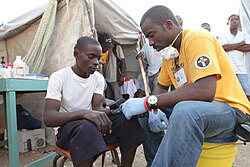
Hubbard devised the Volunteer Minister Program in 1973.[141] They offer help and counseling to those in distress; this includes the Scientological technique of providing "assists".[141] After the September 11, 2001 terrorist attack in New York City, Volunteer Ministers were on the site of Ground Zero within hours of the attack;[142] they subsequently went to New Orleans after Hurricane Katrina.[143] Accounts of the Volunteer Ministers' effectiveness have been mixed, and touch assists are not supported by scientific evidence.[144][145][146]
In 2010, hundreds of members of the Nation of Islam attended a Dianetics seminar near the group's Chicago headquarters, where they were introduced to Scientology auditing practices. Louis Farrakhan subsequently encouraged his followers to study Scientology, telling them that its techniques could help address the struggles of African Americans, and stated that "nobody can lead in our Nation until and unless they become clear." By 2012, according to the Nation of Islam newspaper The Final Call, more than 1,000 members had been certified as auditors and several thousand others were studying Scientology materials. The Church of Scientology opened new facilities in Harlem and Inglewood, California, and former officials reported that course costs for Nation members were sometimes reduced, though the Church denied giving special treatment. Farrakhan described the relationship as a "long and beautiful" alliance.[147]
Responses to opponents
The Scientology organization regards itself as the victim of media and governmental persecution,[14] and the scholar of religion Douglas Cowan observed that "claims to systematic persecution and harassment" are part of the internal culture.[148] In turn, Urban noted the organization has "tended to respond very aggressively to its critics, mounting numerous lawsuits and at times using extralegal means to respond to those who threaten it."[14] The organization has often responded to criticism by ad hominem attacks.[149] Its approach to targeting critics has often generated more negative attention for their organization,[150] with Lewis commenting that it "has proven to be its own worst enemy" in this regard.[151]
It has a reputation for litigiousness stemming from its involvement in a large number of legal conflicts.[152] Barrett characterized the organization as "one of the most litigious religions in the world".[153] It has conducted lawsuits against governments, organizations, and individuals, both to counter criticisms made against it and to gain legal recognition as a religion.[154] J.P. Kumar, who studied the litigation, argued that victory was not always important to the organization; what was important was depleting the resources and energies of its critics.[155]
Suppressive persons and fair game
Those deemed hostile to the Church of Scientology, including ex-members, are labeled "suppressive persons" or SPs.[156] Hubbard maintained that 20 percent of the population would be classed as "suppressive persons" because they were truly malevolent or dangerous: "the Adolf Hitlers and the Genghis Khans, the unrepentant murderers and the drug lords".[157][158] If the organization declares that one of its members is an SP, all other members are forbidden from further contact with them, an act it calls "disconnection".[150] Any member breaking this rule is labeled a "potential trouble source" (PTS) and unless they swiftly cease all contact they can be labeled an SP themselves.[159][160][161]
In an October 1968 letter to members, Hubbard wrote about a policy called "fair game" which was directed at SPs and other perceived threats to the organization.[36][162] Here he stated that these individuals "may be deprived of property or injured by any means by any Scientologist without any discipline of the Scientologists. May be tricked, sued or lied to or destroyed".[156] Following strong criticism, the organization said that it formally ended Fair Game a month later, with Hubbard stating that he had never intended "to authorize illegal or harassment type acts against anyone."[163] Critics and some scholarly observers argue that its practices reflect that the policy remains in place.[164] It is "widely asserted" by former members that Fair Game is still employed;[165] Stacy Brooks, a former member of the internal Office of Special Affairs, stated in court that "practices which were formerly called 'Fair Game' continue to be employed, although the term 'Fair Game' is no longer used."[163]
Hubbard and his followers targeted many individuals as well as government officials and agencies, including a program of illegal infiltration of the IRS and other U.S. government agencies during the 1970s.[166][162] They also conducted private investigations, character assassination and legal action against the organization's critics in the media.[166]
The Scientology ethics and justice system regulates member behavior,[88] and Ethics officers are present in every Scientology organization. Ethics officers ensure "correct application of Scientology technology" and deal with "behavior adversely affecting a Scientology organization's performance", ranging from "errors" and "misdemeanors" to "crimes" and "suppressive acts", as those terms defined by Scientology.[107]
Scientologists
A Scientologist is a person who adheres to the beliefs and practices of Scientology, a movement founded by L. Ron Hubbard in the mid-20th century. The term is used for individuals who participate in Scientology services or training offered by the Church of Scientology, whether as public members or as part of the organization's staff. Estimates of the number of Scientologists vary widely, with the Church claiming worldwide membership in the millions, while national censuses and independent surveys indicate global totals in the tens of thousands.
Free Zone and independent Scientology
The Free Zone, also known as Freezone or Independent Scientology, refers to a loose collection of individuals and groups who practice Scientology outside the authority of the Church of Scientology. These practitioners range from those who closely follow L. Ron Hubbard's early teachings to others who adapt or innovate upon them, often emphasizing a non-hierarchical and individualized approach to Scientology's methods. The Church of Scientology regards such activity as heretical and labels independent practitioners "squirrels", a term used within the Church for those who alter or use Scientology techniques without authorization.
Controversies

Urban described the Church of Scientology as "the world's most controversial new religion",[143] while Lewis termed it "arguably the most persistently controversial" of contemporary new religious movements.[169] According to Urban, the organization had "a documented history of extremely problematic behavior ranging from espionage against government agencies to shocking attacks on critics of the organization and abuse of its own members."[170]
A first point of controversy was its response to its rejection by the scientific establishment. Another was a 1991 Time magazine article about the organization, which responded with a major lawsuit that was rejected by the court as baseless early in 1992. A third is its religious tax status in the United States, as the IRS granted the organization tax-exempt status in 1993.[171]
It has been in conflict with the governments and police forces of many countries (including the United States, the United Kingdom, Canada,[172] France[173] and Germany).[174][175][176][177] It has been one of the most litigious religious movements in history, filing countless lawsuits against governments, organizations and individuals.[178]
Hubbard himself was convicted of fraud in absentia by a French court in 1978 and sentenced to four years in prison.[172] In 1992, a court in Canada convicted the Scientology organization in Toronto of spying on law enforcement and government agencies and criminal breach of trust, later upheld by the Ontario Court of Appeal.[179][180] The Church of Scientology was convicted of fraud by a French court in 2009, a judgment upheld by the supreme Court of Cassation in 2013.[181]
Reports and allegations have been made, by journalists, courts, and governmental bodies of several countries, that the Church of Scientology is an unscrupulous commercial enterprise that harasses its critics and brutally exploits its members.[176][182] A considerable amount of investigation has been aimed at the organization, by groups ranging from the media to governmental agencies.[176][182]
The controversies involving the Church of Scientology, some of them ongoing, include:
- Criminal behavior by members of the organization, including the infiltration of the US Government.[175]
- Organized harassment of people perceived as enemies of the Church of Scientology.[175]
- Scientology's disconnection policy, in which some members are required to shun friends or family members who are "antagonistic" to the organization.[183][184]
- The death of Scientologist Lisa McPherson while in the care of the organization. Robert Minton sponsored the multimillion-dollar lawsuit against Scientology for the death of McPherson. In May 2004, McPherson's estate and the Church of Scientology reached a confidential settlement.[185]
- Attempts to legally force search engines to censor information critical of the Scientology organization.[186]
- Allegations the organization's leader David Miscavige beats and demoralizes staff, and that physical violence by superiors towards staff working for them is a common occurrence in the organization.[72][187] Scientology spokesman Tommy Davis denied these claims and provided witnesses to rebut them.[72]
Stephen A. Kent, a professor of sociology, has said that "Scientologists see themselves as possessors of doctrines and skills that can save the world, if not the galaxy."[188] As stated in Scientology doctrine: "The whole agonized future of this planet, every man, woman and child on it, and your own destiny for the next endless trillions of years depend on what you do here and now with and in Scientology."[189] Kent has described the Scientology ethics and justice system as "a peculiar brand of morality that uniquely benefited [the Church of Scientology] ... In plain English, the purpose of Scientology ethics is to eliminate opponents, then eliminate people's interests in things other than Scientology."[110]
Many former members have come forward to speak out about the organization and the negative effects its teachings have had on them, including celebrities such as Leah Remini. Remini spoke about her split from the Church of Scientology, saying that she still maintains friendships within the organization, but is prohibited from communicating with those individuals.[190]
Throughout the early 1950s, adherents of Hubbard were arrested for practicing medicine without a license. In January 1951, the New Jersey Board of Medical Examiners brought proceedings against the Dianetic Research Foundation on the charge of teaching medicine without a license. In January 1963 U.S. Marshals raided the Founding Church of Scientology in Washington.[70] Scientology social programs such as drug and criminal rehabilitation have also drawn both support and criticism.[191][192][193]
Hubbard's motives
Common criticisms directed at Hubbard was that he drew upon pre-existing sources and the allegation that he was motivated by financial reasons.[194] A number of Hubbard's letters and directives to his subordinates support the notion that he used religion as a façade for Scientology to maintain tax-exempt status[95] and avoid further prosecutions (a number of Dianetics or Scientology practitioners had already been arrested) for medical claims.[195] The IRS cited a statement frequently attributed to Hubbard that the way to get rich was to found a religion.[35] Many of Hubbard's colleagues in the science fiction community, including Sam Merwin, Lloyd Arthur Eshbach and Sam Moscowitz, recall Hubbard raising the topic in conversation.[196][197][198] In 2006, Rolling Stone's Janet Reitman also attributed the statement to Hubbard, as a remark to science fiction writer Lloyd Eshbach and recorded in Eshbach's autobiography.[188]
Secrecy and deception
Scientology has been called "America’s most secretive religion".[23]
Some information about the Scientology belief system is kept hidden from most Scientologists, with layers of secrecy and obfuscation.[199]
Hubbard and his followers have been accused of organized deception, and Hubbard taught insiders that "The only way you can control people is to lie to them."[200][201] In 1983, Hubbard's estranged son Ronald DeWolf argued that "99% of what my father ever wrote or said about himself is totally untrue".[202]
Criminal behavior

In 1978, a number of Scientologists, including L. Ron Hubbard's wife Mary Sue Hubbard (who was second in command in the organization at the time), were convicted of perpetrating what was at the time the largest incident of domestic espionage in the history of the United States, called "Operation Snow White". This involved infiltrating, wiretapping, and stealing documents from the offices of Federal attorneys and the Internal Revenue Service.[203] L. Ron Hubbard was convicted in absentia by French authorities of engaging in fraud and sentenced to four years in prison.[172] The head of the French Church of Scientology was convicted at the same trial and given a suspended one-year prison sentence.[204]
An FBI raid on the Church of Scientology's headquarters revealed documentation that detailed Scientology's criminal actions against various critics of the organization. In "Operation Freakout", agents of the organization attempted to destroy Paulette Cooper, author of The Scandal of Scientology, an early book that had been critical of the movement.[205] Among these documents was a plan to frame Gabe Cazares, the mayor of Clearwater, Florida, with a staged hit-and-run accident. Nine individuals related to the case were prosecuted on charges of theft, burglary, conspiracy, and other crimes.
In 1988, Scientology president Heber Jentzsch and ten other members of the organization were arrested in Spain on various charges including illicit association, coercion, fraud, and labor law violations.[206] In October 2009, the Church of Scientology was found guilty of organized fraud in France.[207] The sentence was confirmed by the court of appeal in February 2012, and by the supreme Court of Cassation in October 2013.[208][181] In 2012, Belgian prosecutors indicted Scientology as a criminal organization engaged in fraud and extortion.[209][210][211] In March 2016, the Church of Scientology was acquitted of all charges, and demands to close its Belgian branch and European headquarters were dismissed.[212]
Organized harassment
Scientology has historically engaged in hostile action toward its critics; executives within the organization have proclaimed that Scientology is "not a turn-the-other-cheek religion".[213] Since the 1960s, Journalists, politicians, former Scientologists and various anti-cult groups have said that Scientology followers have engaged in organized hostility, harassment and threats, and Scientology has targeted these critics–almost without exception–for retaliation, in the form of lawsuits and public counter-accusations of personal wrongdoing. Many of Scientology's critics have also reported they were subject to threats and harassment in their private lives.[214][215]
According to a 1990 Los Angeles Times article, the Scientology organization had largely switched from using members to using private investigators, including former and current Los Angeles police officers, as this gives the organization a layer of protection in case investigators use tactics which might cause the organization embarrassment. In one case, the organization described their tactics as "LAPD sanctioned", which was energetically disputed by Police Chief Daryl Gates. The officer involved in this particular case of surveillance and harassment was suspended for six months.[116]
Journalist John Sweeney reported that "While making our BBC Panorama film Scientology and Me I have been shouted at, spied on, had my hotel invaded at midnight, denounced as a 'bigot' by star Scientologists, brain-washed – that is how it felt to me – in a mock up of a Nazi-style torture chamber and chased round the streets of Los Angeles by sinister strangers".[216]
Mistreatment of members
A prominent ex-member who has spoken out about the Scientology organization's mistreatment of members and ex-members is Leah Remini. Remini is an American actress that has been involved with the Church of Scientology since childhood. She left in 2013. In 2015 she published a book entitled Troublemaker: Surviving Hollywood and Scientology where she recounts her experiences and events leading up to her leaving the organization.[217]
She also has produced a documentary television series on A&E entitled Leah Remini: Scientology and the Aftermath released in 2017 which aired for three seasons. In this series, she and her co-host Mike Rinder, who is also an ex-member, tell their experiences and interview numerous ex-members with similar. Leah Remini has been outspoken about her views on the Church of Scientology and has raised much awareness about some of the major issues within the organization regarding treatment of children, exploitive money practices and mistreatments she has experienced.
As of August 2023, Remini has filed a lawsuit against the Church of Scientology. She alleges verbal, physical and sexual abuse was known and tolerated by the organization, and exploitive practices such as signing billion-year contracts with the organization. The main claims of the lawsuit are for psychological torture, defamation, surveillance, harassment, and intimidation experienced by her for years while a member, and as tactics used after she publicly left.[218]
Violation of auditing confidentiality
During the auditing process, the auditor collects and records personal information from the client.[219] While the Church of Scientology claims to protect the confidentiality of auditing records, the organization has a history of attacking and psychologically abusing former members using information culled from the records.[219] For example, a December 16, 1969, a Guardian's Office order (G. O. 121669) by Mary Sue Hubbard explicitly authorized the use of auditing records for purposes of "internal security".[220] Former members report having participated in combing through information obtained in auditing sessions to see if it could be used for smear campaigns against critics.[206][221]
Allegations of coerced abortions

The Sea Org originally operated on vessels at sea where it was understood that it was not permitted to raise children on board the ships because "children hinder adults from performing their vital assignments". Women who became pregnant have stated that they had been "coercively persuaded" to undergo abortions in order to remain in the Sea Org.[222]
In 2003, The Times of India reported "Forced abortions, beatings, starvation are considered tools of discipline in this church".[223] A former high-ranking source reports that "some 1,500 abortions" have been "carried out by women in the Sea Organization since the implementation of a rule in the late 80s that members could not remain in the organization if they decided to have children". The source noted that "And if members who have been in the Sea Organization for, say, 10 years do decide to have kids, they are dismissed with no more than $1,000" as a severance package.[224]

Longtime member Astra Woodcraft left Scientology for good when the organization tried to pressure her to have an abortion.[225][226] Former Sea Org member Karen Pressley recounted that she was often asked by fellow Scientologists for loans so that they could get an abortion and remain in the Sea Org.[227][228][229] Scientology employee Claire Headley has said she "was forced to have (two) abortions to keep her job and was subjected to violations of personal rights and liberties for the purpose of obtaining forced labor".[230] Laura DeCrescenzo reported she was "coerced to have an abortion" as a minor, and sued in 2009.[231]

In March 2009 a former Scientologist reported that women who worked at Scientology's headquarters were forced to have abortions, or faced being declared a "suppressive person" by the organization's management.[232] In March 2010, former Scientologist Janette Lang stated that at age 20 she became pregnant by her boyfriend while in the organization,[233] and her boyfriend's Scientology supervisors "coerced them into terminating the pregnancy".[234] "We fought for a week, I was devastated, I felt abused, I was lost and eventually I gave in. It was my baby, my body and my choice, and all of that was taken away from me by Scientology", said Lang.[234][235]
Australian Senator Nick Xenophon gave a speech to the Australian Parliament in November 2009, about statements he had received from former Scientologists.[236] He said that he had been told members of the organization had coerced pregnant female employees to have abortions.[236] "I am deeply concerned about this organisation and the devastating impact it can have on its followers," said Senator Xenophon, and he requested that the Australian Senate begin an investigation into Scientology.[236] According to the letters presented by Senator Xenophon, the organization was involved in "ordering" its members to have abortions.[237]
Former Scientologist Aaron Saxton sent a letter to Senator Xenophon stating he had participated in coercing pregnant women within the organization to have abortions.[238] "Aaron says women who fell pregnant were taken to offices and bullied to have an abortion. If they refused, they faced demotion and hard labour. Aaron says one staff member used a coat hanger and self-aborted her child for fear of punishment," said Senator Xenophon.[239] Carmel Underwood, another former Scientologist, said she had been put under "extreme pressure" to have an abortion,[240] and that she was placed into a "disappearing programme", after refusing.[241] Underwood was the executive director of Scientology's branch in Sydney.[239]
Scientology spokesman Tommy Davis said these statements are "utterly meritless".[230] Mike Ferriss, the head of Scientology in New Zealand, told media that "There are no forced abortions in Scientology".[242] Scientology spokesperson Virginia Stewart likewise denied the statements and asserted "The Church of Scientology considers the family unit and children to be of the utmost importance and does not condone nor force anyone to undertake any medical procedure whatsoever."[243]
Allegation of human trafficking and other crimes against women
A number of women have sued the Church of Scientology, alleging a variety of complaints including human trafficking, rape, forced labor, and child abuse.[244] In 2009, two former Sea Org employees, Marc and Claire Headley, sued the Church of Scientology alleging human trafficking.[245]
Scientology, litigation, and the Internet
In the 1990s, Miscavige's organization took action against increased criticism of Scientology on the Internet and online distribution of Scientology-related documents.[246] Starting in 1991, Scientology filed fifty lawsuits against Scientology-critic Cult Awareness Network (CAN).[247] Many of the suits were dismissed, but one resulted in $2 million in losses, bankrupting the network.[247] At bankruptcy, CAN's name and logo were obtained by a Scientologist.[247][248] A New Cult Awareness Network was set up with Scientology backing, which says it operates as an information and networking center for non-traditional religions, referring callers to academics and other experts.[249][250]
In a 1993 U.S. lawsuit brought by the Church of Scientology against former member Steven Fishman, Fishman made a court declaration which included several dozen pages of formerly secret esoterica detailing aspects of Scientologist cosmogony. As a result of the litigation, this material, normally strictly safeguarded and used only in Scientology's more advanced "OT levels", found its way onto the Internet. This resulted in a battle between the Scientology organization and its online critics over the right to disclose this material, or safeguard its confidentiality. The organization was forced to issue a press release acknowledging the existence of this cosmogony, rather than allow its critics "to distort and misuse this information for their own purposes".[251][252]
In January 1995, Church of Scientology lawyer Helena Kobrin attempted to shut down the newsgroup alt.religion.scientology by sending a control message instructing Usenet servers to delete the group.[253] In practice, this rmgroup message had little effect, since most Usenet servers are configured to disregard such messages when sent to groups that receive substantial traffic, and newgroup messages were quickly issued to recreate the group on those servers that did not do so. However, the issuance of the message led to a great deal of public criticism by free-speech advocates.[254][255] Among the criticisms raised, one suggestion is that Scientology's true motive is to suppress the free speech of its critics.[256][257]

The Church of Scientology also began filing lawsuits against those who posted copyrighted texts on the newsgroup and the World Wide Web, lobbied for tighter restrictions on copyrights in general, and supported the controversial Sonny Bono Copyright Term Extension Act as well as the even more controversial Digital Millennium Copyright Act (DMCA).
Beginning in the middle of 1996 and ensuing for several years, the newsgroup was attacked by anonymous parties using a tactic dubbed sporgery by some, in the form of hundreds of thousands of forged spam messages posted on the group. Some investigators said that some spam had been traced to members of the Church of Scientology.[259][260] Former Scientologist Tory Christman later asserted that the Office of Special Affairs had undertaken a concerted effort to destroy alt.religion.scientology through these means; the effort failed.[261]
On January 14, 2008, a video produced by the Scientology organization featuring an interview with Tom Cruise was leaked to the Internet and uploaded to YouTube.[262][263][264] The Church of Scientology issued a copyright violation claim against YouTube requesting the removal of the video.[265] Calling the action by the Church of Scientology a form of Internet censorship, participants of Anonymous coordinated Project Chanology, consisting of a series of denial-of-service attacks against Scientology websites, prank calls, and black faxes to Scientology centers.[266][267][268][269]
On January 21, 2008, Anonymous announced its intentions via a video posted to YouTube entitled "Message to Scientology", and a press release declaring a "war" against the Church of Scientology and the Religious Technology Center.[270] In the press release, the group stated that the attacks against the organization would continue in order to protect the freedom of speech, and end what they saw as the financial exploitation of members of the organization.[271]

On January 28, 2008, an Anonymous video appeared on YouTube calling for protests outside Church of Scientology buildings on February 10, 2008.[272][273] The date was chosen because it was the birthday of Lisa McPherson.[274] According to a letter Anonymous e-mailed to the press, about 7,000 people protested in more than 90 cities worldwide.[275] Many protesters wore masks based on the character V from V for Vendetta (who was influenced by Guy Fawkes) or otherwise disguised their identities, in part to protect themselves from reprisals from the Church of Scientology.[276][277] Many further protests have followed since then in cities around the world.[278]
The Arbitration Committee of the Wikipedia internet encyclopedia decided in May 2009 to restrict access to its site from Church of Scientology IP addresses, to prevent self-serving edits by Scientologists.[279][280] A "host of anti-Scientologist editors" were topic-banned as well.[279][280] The committee concluded that both sides had "gamed policy" and resorted to "battlefield tactics", with articles on living persons being the "worst casualties".[279]
Reception and influence
Scientology has influenced various therapy and spiritual groups formed since the 1960s. Much past-life therapy was influenced by Dianetics, while others, including groups founded by former Scientologists, drew on Scientology.[281]
Many of the organization's critics have utilized the internet, for instance to disseminate leaked confidential documents.[282] The Church of Scientology has sought to sue websites for disseminating Hubbard's writings.[283]
The German government is largely hostile to the Church of Scientology,[284] considering it a threat to democracy, and banning Scientologists in Germany from working in the public sector.[153] Scientologists in France have reported being fired or refused jobs because of their beliefs.[285] A 2022 YouGov poll on American attitudes toward religious groups ranked Scientology as the country's least-favored group, with around 50% of respondents indicating a negative view of the practice, alongside Satanism.[286]
Scientology has received an extraordinary amount of media interest.[287] Hubbard often described journalists in negative terms, calling them "merchants of chaos",[288] and discouraged Scientologists from interacting with journalists.[289]
Popular culture
Scientology has been a prominent and controversial subject in popular culture, inspiring depictions across literature, film, television, music, theatre, video games, and digital media. Since the 1960s, artists and creators have drawn on Scientology's beliefs and practices and its public profile, frequently using them as material for satire, criticism, or fictionalized analogues. These portrayals range from documentaries and dramatic films to comedic treatments and symbolic stand‑ins for the movement. Many works emphasize themes such as secrecy, organizational behavior, celebrity involvement, and the public controversies surrounding Scientology.
See also
- Scientology and religious groups
- Scientology and homosexuality
Notes
- ^ Use of "Church" or "the Church" is a common shortened form of "Church of Scientology"; see The Church (Scientology).
References
- ^ Urban 2011, p. 64ff.
- ^ Richardson 2009
- ^
Carobene, Germana (June 16, 2014). "Problems on the legal status of the Church of Scientology". Stato, Chiese e Pluralismo Confessionale. 2014 (21). Milan: University of Milan. doi:10.13130/1971-8543/4109. Retrieved March 10, 2020.
In this sense the long process of Milan is of great importance, which, after six pronunciations was concluded in 2000 and legally recognized Scientology as a religion in Italy. The case was based on the complaint of a series of criminal offenses against some members of the church: conspiracy, fraud, extortion. After some contradictory rulings, the Milan judges became aware of the need to define the religiosity of the movement, i.e. it is to be considered a religion if all the alleged activities can qualify as normal religious practices
- ^ Alan Aldridge Religion in the Contemporary World, p. 20, Polity, 2007 ISBN 978-0-7456-3405-0
- ^ a b Church of the New Faith v Commissioner of Pay-roll Tax (Vict) [1983] HCA 40, (1983) 154 CLR 120, High Court (Australia) "the evidence, in our view, establishes that Scientology must, for relevant purposes, be accepted as "a religion" in Victoria"
- ^ "2007 U.S. Department of State – 2007 Country Reports on Human Rights Practices: Portugal". State.gov. March 11, 2008. Retrieved September 20, 2012.
- ^ "La Audiencia Nacional reconoce a la Cienciología como iglesia". El País. El Pais. November 1, 2007. Archived from the original on May 13, 2011. (in Spanish)
- ^ Finkelman, Paul (2006). Encyclopedia of American Civil Liberties. CRC Press. p. 287. ISBN 978-0-415-94342-0. "Scientology has achieved full legal recognition as a religious denomination in the United States."
- ^
Davis, Derek H. (2004). "The Church of Scientology: In Pursuit of Legal Recognition" (PDF). Zeitdiagnosen: Religion and Conformity. Münster, Germany: Lit Verlag. Archived from the original (PDF) on June 12, 2009. Retrieved May 10, 2008.
Many countries, including the United States, now give official recognition to Scientology as a religion [...]
- ^
Lucy Morgan (March 29, 1999). "Abroad: Critics public and private keep pressure on Scientology". St. Petersburg Times.
In the United States, Scientology gained status as a tax-exempt religion in 1993 when the Internal Revenue Service agreed to end a long legal battle over the group's right to the exemption.
- ^ Toomey, Shamus (June 29, 2005). "'TomKat' casts spotlight back on Scientology". Chicago Sun Times. Archived from the original on June 29, 2005. Retrieved January 28, 2023.
- ^ "Hubbard's Church 'Unconstitutional': Germany Prepares to Ban Scientology". Spiegel Online. December 7, 2007. Retrieved March 13, 2017.
- ^ "National Assembly of France report No. 2468". assemblee-nationale.fr. Retrieved March 13, 2017.
- ^ a b c Urban 2011, p. 2.
- ^ Willms 2009, p. 245. "Being a religion is one of the most important issues of Scientology's current self-representation."
- ^
Kennedy, Dominic (June 23, 2007). "'Church' that yearns for respectability". The Times. London. Archived from the original on May 23, 2011. Retrieved January 4, 2009.
Scientology is probably unique in that it keeps its sacred texts secret until, typically, devotees have paid enough money to learn what they say.
- ^ Cowan & Bromley 2007, p. 17
- ^
Garcia, Wayne (March 31, 1994). "Scientology suit on PR firm heads for trial". St. Petersburg Times. Retrieved January 4, 2009.
For 2½ years, Hill & Knowlton worked closely with the controversial religion, coming up with ways to turn around Scientology's maligned image and teaching Scientologists how to handle reporters' questions.
[dead link] - ^ Flowers 1984, p. 101
- ^ Flinn, Frank K. (July 5, 2005). "Scientology". Live discussion. The Washington Post. Archived from the original on April 9, 2014. Retrieved February 4, 2008.
- ^ Hexham, Irving (1997) [1978]. "The Religious Status of Scientology: Is Scientology a Religion?". University of Calgary. Archived from the original on November 19, 2009. Retrieved June 13, 2006.
- ^ a b Frantz, Douglas (March 9, 1997). "Scientology's Puzzling Journey From Tax Rebel to Tax Exempt". The New York Times. Archived from the original on January 10, 2023. Retrieved October 26, 2008.
- ^ a b c d Reitman, Janet (2011). Inside Scientology: The Story of America's Most Secretive Religion. Houghton Mifflin Harcourt. ISBN 9780618883028. OL 24881847M.
- ^ Cowan & Bromley 2006, p. 172
- ^
"Church of Scientology & IRS Confidentiality" (Press release). December 31, 1997. Archived from the original on May 18, 2012.
Recognition was based upon voluminous information provided by the Church regarding its financial and other operations to the Internal Revenue Service
- ^ a b Anderson, Kevin Victor (1965). "Report of the Board of Inquiry into Scientology". Government Printer, Melbourne. (alternative link)
- ^ Melton 2009, p. 24.
- ^ A 1995 parliamentary report lists Scientology groups as cults, and in its 2006 report MIVILUDES similarly classified Scientology organizations as a dangerous cult. Rapport au Premier ministre 2006 by MIVILUDES (in French) Archived September 24, 2023, at the Wayback Machine
- ^ Spellman, Frank R.; Price-Bayer, Joan (2010). In Defense of Science: Why Scientific Literacy Matters. Lanham: Rowman & Littlefield. p. 81. ISBN 978-1-60590-735-2. Archived from the original on May 15, 2025. Retrieved May 15, 2025.
- ^ Manca, Terra (March 2012). "L. Ron Hubbard's Alternative to the Bomb Shelter: Scientology's Emergence as a Pseudo-science During the 1950s". Journal of Religion and Popular Culture. 24 (1). Berkeley: University of California Press: 80–96. doi:10.3138/jrpc.24.1.80.
- ^ Kent & Manca 2014.
- ^ Urban 2011, p. 58.
- ^ Beit-Hallahmi 2003; Urban 2011, p. 65.
- ^ Kent 1996, pp. 30–32.
- ^ a b Miller 1987, pp. 140–142
- ^ a b Barrett 2001, p. 463.
- ^ Kent 1996, "Hubbard returned once again to religious claims in late October, 1962, apparently after he learned that the United States Food and Drug Administration (FDA) had become 'interested' in his organisation's e-meters. Fearing the worst, Hubbard issued a policy letter entitled 'Religion', in which he specifically justified the devices by insisting that Scientologists used them 'to disclose truth to the individual who is being processed and thus freehim spiritually'. Regarding the future direction of his organisation, Hubbard announced that "Scientology 1970 is being planned on a religious organization basis throughout the world". He reassured his members, however, by adding that "[t]his will not upset in any way the usual activities of any organization. It is entirely a matter for accountants and solicitors" (Hubbard, 1962: 282).".
- ^ Barrett 2001, p. 466; Melton 2009, p. 25.
- ^ Melton 2009, p. 25.
- ^ a b Barrett 2001, p. 467.
- ^ Melton 2009, pp. 27–28.
- ^ a b Melton 2009, p. 28.
- ^ Barrett 2001, pp. 464–465; Lewis 2009a, p. 5; Melton 2009, p. 26.
- ^ Barrett 2001, p. 468.
- ^ Miller 1987, pp. 374–5.
- ^ Rigley, Colin. "L. Ron Hubbard's last refuge". New Times San Luis Obispo. Archived from the original on December 17, 2013.
- ^ Urban 2011, p. 3; Lewis 2009a, p. 7.
- ^ Melton 2009, p. 25; Lewis 2012, p. 133.
- ^ a b Bromley 2009, p. 97.
- ^ Grünschloß 2009, p. 231.
- ^ a b Lewis 2009a, p. 6.
- ^ Melton 2009, p. 25; Rothstein 2009, p. 378.
- ^ a b c d e Bigliardi 2016, p. 665.
- ^ Dericquebourg, Regis (2014). "Acta Comparanda". Affinities between Scientology and Theosophy. International Conference – Scientology in a scholarly perspective 24–25th January 2014 (in English and French). Antwerp, Belgium: University of Antwerp, Faculty for Comparative Study of Religions and Humanism. Archived from the original on February 16, 2017.
- ^ Hassan & Scheflin 2024, pp. 759–761.
- ^ Hassan & Scheflin 2024, p. 760.
- ^ Thomas 2021, pp. 17, 110.
- ^ a b Lewis 2009a, p. 9.
- ^ Flinn 2009, p. 217.
- ^ Thomas 2021, p. 42.
- ^ Thomas 2021, pp. 42–43; Westbrook 2022, p. 7.
- ^ a b c d Cowan & Bromley 2006, pp. 170–171
- ^ Westbrook 2019, p. 17.
- ^ Westbrook 2019, p. 56.
- ^ Kent, Stephen A. (2001). From Slogans to Mantras: Social Protest and Religious Conversion in the Late Vietnam War Era. Syracuse University Press. p. 99. ISBN 0815629486. OL 15521204M.
- ^ Chryssides, George D.; Wilkins, Margaret (2006). A Reader in New Religious Movements. Continuum International Publishing Group. p. 18. ISBN 0826461689. OL 8168615M.
- ^ Rothstein 2016.
- ^ Kent 1999a, p. 6.
- ^ Miller 1987, p. 184.
- ^ a b Urban 2011, pp. 62–68; Westbrook 2019, pp. 81–83; Kent 1996.
- ^ a b Cowan & Bromley 2006, p. 184
- ^ a b c
- The Truth Rundown, a three-part series by Thomas C. Tobin and Joe Childs, St Petersburg Times
- "Part 1 — Scientology: The Truth Rundown". June 21, 2009. Archived from the original on February 9, 2013.
- "The Truth Rundown, Part 2 — Death in slow motion". June 22, 2009. Archived from the original on October 24, 2019.
- "The Truth Rundown, Part 3 — Ecclesiastical justice". June 23, 2009. Archived from the original on August 9, 2009.
- ^ Bigliardi 2016, p. 665; Westbrook 2019, p. 27; Westbrook 2022, p. 14.
- ^ a b Bromley 2009, p. 88.
- ^ Bromley 2009, p. 89.
- ^ Bromley 2009, p. 89; Bigliardi 2016, p. 662; Westbrook 2019, p. 24.
- ^ Bromley 2009, p. 89; Westbrook 2019, p. 24.
- ^ Bromley 2009, p. 89; Grünschloß 2009, p. 229.
- ^ Bromley 2009, p. 88–89, 99; Lewis 2009b, p. 133.
- ^ Thomas 2021, p. 22.
- ^ Bromley 2009, p. 89; Urban 2012, p. 338.
- ^ Cowan 2009, p. 63; Palmer 2009, p. 295; Westbrook 2019, p. 22.
- ^ Westbrook 2019, p. 22.
- ^ Urban 2011, p. 10; Lewis & Hellesøy 2017, p. 216.
- ^ Thomas 2021, pp. 7–8.
- ^ Cusack 2009, pp. 394, 397.
- ^ Dericquebourg 2009, p. 177.
- ^ a b c Cowan & Bromley 2006, p. 180
- ^ Urban 2011, p. 1; Urban 2012, p. 335.
- ^ Lewis 2009b, p. 134.
- ^ Rigal-Cellard 2009, p. 325.
- ^ Rigal-Cellard 2009, p. 327.
- ^ Rigal-Cellard 2009, p. 328.
- ^
Wright, Lawrence (2013). Going Clear: Scientology, Hollywood and the Prison of Belief. Alfred A. Knopf. p. 227. ISBN 978-0-307-70066-7. OL 25424776M.
There was a deliberate campaign to provide religious cloaking for the church's activities. A Scientology cross was created. Scientology ministers now appeared wearing Roman collars.
- ^ a b Beit-Hallahmi 2003.
- ^ Urban 2012, p. 352.
- ^ Bromley 2009, p. 98; Rigal-Cellard 2009, p. 327.
- ^ Bromley 2009, p. 98.
- ^ a b Bromley 2009, p. 99.
- ^ Bromley 2009, pp. 98–99.
- ^ Lewis 2009b, p. 120.
- ^ Westbrook 2019, p. 42.
- ^ Kent 1999a, p. 7; Bromley 2009, p. 99; Urban 2011, p. 36; Halupka 2014, p. 618.
- ^ Kent 1999a, pp. 7–11.
- ^ a b Urban 2011, p. 10.
- ^ Kent 1999a, p. 11; Halupka 2014, p. 618.
- ^ a b c Cowan & Bromley 2006, p. 181
- ^ Kent 1999a, pp. 11–12.
- ^ Kent 1999a, p. 11.
- ^ a b Kent, Stephen (September 2003). "Scientology and the European Human Rights Debate: A Reply to Leisa Goodman, J. Gordon Melton, and the European Rehabilitation Project Force Study". Marburg Journal of Religion. 8 (1). University of Marburg. doi:10.17192/mjr.2003.8.3725. Archived from the original on June 29, 2006. Retrieved May 21, 2006.
- ^ Halupka 2014, p. 618.
- ^ Wakefield, Margery (1991). "12: OSA (Office of Special Affairs) – The Secret CIA of Scientology". Understanding Scientology. Retrieved January 28, 2023 – via David S. Touretzky.
- ^ Cisar, Joe (translator) The Guardian Office (GO)
- ^ Hamburg Regional Office of the German Constitutional Security Agency. "Der Geheimdienst der Scientology-Organisation – Grundlagen, Aufgaben, Strukturen, Methoden und Ziele – Zweite Auflage, Stand 06.05.1998" (PDF). Archived from the original (PDF) on June 14, 2006.
- ^ Dyer, Clare (June 9, 1999). "Scientologists pay for libel". The Guardian. Retrieved January 28, 2023.
- ^ a b Sappell, Joel; Welkos, Robert W. (June 29, 1990). "On the Offensive Against an Array of Suspected Foes". Los Angeles Times. Archived from the original on January 28, 2023. Retrieved January 28, 2023.
- ^ Kent 1999a, p. 5.
- ^ Thomas 2021, p. 32.
- ^ Grünschloß 2009, p. 229; Thomas 2021, p. 51.
- ^ Grünschloß 2009, p. 229.
- ^ Thomas 2021, p. 34.
- ^ Bigliardi 2016, p. 675; Thomas 2021, p. 33.
- ^ Thomas 2021, p. 33.
- ^ Westbrook 2019, p. 51.
- ^ Shaw, William (February 14, 2008). "What do Tom Cruise and John Travolta know about Scientology that we don't?". The Daily Telegraph. London. Archived from the original on February 23, 2012. Retrieved June 25, 2009.
- ^ Cusack 2009, p. 389; Urban 2011, p. 1; Urban 2012, p. 335; Westbrook 2019, p. 51.
- ^ Cusack 2009, p. 396.
- ^ Cusack 2009, p. 396–397.
- ^ Neusner, Jacob (2009). World Religions in America (4th ed.). Westminster John Knox Press.
- ^ Lewis & Hellesøy 2017, pp. 565–569.
- ^ Andersen & Wellendorf 2009, p. 155; Bromley 2009, p. 97; Lewis 2009a, p. 9.
- ^
"Drugs charity is front for 'dangerous' organisation; Insight; Focus". Sunday Times. January 7, 2007. Retrieved March 20, 2014.
Narconon's international website claims: "The ministry of health in England [sic] has also directly funded Narconon residential rehabilitation." But the Department of Health denies any knowledge of this. ... Professor Stephen Kent, a Canadian academic who is an authority on Scientology, said: "The connection between Narconon and Scientology is solid. Of course, Scientology tries to get non-Scientologists involved in the programme, but the engine behind the programme is Scientology." ... The British government expressed concern about Narconon as long as eight years ago. A 1998 memo from the Home Office's drug strategy unit warned that the charity had its "roots in the Church of Scientology and (is) not in the mainstream of drug rehabilitation". Tower Hamlets council in east London advises its schools against using Narconon. DrugScope, one of the UK's main drug charities, said: "We feel that the quality of Narconon's information is not objective and non-judgmental. It does not have any credibility." Stephen Shaw, the prisons ombudsman, advised that inmates in British jails should not receive drug education from Narconon because it is so "closely associated with the Church of Scientology".
- ^ Behar 1991: "Hubbard's purification treatments are the mainstay of Narconon, a Scientology-run chain of 33 alcohol and drug rehabilitation centers—some in prisons under the name "Criminon"—in 12 countries. Narconon, a classic vehicle for drawing addicts into the cult, now plans to open what it calls the world's largest treatment center, a 1,400-bed facility on an Indian reservation near Newkirk, Okla. (pop. 2,400). At a 1989 ceremony in Newkirk, the Association for Better Living and Education presented Narconon a check for $200,000 and a study praising its work. The association turned out to be part of Scientology itself. Today the town is battling to keep out the cult, which has fought back through such tactics as sending private detectives to snoop on the mayor and the local newspaper publisher."
- ^
"What Germans think about their Narconon". Der Spiegel. October 21, 1991. Archived from the original on November 4, 2012. Retrieved March 20, 2014.
The enterprising Scientology sect increases its profits thanks to the misery of addicts. The cover organization, Narconon, offers drug rehabilitation therapy that, in the opinion of experts and doctors in the field, is not only useless but also dangerous. ... Narconon closely follows the motto of the Scientology sect's founder, Lafayette Ron Hubbard, who died in 1986 at the age of 74. The discoverer of this pseudo-scientific hocus pocus, gave this advice: Make money, make more money, make other people make money. The disciples at Narconon follow this order. It is officially an independent subsidiary of Scientology. The Scientologists have developed countless supposedly humanitarian initiatives around their church. One example is the commission for the violations of psychiatry against human rights. Another is the organization for the furthering of religious tolerance and interhuman relations. In fact all these activities, like the drug rehabilitation program, are only to further the fame and increase the paying followers of the sect.
- ^ Cowan & Bromley 2006, p. 182
- ^ Andersen & Wellendorf 2009, p. 155; Bromley 2009, p. 98.
- ^ a b c d Cowan & Bromley 2006, p. 183
- ^ Mantesso, Sean (May 4, 2019). "Scientology's controversial push to enter schools with learning material — including in Australia". ABC Online.
- ^ Asimov, Nanette (May 25, 2014). "Narconon: Misleading antidrug program back in public schools". SFGate.com.
- ^ Kent 1999a, p. 4.
- ^ a b Cusack & Digance 2009, p. 436.
- ^ Cusack & Digance 2009, pp. 435–436.
- ^ a b Urban 2011, p. 9.
- ^ Winn, Patrick (May 15, 2015). "Scientologists are in Nepal trying to 'heal' trauma victims". Global Post. Retrieved December 16, 2015.
- ^ Winn, Patrick (April 11, 2011). "Scientology's global disaster squad". MinnPost. Retrieved December 16, 2015.
- ^ Goodman, Peter S. (January 28, 2005). "For Tsunami Survivors, A Touch of Scientology (washingtonpost.com)". The Washington Post. Retrieved February 22, 2022.
- ^ Gray, Eliza (October 5, 2012). "Thetans and Bowties". The New Republic. ISSN 0028-6583. Retrieved September 8, 2025.
- ^ Cowan 2009, p. 68.
- ^ Barrett 2001, p. 446.
- ^ a b Thomas 2021, p. 30.
- ^ Lewis 2012, p. 140.
- ^ Lewis 2012, p. 134.
- ^ a b Barrett 2001, p. 471.
- ^ Richardson 2009, p. 283.
- ^ Halupka 2014, p. 620.
- ^ a b Barrett 2001, p. 463; Thomas 2021, p. 30.
- ^ Cowan & Bromley 2006, p. 177
- ^ Zellner & Petrowsky 1998, pp. 146–147
- ^ Thomas 2021, pp. 30–31.
- ^ Bednarowski, Mary Farrell (1995). New Religions and the Theological Imagination in America (Religion in North America). Bloomington: Indiana University Press. p. 114. ISBN 978-0-253-20952-8.
- ^ Bednarowski, Mary Farrell (1995). "The Church of Scientology: Lightning Rod for Cultural Boundary Conflicts". In Timothy Miller (ed.). America's Alternative Religions. SUNY Press. p. 388. ISBN 978-0-7914-2397-4. OL 1092279M.
- ^ a b Urban, Hugh B. (2008). "Secrecy and New Religious Movements: Concealment, Surveillance, and Privacy in a New Age of Information". Religion Compass. 2 (1): 66–83. doi:10.1111/j.1749-8171.2007.00052.x. ISSN 1749-8171.
- ^ a b Barrett 2001, p. 464.
- ^ Barrett 2001, p. 464; Thomas 2021, p. 31.
- ^ Doherty 2014, p. 46.
- ^ a b Urban, Hugh B. Magia sexualis: sex, magic, and liberation in modern Western esotericism, p. 137. Berkeley, CA: University of California Press, 2006. ISBN 978-0-520-24776-5
- ^ "Publications listing on the website of the Bavarian Office for the Protection of the Constitution". Lfv.bayern.de. Archived from the original on February 19, 2012. Retrieved September 4, 2010.
- ^ Department Of State. The Office of Electronic Information, Bureau of Public Affairs. "Germany". 2001-2009.state.gov.
- ^ Lewis 2009a, p. 4; Lewis 2012, p. 133.
- ^ Urban 2011, p. 7.
- ^ Lewis, James R. (March 11, 2009). Scientology. Oxford University Press. ISBN 978-0-19-988711-8. Retrieved November 5, 2015.
- ^ a b c Morgan, Lucy (March 29, 1999). "Abroad: Critics public and private keep pressure on Scientology". St. Petersburg Times. Archived from the original on December 19, 2007. Retrieved November 4, 2007.
- ^
Souchard, Pierre-Antoine (February 2, 2012). "Scientology Fraud Conviction Upheld". Huffington Post. Archived from the original on November 3, 2013. Retrieved February 3, 2012.
A French appeals court on Thursday upheld the Church of Scientology's 2009 fraud conviction on charges it pressured members into paying large sums for questionable remedies.
- ^ "Remember Venus?". Time. December 22, 1952. Archived from the original on July 21, 2013. Retrieved July 20, 2007.
- ^ a b c Behar 1991.
- ^ a b c Leiby, Richard (December 25, 1994). "Scientology Fiction: The Church's War Against Its Critics – and Truth". The Washington Post. Archived from the original on December 11, 2024.
- ^ Schön, Brigitte (May 22, 2009). "Marburg Journal of Religion: Framing Effects in the Coverage of Scientology versus Germany: Some Thoughts on the Role of Press and Scholars" (PDF). Web.uni-marburg.de. Archived from the original (PDF) on April 9, 2008. Retrieved September 4, 2010.
- ^ Richardson 2009, p. 283
- ^ Brown, Barry; Cooper, David Y. (August 19, 1992). "Toronto Church Faces Heavy Fine: Scientology Branch is Convicted of Spying on Police, Others". The Buffalo News. Buffalo, NY. Retrieved July 3, 2020.
- ^ Regina v. Church of Scientology of Toronto, 33 O.R. (3d) 65 (Court of Appeal for Ontario April 18, 1997).
- ^ a b "Scientology's fraud conviction upheld in France". The Daily Telegraph. London. AFP. October 17, 2013. Archived from the original on May 30, 2014. Retrieved July 3, 2020.
- ^ a b Goodin, Dan (June 3, 1999). "Scientology subpoenas Worldnet". CNET News.com. Archived from the original on January 28, 2007. Retrieved May 4, 2006.
- ^ Cooper, Robert (August 19, 2014). "Scientology Gateshead building still empty after seven years". BBC News.
- ^ Farley, Robert (June 24, 2006). "The unperson". St. Petersburg Times. pp. 1A, 14A. Archived from the original on July 3, 2007. Retrieved June 24, 2007.
- ^ Farley, Robert (May 29, 2004). "Scientologists settle death suit". St. Petersburg Times. Archived from the original on October 29, 2013. Retrieved November 3, 2008.
- ^ Matt Loney; Evan Hansen (March 21, 2002). "Google pulls anti-Scientology links". CNET. Archived from the original on October 15, 2008. Retrieved May 10, 2007.
- ^ Joe Childs, Thomas C. Tobin (June 23, 2009). "Scientology: Ecclesiastical justice". St Petersburg Times. Archived from the original on January 17, 2013. Retrieved June 23, 2009.
- ^ a b Reitman, Janet (February 8, 2011) [February 23, 2006]. "Inside Scientology". Rolling Stone. Archived from the original on May 2, 2018.
- ^ Hubbard, L. Ron (February 7, 1965). "Keeping Scientology Working Series 1" (PDF). Chaplain Mini Hat (This document was included in the attached documents submitted to the IRS in 1993.). Page with Bates# 240513. Archived from the original on September 7, 2012.
- ^ Eggenberger, Nicole (September 10, 2013). "Leah Remini "Lost Friends" After Leaving Scientology". Us Weekly. Archived from the original on December 11, 2013. Retrieved January 28, 2023.
- ^ Gianni, Luke (February 22, 2007). "Scientology does detox – David E. Root, M.D". local stories > 15 minutes. Sacramento News & Review. Archived from the original on January 30, 2011. Retrieved May 6, 2007.
- ^ "Monserrate Defends Detox Program". The Politicker. New York Observer. April 20, 2007. Archived from the original on February 5, 2012. Retrieved November 27, 2007.
- ^ Etter, Lauren (January 19, 2007). "Program for prisoners draws fire over Scientology". Wall Street Journal. Pittsburgh Post-Gazette. Archived from the original on January 18, 2012. Retrieved November 27, 2007.
- ^ Westbrook 2019, p. 27.
- ^ Kent 1996.
- ^ Eshbach, Lloyd Arthur (1983). Over my shoulder : reflections on a science fiction era. Philadelphia: O. Train. ISBN 978-1-880418-11-6. OCLC 939141508.
- ^ Miller 1987, pp. 117, 133, 148.
- ^ Atack 1990, pp. 137–152
- ^ Hammer & Rothstein 2012, p. 123; Urban 2021, p. 166.
- ^ Lewis, James R. (January 5, 2017). Handbook of Scientology. BRILL. ISBN 978-90-04-33054-2.
- ^ Alexis, Jonas E. (2010). Christianity's Dangerous Idea: How the Christian Principle and Spirit Offer the Best Explanation for Life and Why Other Alternatives Fail: Volume One. AuthorHouse. ISBN 978-1-4520-0611-6.
- ^ Morning Break. WDVM. 1983. Event occurs at 01:03.
- ^ Ficsher, Erika. National Reporting, 1941–1986. Walter de Gruyter. p. 302.
- ^ Catholic Sentinel, March 17, 1978
- ^ Stafford, Charles (1979). "Scientology: An in-depth profile of a new force in Clearwater" (PDF). St Petersburg Times. Archived from the original (PDF) on August 9, 2007. "The 1980 Pulitzer Prize Winner in National Reporting". The Pulitzer Prizes.
- ^ a b Koff, Stephen (December 22, 1988). "Scientology church faces new claims of harassment". St. Petersburg Times. Archived from the original on May 15, 2009. Retrieved March 8, 2026. Newspapers.com: (page 1 page 6 page 7)
- ^ "Scientology convicted for fraud in France, escapes ban". Reuters. October 27, 2009. Archived from the original on January 14, 2010., Reuters, October 27, 2009
- ^ "French court upholds Scientology fraud conviction". CBS News. February 2, 2012., AFP, February 2, 2012
- ^ "Could Belgium Bring Down Scientology? – The Atlantic". The Wire. thewire.com. December 28, 2012. Retrieved March 13, 2017.
- ^ "Belgium will try two Scientology organizations and 10 Scientologists for fraud ' The Underground Bunker". tonyortega.org. Retrieved March 13, 2017.
- ^ "Our man in Europe reports on Belgium's criminal prosecution of Scientology ' The Underground Bunker". tonyortega.org. Retrieved March 13, 2017.
- ^ Lewins, Dean (March 11, 2016). "Scientology: Belgium court acquits church of organised crime charges (Australian Broadcasting Corporation)". ABC News. abc.net.au. Retrieved March 13, 2017.
- ^ "A Sci-Fi Faith". Time. April 5, 1976. Archived from the original on October 14, 2007. Retrieved July 24, 2009.
- ^ Behar, Richard (May 6, 1991a). "The Scientologists and Me". Time. Archived from the original on November 10, 2007.
- ^ Strupp, Joe (June 30, 2005). "The press vs. Scientology". Salon. Archived from the original on January 7, 2007. Retrieved September 19, 2007.
- ^ Sweeney, John (May 14, 2007). "Row over Scientology video". BBC News. Retrieved November 3, 2008.
- ^ Remini, Leah (2015). Troublemaker: Surviving Hollywood and Scientology. Ballantine Books.
- ^ Hauser, Christine; Tumin, Remy (August 4, 2023). "Leah Remini, Vocal Scientology Critic, Files Suit Against Church". The New York Times. ISSN 0362-4331. Archived from the original on August 8, 2023. Retrieved October 22, 2023.
- ^ a b Donaghy, James (June 9, 2007). "My name is L Ron Hubbard". The Guardian. London. Archived from the original on March 7, 2013. Retrieved January 14, 2009.
- ^ Breckenridge, Memorandum of Intended Decision in Church of Scientology of California vs. Gerald Armstrong, Superior Court, Los Angeles County, case no. C420153. quoted in Atack 1990, p. 332
- ^ Steven Girardi (May 9, 1982). "Witnesses Tell of Break-ins, Conspiracy". Clearwater Sun: 1A.
- ^ Kent 1999a, p. 10.
- ^ The Times of India staff (July 17, 2003). "Tom Cruise and the Church of Scientology". The Times of India.
- ^ New York Post staff (June 29, 2005). "Abort-Happy Folks". New York Post. News Corporation. p. 011.
- ^ Los Angeles Times staff (February 29, 2008). "Kids against Scientology". Web Scout. Los Angeles Times. Archived from the original on March 2, 2008. Retrieved November 7, 2009.
- ^ Lattin, Don (February 12, 2001). "Leaving the Fold – Third-generation Scientologist grows disillusioned with faith". San Francisco Chronicle. The Chronicle Publishing Co. p. A1.
- ^ MSNBC staff (January 15, 2008). "Exclusive: 'Tom Cruise: An Unauthorized Biography' – Read an excerpt from Andrew Morton's controversial new book". Today.com. NBC. Retrieved November 7, 2009.
- ^ Morton, Andrew (2008). Tom Cruise: An Unauthorized Biography. St. Martin's Press. p. 130. ISBN 978-0-312-35986-7.
- ^ Pressley, Karen Schless (2017). Escaping Scientology: An Insider's True Story. Bayshore Publications. p. 222. ISBN 978-0-9990881-0-4.
- ^ a b Perrault, Michael (March 26, 2009). "Suit alleges wing of Church of Scientology violated labor laws". The Press-Enterprise. The Press-Enterprise Co. p. C01.
- ^ Courthouse News Service staff (April 3, 2009). "Scientology Accused of Human Trafficking". Courthouse News Service. www.courthousenews.com. Archived from the original on April 13, 2009. Retrieved November 7, 2009.
- ^ Baca, Nathan (March 31, 2009). "Former Scientologist Recounts 'Torturous' Past Inside the Church". KESQ-TV.
- ^ "Scientologists forced me to have two abortions". Herald Sun. www.heraldsun.com.au. March 17, 2010. Retrieved March 17, 2010.
- ^ a b Australian Associated Press (March 17, 2010). "Scientologists forced me to have two abortions, ex-disciple says". News.com.au. News Limited. Archived from the original on March 22, 2010. Retrieved March 17, 2010.
- ^ "Scientologists pressured me to have abortions". ABC News (Australia). Australian Broadcasting Corporation. March 27, 2010. Archived from the original on March 22, 2010. Retrieved March 17, 2010.
- ^ a b c Tedmanson, Sophie (November 19, 2009). "Church of Scientology accused of torture and forced abortions". The Times. Times Newspapers Ltd. Archived from the original on January 7, 2010. Retrieved November 19, 2009.
- ^ Agence France-Presse (November 18, 2009). "Australian PM voices 'concerns' over Scientology". Canada.com. Canwest News Service. Archived from the original on November 21, 2009. Retrieved November 19, 2009.
- ^ Collins, Pádraig (November 19, 2009). "Scientology faces allegations of abuse and covering up deaths in Australia". Irish Times. www.irishtimes.com. Retrieved November 19, 2009.
- ^ a b O'Loughlin, Toni (November 18, 2009). "Scientology faces allegations of torture in Australia: Australian prime minister considers inquiry after senator tables allegations including forced abortions, assault and blackmail". The Guardian. Guardian News and Media Limited. Retrieved November 19, 2009.
- ^ Saulwick, Jacob (November 18, 2009). "Pressure mounts for Scientology inquiry". Sydney Morning Herald. Fairfax Digital. Retrieved November 19, 2009.
- ^ Ansley, Greg (November 19, 2009). "Church attacked for 'criminal' activities". New Zealand Herald. Retrieved November 19, 2009.
- ^ "Kiwi blows the whistle on Scientology". 3 News. www.3news.co.nz. November 26, 2009. Archived from the original on April 6, 2012. Retrieved November 26, 2009.
- ^ Australian Associated Press (March 18, 2010). "Scientologists reject claims they forced abortions". Sydney Morning Herald. Retrieved March 17, 2010.
- ^ Mark, Michelle (September 21, 2019). "Lawsuits against the Church of Scientology are piling up, alleging a vast network of human trafficking, child abuse, and forced labor". Insider Inc. Retrieved June 25, 2020.
- ^ "Marc And Claire Headley Lose Forced Labor Lawsuit Against Church Of Scientology". HuffPost. July 24, 2012. Archived from the original on July 28, 2012.
- ^ Grossman, Wendy (October 1997). "Copyright Terrorists". Net.Wars. New York: New York University Press. pp. 77–78. ISBN 978-0-8147-3103-1. Archived from the original on July 22, 2018. Retrieved June 11, 2006.
- ^ a b c Knapp, Dan (December 19, 1996). "Group that once criticized Scientologists now owned by one". CNN. Archived from the original on April 8, 2014. Retrieved October 29, 2007.
- ^ Russell, Ron (September 9, 1999). "Scientology's Revenge – For years, the Cult Awareness Network was the Church of Scientology's biggest enemy. But the late L. Ron Hubbard's L.A.-based religion cured that–by taking it over". New Times LA.
- ^ Lewis, James R (May 3, 2005). Book: Cults: A Reference Handbook By James R. Lewis, Published by ABC-CLIO, 2005, ISBN 1-85109-618-3, ISBN 978-1-85109-618-3. Abc-Clio. ISBN 978-1-85109-618-3. Retrieved September 4, 2010.
- ^ Goodman, Leisa (2001). "A Letter from the Church of Scientology". Marburg Journal of Religion: Responses From Religions. pp. Volume 6, No. 2, 4 pages. Archived from the original on February 13, 2007. Retrieved October 28, 2007.
- ^ Dawson, Lorne L.; Cowan, Douglas E. (2004). Religion Online: Finding Faith on the Internet. New York, NY/London, UK: Routledge Taylor & Francis Group. pp. 262, 264–265. ISBN 978-0-415-97022-8.
- ^ Ortega, Tony (December 23, 1999). "Double Crossed". Phoenix New Times. Archived from the original on March 12, 2007. Retrieved September 16, 2007.
- ^ Wendy Grossman Net.wars, p. 77, NYU Press, 1997 ISBN 978-0-8147-3103-1
- ^ Steven Vedro Digital Dharma, p. 190, Quest Books, 2007 ISBN 978-0-8356-0859-6
- ^ Mike Godwin Cyber Rights, p. 219, Massachusetts Institute of Technology Press, 2003 ISBN 978-0-262-57168-5
- ^ Catharine Cookson Encyclopedia of Religious Freedom, p. 432, Taylor & Francis, 2003 ISBN 978-0-415-94181-5
- ^ Wendy Grossman Net.wars, p. 90, New York University Press, 1997 ISBN 978-0-8147-3103-1
- ^ Sarno, David (February 11, 2008). "Global Scientology protests include L.A." Los Angeles Times. Archived from the original on November 7, 2012., Los Angeles Times, February 11, 2008.
- ^ Christopher Lueg From Usenet to CoWebs, p. 37, Springer, 2003 ISBN 978-1-85233-532-8
- ^ Wendy Grossman Net.wars, pp. 74–76, NYU Press, 1997 ISBN 978-0-8147-3103-1
- ^ Nordhausen, Frank (2008). Scientology: Wie der Sektenkonzern die Welt erobern will (in German). Links Christoph Verlag. p. 518. ISBN 978-3-86153-470-9.
- ^ John Cook (March 17, 2008). "Scientology – Cult Friction". Radar. Archived from the original on March 23, 2008. Retrieved March 18, 2008.
- ^ Vamosi, Robert (January 24, 2008). "Anonymous threatens to "dismantle" Church of Scientology via internet". cnet.com. CNET. Retrieved May 30, 2015.
- ^ KNBC Staff (January 24, 2008). "Hacker Group Declares War On Scientology: Group Upset Over Church's Handling Of Tom Cruise Video". KNBC. Archived from the original on August 21, 2008. Retrieved January 25, 2008.
- ^ Vamosi, Robert (January 24, 2008). "Anonymous hackers take on the Church of Scientology". CNET News. CNET Networks, Inc. Retrieved January 25, 2008.
- ^ George-Cosh, David (January 25, 2008). "Online group declares war on Scientology". National Post. Archived from the original on June 3, 2008.
- ^ Singel, Ryan (January 23, 2008). "War Breaks Out Between Hackers and Scientology – There Can Be Only One". Wired. CondéNet, Inc. Archived from the original on April 4, 2009. Retrieved January 25, 2008.
- ^ Feran, Tom (January 24, 2008). "Where to find the Tom Cruise Scientology videos online, if they're still posted". The Plain Dealer. Newhouse Newspapers. Archived from the original on May 1, 2008. Retrieved January 25, 2008.
- ^ Matthew A. Schroettnig; Stefanie Herrington; Lauren E. Trent (February 6, 2008). "Anonymous Versus Scientology: Cyber Criminals or Vigilante Justice?". Archived from the original on June 3, 2013. Retrieved January 25, 2008.
- ^ Chan Enterprises (January 21, 2008). "Internet Group Declares "War on Scientology": Anonymous are fighting the Church of Scientology and the Religious Technology Center". Press Release. PRLog.Org. Archived from the original (PDF) on May 8, 2011. Retrieved January 25, 2008.
- ^ Brandon, Mikhail (January 28, 2008). "Scientology in the Crosshairs". The Emory Wheel. Emory University. Archived from the original on May 15, 2012. Retrieved January 31, 2008.
- ^ Feran, Tom (January 31, 2008). "The group Anonymous calls for protests outside Scientology centers – New on the Net". The Plain Dealer. Newhouse Newspapers. Archived from the original on June 19, 2008. Retrieved February 4, 2008.
- ^ Vamosi, Robert (January 28, 2008). "Anonymous names 10 February as its day of action against Scientology". CNET News. CNET Networks, Inc. Archived from the original on October 15, 2008. Retrieved January 28, 2008.
- ^ Greenwald, Will (February 11, 2008). "Anonymous Attacks!". CNET. Archived from the original on August 29, 2012.
- ^ Carlos Moncada (February 12, 2008). "Organizers Tout Scientology Protest, Plan Another". TBO.com. Archived from the original on February 10, 2012. Retrieved February 13, 2008.
- ^ Harrison, James (The State News) (February 12, 2008). "Scientology protestors take action around world". Archived from the original on October 21, 2013. Retrieved February 14, 2008.
- ^ Forrester, John (February 11, 2008). "Dozens of masked protesters blast Scientology church". The Boston Globe. Archived from the original on October 27, 2013. Retrieved February 15, 2008.
- ^ Andrew Ramadge (March 17, 2008). "Second round of Anonymous v Scientology". News.com.au. Archived from the original on October 6, 2009. Retrieved March 17, 2008.
- ^ a b c Shea, Danny (May 29, 2009). "Wikipedia Bans Scientology From Site". The Huffington Post. Archived from the original on September 5, 2012. Retrieved May 29, 2009.
- ^ a b Metz, Cade (May 29, 2009). "Wikipedia bans Church of Scientology". The Register. Archived from the original on April 3, 2011. Retrieved May 29, 2009.
- ^ Lewis 2013, p. 264.
- ^ Urban 2011, p. 23.
- ^ Barrett 2001, pp. 471–472; Urban 2012, p. 360.
- ^ Richardson 2009, p. 289.
- ^ Palmer 2009, p. 314.
- ^ YouGov (December 23, 2022). Americans' views on 35 religious groups, organizations, and belief systems (Report). YouGov. Retrieved May 27, 2023.
- ^ Graham 2014.
- ^ Westbrook 2022, p. 6.
- ^ Westbrook 2019, p. 11.
Sources
- Andersen, Peter B.; Wellendorf, Rie (2009). "Community in Scientology and among Scientologists". In Lewis, James R. (ed.). Scientology. Oxford/New York: Oxford University Press. pp. 143–163. doi:10.1093/acprof:oso/9780195331493.001.0001. ISBN 978-0-19-5331-49-3.
- Atack, Jon (1990). A Piece of Blue Sky: Scientology, Dianetics and L. Ron Hubbard Exposed. Carol Publishing Group. ISBN 081840499X. OL 9429654M.
- Barrett, David V. (2001). The New Believers: A Survey of Sects, Cults and Alternative Religions. London: Cassell and Co. ISBN 978-0304355921. OL 3999281M.
- Behar, Richard (May 6, 1991). "Scientology: The Thriving Cult of Greed and Power". Time. Archived from the original on May 25, 2014.
- Beit-Hallahmi, Benjamin (September 2003). "Scientology: Religion or Racket?". Marburg Journal of Religion. 8 (1). University of Marburg: 1–56. doi:10.17192/mjr.2003.8.3724.
- Bigliardi, Stefano (2016). "New Religious Movements, Technology, and Science: The Conceptualization of the E-Meter in Scientology Teachings". Zygon. 51 (3): 661–683. doi:10.1111/zygo.12281.
- Bromley, David G. (2009). "Making Sense of Scientology: Prophetic, Contractual Religion". In Lewis, James R. (ed.). Scientology. Oxford/New York: Oxford University Press. pp. 83–102. doi:10.1093/acprof:oso/9780195331493.003.0005. ISBN 978-0-19-5331-49-3. OL 16943235M.
- Cowan, Douglas E. (2009). "Researching Scientology: Perceptions, Premises, Promises, and Problematics". In Lewis, James R. (ed.). Scientology. Oxford/New York: Oxford University Press. pp. 53–79. doi:10.1093/acprof:oso/9780195331493.001.0001. ISBN 978-0-19-5331-49-3.
- Cowan, Douglas E.; Bromley, David G. "The Church of Scientology". In Gallagher & Ashcraft (2006), pp. 169–196.
- Cowan, Douglas E.; Bromley, David G. (2007). Cults and New Religions: A Brief History. Malden, MA / Oxford, UK / Carlton, Victoria, Australia: Blackwell Publishing. ISBN 978-1-4051-6127-5.
- Cusack, Carole M. (2009). "Celebrity, the Popular Media, and Scientology: Making Familiar the Unfamiliar". In Lewis, James R. (ed.). Scientology. Oxford/New York: Oxford University Press. pp. 389–409. doi:10.1093/acprof:oso/9780195331493.001.0001. ISBN 978-0-19-5331-49-3.
- Cusack, Carole M.; Digance, Justine (2009). "Pastoral Care and September 11: Scientology's Nontraditional Religious Contribution". In Lewis, James R. (ed.). Scientology. Oxford/New York: Oxford University Press. pp. 435–437. doi:10.1093/acprof:oso/9780195331493.001.0001. ISBN 978-0-19-5331-49-3.
- Dericquebourg, Régis (2009). "How Should We Regard the Religious Ceremonies of the Church of Scientology?". In Lewis, James R. (ed.). Scientology. Oxford/New York: Oxford University Press. pp. 165–182. doi:10.1093/acprof:oso/9780195331493.001.0001. ISBN 978-0-19-5331-49-3.
- Doherty, Bernard (2014). "Sensational Scientology! The Church of Scientology and Australian Tabloid Television". Nova Religio: The Journal of Alternative and Emergent Religions. 17 (3): 38–63. doi:10.1525/nr.2014.17.3.38. JSTOR 10.1525/nr.2014.17.3.38.
- Flowers, Ronald B. (1984). Religion in Strange Times: The 1960s and 1970s. Macon, GA: Mercer University Press. ISBN 978-0-86554-127-6.
- Flinn, Frank K. (2009). "Scientology as Technological Buddhism". In Lewis, James R. (ed.). Scientology. Oxford/New York: Oxford University Press. pp. 209–223. doi:10.1093/acprof:oso/9780195331493.001.0001. ISBN 978-0-19-5331-49-3.
- Gallagher, Eugene V.; Ashcraft, W. Michael, eds. (2006). Introduction to New and Alternative Religions in America. Volume 5: African diaspora traditions and other American innovations. Westport, CT: Greenwood Press. ISBN 978-0-275-98712-1. Retrieved November 5, 2015.
- Graham, Ruth (November 5, 2014). "Are Academics Afraid to Study Scientology?". JSTOR Daily.
- Grünschloß, Andreas (2009). "Scientology, a 'New Age' Religion?". In Lewis, James R. (ed.). Scientology. Oxford/New York: Oxford University Press. pp. 225–243. doi:10.1093/acprof:oso/9780195331493.001.0001. ISBN 978-0-19-5331-49-3.
- Halupka, Max (2014). "The Church of Scientology: Legitimacy through Perception Management". Politics and Religion. 7 (3): 613–630. doi:10.1017/S1755048314000066. S2CID 143524953.
- Hammer, Olav; Rothstein, Mikael (2012). "Canonical and Extracanonical Texts in New Religions". The Cambridge Companion to New Religious Movements. Cambridge/New York: Cambridge University Press. pp. 113–132. ISBN 978-0-521-19650-5. OL 25323554M.
- Hassan, Steven A.; Scheflin, Alan W. (2024). "Understanding the Dark Side of Hypnosis as a Form of Undue Influence Exerted in Authoritarian Cults: Implications for Practice, Policy, and Education". In Linden, Julie H.; De Benedittis, Giuseppe; Sugarman, Laurence I.; Varga, Katalin (eds.). The Routledge International Handbook of Clinical Hypnosis. Abingdon/New York: Routledge. pp. 755–772. ISBN 978-1-032-31140-1.
- Kent, Stephen A. (1996). "Scientology's Relationship With Eastern Religious Traditions" (PDF). Journal of Contemporary Religion. 11 (1): 21–36. doi:10.1080/13537909608580753. Archived from the original (PDF) on May 31, 2023. Retrieved December 7, 2025.
- Kent, Stephen A. (1999a). "Scientology -- Is this a Religion?". Marburg Journal of Religion. 4 (1). University of Marburg: 1–56. doi:10.17192/mjr.1999.4.3754.
- Kent, Stephen A.; Manca, Terra A. (2014). "A War over Mental Health Professionalism: Scientology versus Psychiatry". Mental Health, Religion & Culture. 17 (1): 1–23. doi:10.1080/13674676.2012.737552. PMC 3856510. PMID 24348087.
- Lewis, James R. (2009a). "Introduction". In Lewis, James R. (ed.). Scientology. Oxford/New York: Oxford University Press. pp. 3–14. doi:10.1093/acprof:oso/9780195331493.001.0001. ISBN 978-0-19-5331-49-3.
- Lewis, James R. (2009b). "The Growth of Scientology and the Stark Model of Religious 'Success'". In Lewis, James R. (ed.). Scientology. Oxford/New York: Oxford University Press. pp. 117–140. doi:10.1093/acprof:oso/9780195331493.001.0001. ISBN 978-0-19-5331-49-3.
- Lewis, James R. (2012). "Scientology: Up Stat, Down Stat". In Olav Hammer; Mikael Rothstein (eds.). The Cambridge Companion to New Religious Movements. Cambridge/New York: Cambridge University Press. pp. 133–149. ISBN 978-0-521-19650-5. OL 25323554M.
- Lewis, James R. (2013). "Free Zone Scientology and Other Movement Milieus: A Preliminary Characterization". Temenos: Nordic Journal of Comparative Religion. 49 (2): 255–276. doi:10.33356/temenos.8203. hdl:10037/25718.
- Lewis, James R.; Hellesøy, Kjersti, eds. (2017). Handbook of Scientology. Leiden: Brill Publishers. ISBN 9789004328716.
- Melton, Gordon (March 19, 2009). "Birth of a Religion". In Lewis, James R. (ed.). Scientology. New York/Oxford: Oxford University Press. pp. 17–29. doi:10.1093/acprof:oso/9780195331493.003.0002. ISBN 978-0-1953-3149-3. Retrieved November 23, 2020.
- Miller, Russell (1987). Bare-faced Messiah: The True Story of L. Ron Hubbard (1st American ed.). New York: H. Holt. ISBN 978-0-8050-0654-4.
- Palmer, Susan J. (2009). "The Church of Scientology in France: Legal and Activist Counterattacks in the 'War on Sectes'". In Lewis, James R. (ed.). Scientology. Oxford/New York: Oxford University Press. pp. 295–322. doi:10.1093/acprof:oso/9780195331493.001.0001. ISBN 978-0-19-5331-49-3.
- Richardson, James T. (2009). "Scientology in Court: A Look at Some Major Cases from Various Nations". In Lewis, James R. (ed.). Scientology. Oxford/New York: Oxford University Press. pp. 283–294. doi:10.1093/acprof:oso/9780195331493.001.0001. ISBN 978-0-19-5331-49-3.
- Rigal-Cellard, Bernadette (2009). "Scientology Missions International (SMI): An Immutable Model of Technological Missionary Activity". In Lewis, James R. (ed.). Scientology. Oxford/New York: Oxford University Press. pp. 325–334. doi:10.1093/acprof:oso/9780195331493.001.0001. ISBN 978-0-19-5331-49-3.
- Rothstein, Mikael (2009). "'His Name was Xenu. He used Renegades...': Aspects of Scientology's Founding Myth". In Lewis, James R. (ed.). Scientology. Oxford/New York: Oxford University Press. pp. 365–387. doi:10.1093/acprof:oso/9780195331493.003.0020. ISBN 9780199852321. OL 16943235M.
- Rothstein, Mikael (January 13, 2016). "The Significance of Rituals in Scientology: A Brief Overview and a Few Examples". Numen. 63 (1). Leiden: Brill Publishers: 54–70. doi:10.1163/15685276-12341408.
- Thomas, Aled (2021). Free Zone Scientology: Contesting the Boundaries of a New Religion. London: Bloomsbury. ISBN 978-1-350-18254-7.
- Urban, Hugh B. (2011). The Church of Scientology: A History of a New Religion. Princeton and Oxford: Princeton University Press. ISBN 978-0-691-14608-9.
- Urban, Hugh B. (2012). "The Occult Roots of Scientology? L. Ron Hubbard, Aleister Crowley, and the Origins of a Controversial New Religion". In Bogdan, Henrik; Starr, Martin P. (eds.). Aleister Crowley and Western Esotericism. Oxford and New York: Oxford University Press. pp. 335–68. ISBN 978-0-19-986309-9. OCLC 820009842.
- Urban, Hugh (2021). "The Third Wall of Fire". Secrecy: Silence, Power, and Religion. Chicago/London: University of Chicago Press. pp. 165–186. ISBN 978-0-226-74650-0.
- Westbrook, Donald A. (2019). Among the Scientologists: History, Theology, and Praxis. Oxford Studies in Western Esotericism. Oxford and New York: Oxford University Press. ISBN 978-0190664978.
- Westbrook, Donald A. (2022). L. Ron Hubbard and Scientology Studies. Cambridge Elements: New Religious Movements. Cambridge: Cambridge University Press. ISBN 978-1-009-01455-7.
- Willms, Gerald (2009). "Scientology: 'Modern Religion' or 'Religion of Modernity'?". In Lewis, James R. (ed.). Scientology. Oxford/New York: Oxford University Press. pp. 245–265. doi:10.1093/acprof:oso/9780195331493.001.0001. ISBN 978-0-19-5331-49-3.
- Zellner, William W.; Petrowsky, Marc (1998). Sects, Cults, and Spiritual Communities: a Sociological Analysis. Westport CT: Praeger Publishers. ISBN 978-0-275-96335-4.
External links
 Definitions from Wiktionary
 Media from Commons
 Quotations from Wikiquote
 Texts from Wikisource
 Resources from Wikiversity
 Data from Wikidata


- Scientology – Is This a Religion? by Stephen A. Kent
- An Annotated Bibliographical Survey of Primary and Secondary Literature on L. Ron Hubbard and Scientology
- Lord, Phil (2019). "Scientology's Legal System". Marburg Journal of Religion. 21 (1). Marburg Journal of Religion. doi:10.2139/ssrn.3232113. SSRN 3232113.
|
Authority control databases
|
|
|---|---|
| International | |
| National | |
| Other | |
