|
The Honourable
Louise Arbour
CC GOQ
|
|
|---|---|
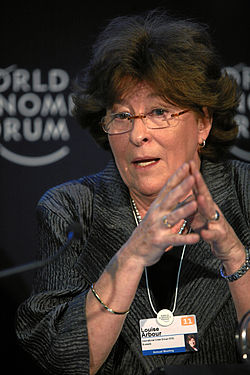
Arbour in 2011
|
|
| Governor General-designate of Canada | |
| Assuming office June 8, 2026 |
|
| Nominated by | Mark Carney |
| Succeeding | Mary Simon |
| United Nations Special Representative for International Migration | |
| In office March 1, 2017 – December 31, 2018 |
|
| Secretary General | António Guterres |
| Preceded by | Peter Sutherland |
| Succeeded by | Position abolished |
| United Nations High Commissioner for Human Rights | |
| In office July 30, 2004 – August 31, 2008 |
|
| Secretary General |
|
| Preceded by | Sérgio Vieira de Mello |
| Succeeded by | Navi Pillay |
| Puisne Justice of the Supreme Court of Canada | |
| In office September 15, 1999 – July 28, 2004 |
|
| Nominated by | Jean Chrétien |
| Preceded by | Peter Cory |
| Succeeded by | Rosalie Abella and Louise Charron |
| Chief Prosecutor of the International Criminal Tribunals for Rwanda and the former Yugoslavia | |
| In office October 1, 1996 – September 15, 1999 |
|
| Secretary General |
|
| Preceded by | Richard Goldstone |
| Succeeded by | Carla Del Ponte |
| Personal details | |
| Born | February 10, 1947
Montreal, Quebec, Canada
|
|
Domestic partner
|
Larry Taman (separated) |
| Children | 3 |
|
Alma mater
|
|
| Occupation |
|
| Signature |  |
Louise Arbour (born February 10, 1947) is a Canadian lawyer, prosecutor, civil servant and jurist who has been designated to become the 31st governor general of Canada.
Born in Montreal, Arbour was the UN High Commissioner for Human Rights, a former justice of the Supreme Court of Canada and the Court of Appeal for Ontario and a former chief prosecutor of the International Criminal Tribunals for the former Yugoslavia and Rwanda. From 2009 until 2014, she served as president and CEO of the International Crisis Group.[1] She made history with the indictment of a sitting head of state, Yugoslavian president Slobodan Milošević, as well as the first prosecution of sexual assault as a crime against humanity. From March 2017 to December 2018, she was the special representative of the United Nations Secretary-General for international migration.[2] After leaving office, she continued her private law practice in Montreal.[3] On May 5, 2026, Canadian prime minister Mark Carney announced Arbour's appointment as governor general effective on June 8, 2026, to succeed Mary Simon.
Early life and education
Louise Arbour was born in Montreal, Quebec, to Bernard and Rose (née Ravary) Arbour, the owners of a hotel chain. She attended convent school, during which time her parents divorced. As editor of the school magazine, she earned a reputation for irreverence.[4]
In 1967, she graduated from Collège Regina Assumpta and proceeded to the Université de Montréal where she completed an LL.B. with distinction in 1970. She was a law clerk for Justice Louis-Philippe Pigeon of the Supreme Court of Canada from 1971–1972 while completing graduate studies at the Faculty of Law (Civil Section) of the University of Ottawa. In a 2014 interview, Arbour named the move from Quebec to Ontario as the "biggest hurdle [she] had to overcome to succeed in [her] career," as her entire education had been in French.[5] She was called to the Bar of Quebec in 1971 and the Law Society of Upper Canada in 1977.[6]
Career
Legal career
Canada
From 1972–73, Arbour served as a research officer for the Law Reform Commission of Canada. She then taught at Osgoode Hall Law School, York University, first as a Lecturer (1974), then as Assistant Professor (1975), Associate Professor (1977–1987), and finally as Associate Professor and Associate Dean (1987). She was vice-president of the Canadian Civil Liberties Association until her appointment to the Supreme Court of Ontario (High Court of Justice) in 1987 and to the Court of Appeal for Ontario in 1990. In 1995, Arbour was appointed as President of a Commission of Inquiry, under the Inquiries Act, for the purpose of investigating and reporting on events at the Prison for Women in Kingston, Ontario, following allegations by prisoners of abuse.[7] The inquiry resulted in the publication of the Arbour Report.
The Hague
In 1996, at Richard Goldstone's recommendation, Arbour was appointed as his replacement as Chief Prosecutor of the International Criminal Tribunal for Rwanda in Arusha, and of the International Criminal Tribunal for the former Yugoslavia (ICTY) in The Hague. She helped convict Jean-Paul Akayesu of genocide, the first such conviction since 1948 Genocide Convention.[8] She also indicted then-Serbian President Slobodan Milošević for war crimes, the first time a serving head of State was called to account before an international court.[9] Arbour declined to investigate any potential NATO war crimes, stating that "I accept the assurances given by NATO leaders that they intend to conduct their operations in the Federal Republic of Yugoslavia in full compliance with international humanitarian law".[10]
Supreme Court of Canada
In 1999, Prime Minister Jean Chrétien appointed Arbour to the Supreme Court of Canada on May 26, just one day before the publication of the indictment of Milosevic by the International Criminal Tribunal for the former Yugoslavia (ICTY).[11] In 2004, Arbour retired from the Supreme Court of Canada, having served for just under five years. During her time on the Court, she wrote 68 reasons.[12][13]
United Nations and later career

After leaving the Supreme Court of Canada, Arbour became the United Nations High Commissioner of Human Rights.[12] She criticized a number of countries for their human rights records.[14] In 2008, she stepped down after serving one four-year term. In 2014, after leaving the International Crisis Group as president and CEO since 2009, Arbour began working for Borden Ladner Gervais as counsel.[14][15] Arbour was also a member of the Global Commission on Drug Policy, the International Commission Against the Death Penalty,[15][16] and the Whitney R. Harris World Law Institute's International Council.[17]
On March 9, 2017, Arbour was appointed by the U.N. Secretary-General, António Guterres, to be his Special Representative for International Migration.[18][19] In 2018, she described anti-migration sentiment in Western countries as "completely self-defeating."[20] In April 2021, Canadian Minister of National Defence Harjit Sajjan appointed Arbour to lead an independent review of the military’s handling of sexual assault, harassment and other misconduct.[21] In May 2022, she delivered her final report, which included 48 recommendations, including a proposal for civilian courts to handle sexual assault allegations involving members of the military.[22][23]
Governor General of Canada
On May 5, 2026, Prime Minister Mark Carney announced that King Charles III had approved Arbour's appointment as the 31st governor general of Canada, succeeding Mary Simon.[24] She will be sworn in on June 8.[25] Arbour is the oldest person to hold the office in Canadian history.[26]
Personal life
At the University of Ottawa, Arbour met her long-time common-law partner Larry Taman, with whom she lived for 27 years before separating after she moved to The Hague in 1996.[27][28] Arbour had three children with Taman: Emilie, Patrick and Catherine.[6] She also has grandchildren.[5]
Arbour speaks both English and French fluently.[29]
Her daughter, Emilie Taman, is a lawyer and politician affiliated with the New Democratic Party (NDP). Emilie was the NDP candidate for Ottawa—Vanier in the 2015 Canadian federal election and the 2017 Ottawa—Vanier federal by-election, and later contested Ottawa Centre in the 2019 Canadian federal election.[30][31][32]
Arbour has described herself as a supporter of international justice, human rights and multilateral cooperation, themes that have shaped both her judicial and diplomatic career.[33]
In the media
Arbour has published works on criminal procedure and criminal law in both French and English. At various times, she has served as an editor for the Criminal Reports, the Canadian Rights Reporter, and the Osgoode Hall Law Journal.[34]
On April 1, 2016, Arbour participated in a Munk Debate concerning what was being called a global refugee crisis at the time, arguing alongside historian Simon Schama in favour of the resolution that Western nations have a moral imperative to accept a large influx of refugees.[35] Beginning the evening with 77 percent of the audience supporting their side, Arbour and Schama lost the debate to opponents Mark Steyn and Nigel Farage, who swung 22 percent of the audience vote against the resolution by the end of the event.[36][37]
Awards and recognition

In 2005, Arbour was awarded the Thomas J. Dodd Prize in International Justice and Human Rights, along with Justice Richard Goldstone, in recognition of her work on the International Criminal Tribunals for the former Yugoslavia and Rwanda.[38] She was the subject of a 2005 fact-based Canadian-German made-for-television movie, Hunt for Justice, which follows her quest to indict Bosnian Serb war criminals. Arbour was played by Canadian actress Wendy Crewson.[39] In 2016, she was awarded the Tang Prize in rule of law for her contributions to international criminal justice and the protection of human rights.[40] She has multiple schools named after her, including Louise Arbour Secondary School in Brampton, Ontario.[41][42][43]
She was made a Companion to the Order of Canada in 2007 "for her contributions to the Canadian justice system and for her dedication to the advancement of human rights throughout the world".[44] She was made a Grand Officer of the National Order of Quebec in 2009.[45] She was made a Commander of the National Order of the Legion of Honour in 2011.[46] She has been awarded numerous honorary degrees, including Doctor of Civil Laws from the University of Western Ontario in June 2000,[47] Doctor of Humane Letters from Mount Saint Vincent University in May 2001,[48] and Doctor of Laws degrees from the University of New Brunswick in 1999, from the University of British Columbia in November 2001, from Concordia University in 2001,[49] the University of Waterloo in October 2006,[50] in June 2009 from the University of Alberta[51][52] and University of Guelph,[53] from Simon Fraser University in October 2009, and from Vancouver Island University in January 2020.[54]
In January 2023, Arbour was awarded the 2023 Sandra Day O'Connor Justice Prize from Arizona State University, a lifetime achievement award for human rights work as well as upholding the rule of law and judicial independence.[55]
Footnotes
- ^ "International Crisis Group - President". International Crisis Group. July 2009. Archived from the original on September 2, 2009.
- ^ "Secretary-General Appoints Louise Arbour of Canada Special Representative for International Migration | Meetings Coverage and Press Releases". Un.org. Archived from the original on April 25, 2017. Retrieved April 24, 2017.
- ^ The Honourable Louise Arbour C.C., G.O.Q., Senior Counsel, Borden Ladner Gervais.
- ^ "Indepth: Louise Arbour". CBC News. March 11, 2008. Archived from the original on June 30, 2020. Retrieved January 22, 2020.
- ^ a b "Louise Arbour, noted legal mind, shares insights and advice as she joins her first law firm". Theglobeandmail.com. Archived from the original on August 28, 2016. Retrieved August 3, 2016.
- ^ a b "Supreme Court of Canada - Biography - Louise Arbour". Supreme Court of Canada. January 1, 2001. Archived from the original on January 23, 2020. Retrieved January 22, 2020.
- ^ "Commission of Inquiry into certain events at the Prison for Women in Kingston" (PDF). Caefs.ca. Archived (PDF) from the original on February 2, 2017. Retrieved November 19, 2017.
- ^ Zimonjic, Peter (May 5, 2026). "Canada's incoming GG Louise Arbour brings rich palette of experience to Rideau Hall". CBC.ca. Retrieved May 5, 2026.
- ^ "Indictments | International Criminal Tribunal for the former Yugoslavia". ICTY. Archived from the original on February 4, 2017. Retrieved January 25, 2017.
- ^ Rajkovic, Nikolas M. (2012). The Politics of International Law and Compliance: Serbia, Croatia and The Hague Tribunal. Taylor & Francis. p. 58. ISBN 9780203803295.
- ^ "Louise Arbour named to Supreme Court". Archived from the original on June 25, 2009. Retrieved October 22, 2007.
- ^ a b Nersessian, Mary (June 7, 2004). "Supreme Court Justice Louise Arbour steps down". The Globe and Mail. Retrieved January 16, 2022.
- ^ "Supreme Court Justice Arbour steps down". CBC News. Retrieved January 15, 2022.
- ^ a b "Arbour stepping down as UN human rights chief". CBC News. Retrieved January 15, 2022.
- ^ a b Harris, Kathleen (June 26, 2012). "War on drugs 'unsustainable,' ex-justice Louise Arbour says".
- ^ "'The search for the truth is becoming more elusive,' says former Supreme Court Justice". CBC News. January 17, 2025.
- ^ "Harris Institute International Council (Updated July 2020)" (PDF). Washington University School of Law. Retrieved June 27, 2025.
- ^ "United Nations Population Division - Department of Economic and Social Affairs". Un.org. Archived from the original on December 1, 2017. Retrieved November 19, 2017.
- ^ "The United Nations Global Compact for Migration – Aspirations and Realities". alumni.cam.ac.uk. Retrieved June 14, 2024.
- ^ https://www.france24.com/en/20180115-interview-louise-arbour-united-nations-migration-compact-trump-administration-icty
- ^ "Former Supreme Court justice Louise Arbour to lead review of military's handling of sexual misconduct". Retrieved April 29, 2021.
- ^ Walsh, Marieke (May 30, 2022). "Military has 'failed' to keep women in uniform safe from sexual assault, former justice Louise Arbour finds". The Globe and Mail. Retrieved May 30, 2022.
- ^ Burke, Ashley (May 30, 2022). "Military should give up control of sexual assault cases permanently: former Supreme Court justice". CBC News. Retrieved May 5, 2026.
- ^ Tasker, John Paul (May 5, 2026). "Carney picks former Supreme Court justice Louise Arbour to be governor general". CBC News. Retrieved May 5, 2026.
- ^ Robertson, Dylan (May 7, 2026). "Ottawa says Louise Arbour to be installed as governor general on June 8". The Canadian Press. Ottawa, Ontario: CTV News. Retrieved May 7, 2026.
- ^ Cecco, Leyland (May 5, 2026). "Carney appoints former war crimes prosecutor as Canada governor general". The Guardian. Toronto, Ontario. Retrieved May 5, 2026.
- ^ "Louise Arbour - Canadian attorney and judge". Britannica.com. Archived from the original on December 1, 2017. Retrieved November 19, 2017.
- ^ Thompson, Allan (2004). "Louise Arbour". International Journal. 59 (3): 681–692.
- ^ Aiello, Rachel; Van Dyk, Spencer (May 5, 2026). "PM Carney names Louise Arbour as Canada's next governor general". CTV News. Ottawa, Ontario. Retrieved May 6, 2026.
- ^ "L'ex-juge Louise Arbour appuie sa fille, candidate pour le NPD". La Presse (in French). July 7, 2015. Archived from the original on April 21, 2019. Retrieved January 22, 2020.
- ^ Baker, Michelle Nash (March 27, 2017). "Emilie Taman: NDP candidate for Ottawa-Vanier byelection". Toronto.com. Retrieved January 4, 2022.
- ^ "'It's too close to call:' The final push for Ottawa Centre". Ottawa Citizen. Retrieved January 4, 2022.
- ^ "Louise Arbour". The Elders. Retrieved May 7, 2026.
- ^ "Secretary-General Appoints Louise Arbour of Canada High Commissioner for Human Rights". United Nations. Archived from the original on February 2, 2017. Retrieved January 25, 2017.
- ^ "Global Refugee Crisis". Munk Debates. April 1, 2016. Retrieved May 5, 2026.
- ^ Paikin, Steve (April 4, 2016). "What the Munk debate on refugees reveals about Canada's inclusivity". TVO Today. Retrieved May 5, 2026.
- ^ "Give Us Your Tired - The Munk Debate on the Global Refugee Crisis". CBC Radio. April 28, 2016. Retrieved May 5, 2026.
- ^ Ali, Zahra (May 14, 2015). "2005 Dodd Prize Recipients | Thomas J. Dodd Research Center". Retrieved September 28, 2020.
- ^ "Wendy Crewson | The Canadian Encyclopedia". www.thecanadianencyclopedia.ca. Archived from the original on March 16, 2020. Retrieved January 22, 2020.
- ^ "Canadian Jurist Louise Arbour Awarded 2016 Tang Prize in Rule of Law". Tang Prize Foundation. June 21, 2016. Retrieved May 5, 2026.
- ^ "Louise Arbour Secondary honours ex-judge". CBC News. September 7, 2010. Retrieved May 5, 2026.
- ^ Blewett, Taylor (January 20, 2022). "Province under pressure to fund new French public school in Gladstone Village". Ottawa Citizen. Ottawa, Ontario. Retrieved May 5, 2026.
- ^ Dubinski, Kate (August 7, 2014). "Louise Arbour French -immersion elementary school in London almost ready after $3.3-million renovation". The London Free Press. London, Ontario. Retrieved May 5, 2026.
- ^ "Governor General Announces New Appointments to the Order of Canada". Governor General of Canada. December 28, 2007. Archived from the original on January 1, 2008.
- ^ "National Order of Quebec citation" (in French). Archived from the original on April 13, 2014. Retrieved April 29, 2015.
- ^ "AWARDS TO CANADIANS". Canada Gazette. Archived from the original on December 1, 2017. Retrieved December 14, 2011.
- ^ "Honorary Degrees Awarded" (PDF). University Secretariat. London, Ontario: University of Western Ontario. Retrieved May 5, 2026.
- ^ "Honorary Degree Recipient Announcement". May 1, 2001. Archived from the original on June 24, 2009.
- ^ "UBC Honorary Degree Recipients - Alphabetical List". Library.ubc.ca. November 22, 2001. Archived from the original on June 24, 2009. Retrieved June 13, 2009.
- ^ "More than 1,300 stars at convocation". UW Daily Bulletin. Waterloo, Ontario: University of Waterloo. October 20, 2006. Retrieved May 5, 2026.
- ^ "Past Honorary Degree Recipients | Chancellor and Senate". www.ualberta.ca. Retrieved May 5, 2026.
- ^ "ARBOUR, L-2009 Address.pdf". Google Docs. Retrieved May 5, 2026.
- ^ "Eight to Receive Honorary Degrees". Uoguelph.ca. June 1, 2009. Archived from the original on June 7, 2009. Retrieved June 13, 2009.
- ^ "SFU 2009 Honorary Degree Recipients". Sfu.ca. Archived from the original on June 23, 2011. Retrieved April 29, 2015.
- ^ Mulgrew, Ian (March 9, 2023). "High court justice Russell Brown under investigation after altercation at Arizona resort". Vancouver Sun. Retrieved March 10, 2023.
External links

