| Chief Minister of Bihar | |
|---|---|
| बिहार के मुख्यमंत्री | |
Seal of the State of Bihar
|
|

Flag of India
|
|

Incumbent
since 15 April 2026
Samrat Choudhary |
|
|
|
| Style | The Honourable (formal) Sir Chief Minister (informal) His Excellency (diplomatic) |
| Type | Head of Government |
| Status | Leader of the Executive |
| Abbreviation | CMoBihar |
| Member of |
|
| Reports to |
|
| Residence | 1, Aney Marg, Patna |
| Seat | State Secretariat, Patna |
| Nominator | MLAs of the majority party or alliance in the Legislative Assembly |
| Appointer | Governor of Bihar by convention based on appointees ability to command confidence in the Bihar Legislative Assembly |
| Term length | At the confidence of the assembly Chief Minister's term is for five years and is subject to no term limits.[1] |
| Precursor | Premier of Bihar |
| Inaugural holder | Mohammad Yunus (Indian politician) as Premier Sri Krishna Sinha as Chief Minister |
| Formation | 26 January 1950 |
| Deputy | Deputy Chief Minister of Bihar |
| Salary |
|
| Website | Official website |
The chief minister of Bihar is the de facto head of the executive branch of the Government of Bihar, of the Indian state of Bihar. The chief minister of Bihar overseeing its administration and governance within the constitutional framework of India.[2][3] While the Governor of Bihar holds the ceremonial role of the constitutional head, real executive authority rests with the chief minister, who is responsible for implementing policies and managing the state's day-to-day affairs. Appointed by the Governor following elections to the Bihar Legislative Assembly, the chief minister is typically the leader of the majority party or coalition in the assembly. Upon taking office, they form a council of ministers, assigning portfolios to manage various government departments. This council operates collectively under the chief minister's leadership and remains accountable to the legislative assembly. Responsibilities of the office include leading cabinet meetings, drafting and implementing state policies, and presenting the annual budget. In addition to maintaining law and order, the chief minister directs efforts toward economic development, public welfare, and infrastructure improvement. Coordination with the Government of India and advocacy for Bihar's interests at the national level are also integral parts of the role. Chief Minister also serves as Leader of the House in the Legislative Assembly.
Policy proposals and legislative initiatives are often introduced under the chief minister's guidance, shaping the government's agenda in the assembly. Administrative oversight is another key function, ensuring government departments and officials deliver public services efficiently and in line with policy objectives. The position carries a five-year term, concurrent with the tenure of the legislative assembly. However, tenure depends on retaining the confidence of the assembly, as the chief minister can be removed through a vote of no confidence. There are no term limits, allowing for multiple consecutive or non-consecutive terms. Since its establishment in 1946, the office has grown in influence, reflecting shifts in state politics and governance. The role has become central to Bihar's administration, with successive holders contributing to the state's legislative, economic, and social development efforts.[4]
From 1946, 23 people have been chief minister of Bihar. The current holder of the position is Samrat Chaudhary, who succeeded the longest-serving Nitish Kumar from 22 February 2015 to 14 April 2026.[5] Kumar vacated the Chief Minister's Office due to his election as an MP in the upper chamber of the union Parliament, the Rajya Sabha.
Oath as the state chief minister
The chief minister serves five years in the office. The following is the oath of the chief minister of state:
I, <name of Chief Minister>, do swear in the name of God/solemnly affirm that I will bear true faith and allegiance to the Constitution of India as by law established, that I will uphold the sovereignty and integrity of India, that I will faithfully and conscientiously discharge my duties as a Minister for the State of Bihar and that I will do right to all manner of people in accordance with the Constitution and the law without fear or favour, affection or ill-will.
List
Prime Ministers from Bihar
Before independence, Bihar was part of the larger Bihar and Orissa province, which was divided into two separate provinces on 1 April 1936. The Government of India Act 1935 introduced a bicameral legislature in Bihar, with a Legislative Assembly and a Legislative Council, headed by the Premier. Shri Krishna Sinha became the first Premier in 1937, leading a government formed by the Indian National Congress. He continued as Bihar's leader after independence, becoming the first chief minister in 1946. The role of premier was replaced by the chief minister after India's independence in 1947, with Bihar's political leadership transitioning to a new democratic framework.[6][7]
| # | Portrait | Name | Term of office | Party | |||
|---|---|---|---|---|---|---|---|
| Took office | Left office | Tenure | |||||
| 1 | 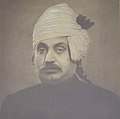 |
Mohammad Yunus | 1 April 1937 | 19 July 1937 | 109 days | Muslim Independent Party | |
| 2 |  |
Shri Krishna Sinha | 20 July 1937 | 31 October 1939 | 2 years, 103 days | Indian National Congress | |
| Vacant | |||||||
| (2) | |
Shri Krishna Sinha | 23 March 1946 | 14 August 1947 | 1 year, 144 days | Indian National Congress | |
Chief ministers of Bihar
Key
- No.: Incumbent number
- § Assassinated or died in office
- RES Resigned
- NC Resigned following a no-confidence motion
| # | Portrait | Name | Constituency | Term of office | Assembly
(Election) |
Party[a] | |||
|---|---|---|---|---|---|---|---|---|---|
| 1 | |
Shri Krishna Sinha | Kharagpur | 15 August 1947 | 29 April 1952 | 13 years, 169 days | Provincial
(1946 election) |
Indian National Congress | |
| 29 April 1952 | 5 May 1957 | 1st
(1952 election) |
|||||||
| Sheikhpura | 5 May 1957 | 31 January 1961 [†] | 2nd
(1957 election) |
||||||
| 2 | Deep Narayan Singh | Hajipur | 1 February 1961 | 18 February 1961 | 17 days | ||||
| 3 |  |
Binodanand Jha | Rajmahal | 18 February 1961 | 15 March 1962 | 2 years, 226 days | |||
| 15 March 1962 | 2 October 1963 | 3rd
(1962 election) |
|||||||
| 4 |  |
Krishna Ballabh Sahay | Patna West | 2 October 1963 | 5 March 1967 | 3 years, 154 days | |||
| 5 |  |
Mahamaya Prasad Sinha | Patna West | 5 March 1967 | 28 January 1968 | 329 days | 4th
(1967 election) |
Jana Kranti Dal | |
| 6 |  |
Satish Prasad Singh | Parbatta | 28 January 1968 | 1 February 1968 | 4 days | Shoshit Dal | ||
| 7 |  |
B. P. Mandal | MLC | 1 February 1968 | 22 March 1968 | 50 days | |||
| 8 |  |
Bhola Paswan Shastri | Korha | 22 March 1968 | 29 June 1968 | 99 days | Loktantrik Congress | ||
| – |  |
Vacant[b]
(President's rule) |
N/A | 29 June 1968 | 26 February 1969 | 242 days | Dissolved | N/A | |
| 9 |  |
Harihar Singh | Nayagram | 26 February 1969 | 22 June 1969 | 116 days | 5th
(1969 election) |
Indian National Congress | |
| (8) | |
Bhola Paswan Shastri | Korha | 22 June 1969 | 4 July 1969 | 12 days | Loktantrik Congress | ||
| – | |
Vacant[b] | N/A | 4 July 1969 | 16 February 1970 | 227 days | N/A | ||
| 10 |  |
Daroga Prasad Rai | Parsa | 16 February 1970 | 22 December 1970 | 309 days | Indian National Congress (R) | ||
| 11 |  |
Karpoori Thakur | Tajpur | 22 December 1970 | 2 June 1971 | 162 days | Samyukta Socialist Party | ||
| (8) | |
Bhola Paswan Shastri | Korha | 2 June 1971 | 9 January 1972 | 221 days | Loktantrik Congress | ||
| – | |
Vacant[b] | N/A | 9 January 1972 | 19 March 1972 | 70 days | Dissolved | N/A | |
| 12 |  |
Kedar Pandey | Nautan | 19 March 1972 | 2 July 1973 | 1 year, 105 days | 6th
(1972 election) |
Indian National Congress | |
| 13 |  |
Abdul Ghafoor | MLC | 2 July 1973 | 11 April 1975 | 1 year, 283 days | |||
| 14 | Jagannath Mishra | Jhanjharpur | 11 April 1975 | 30 April 1977 | 2 years, 19 days | ||||
| – | |
Vacant[b] | N/A | 30 April 1977 | 24 June 1977 | 55 days | Dissolved | N/A | |
| (11) | |
Karpoori Thakur | Phulparas | 24 June 1977 | 21 April 1979 | 1 year, 301 days | 7th
(1977 election) |
Janata Party | |
| 15 |  |
Ram Sundar Das | Sonepur | 21 April 1979 | 17 February 1980 | 302 days | |||
| – | |
Vacant[b] | N/A | 17 February 1980 | 8 June 1980 | 112 days | N/A | ||
| (14) | Jagannath Mishra | Jhanjharpur | 8 June 1980 | 14 August 1983 | 3 years, 67 days | 8th
(1980 election) |
Indian National Congress | ||
| 16 |  |
Chandrashekhar Singh | MLC | 14 August 1983 | 12 March 1985 | 1 year, 210 days | |||
| 17 |  |
Bindeshwari Dubey | Shahpur | 12 March 1985 | 14 February 1988 | 2 years, 339 days | 9th
(1985 election) |
||
| 18 |  |
Bhagwat Jha Azad | MLC | 14 February 1988 | 11 March 1989 | 1 year, 25 days | |||
| 19 |  |
Satyendra Narayan Sinha | MLC | 11 March 1989 | 6 December 1989 | 270 days | |||
| (14) | Jagannath Mishra | Jhanjharpur | 6 December 1989 | 10 March 1990 | 94 days | ||||
| 20 | 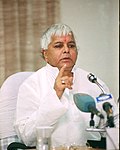 |
Lalu Prasad Yadav | MLC | 10 March 1990 | 28 March 1995 | 5 years, 18 days | 10th
(1990 election) |
Janata Dal | |
| – | |
Vacant[b] | N/A | 28 March 1995 | 4 April 1995 | 7 days | Dissolved | N/A | |
| (20) | |
Lalu Prasad Yadav | Raghopur | 4 April 1995 | 25 July 1997 | 2 years, 112 days | 11th
(1995 election) |
Janata Dal | |
| Rashtriya Janata Dal | |||||||||
| 21 |  |
Rabri Devi | MLC | 25 July 1997 | 11 February 1999 | 1 year, 201 days | |||
| – | |
Vacant[b]) | N/A | 11 February 1999 | 9 March 1999 | 26 days | N/A | ||
| (21) | |
Rabri Devi | MLC | 9 March 1999 | 3 March 2000 | 360 days | Rashtriya Janata Dal | ||
| 22 |  |
Nitish Kumar | MLC | 3 March 2000 | 11 March 2000[9] | 8 days | 12th
(2000 election) |
Samata Party | |
| (21) | |
Rabri Devi [c] | Raghopur | 11 March 2000 | 7 March 2005 | 4 years, 361 days | Rashtriya Janata Dal | ||
| – | |
Vacant[b] | N/A | 7 March 2005 | 24 November 2005 | 262 days | 13th
(Feb 2005 election) |
N/A | |
| (22) | |
Nitish Kumar | MLC | 24 November 2005 | 26 November 2010 | 8 years, 177 days | 14th
(Oct 2005 election) |
Janata Dal (United) | |
| 26 November 2010 | 20 May 2014 | 15th
(2010 election) |
|||||||
| 23 |  |
Jitan Ram Manjhi | Makhdumpur | 20 May 2014 | 22 February 2015 | 278 days | |||
| (22) |  |
Nitish Kumar | MLC | 22 February 2015 | 20 November 2015 | 11 years, 52 days | |||
| 20 November 2015 | 16 November 2020 | 16th
(2015 election) |
|||||||
| 16 November 2020 | 20 November 2025 | 17th
(2020 election) |
|||||||
| 20 November 2025 | 15 April 2026 | 18th
(2025 election) |
|||||||
| 23 |  |
Samrat Choudhary | Tarapur | 15 April 2026 | Incumbent | 3 days | Bharatiya Janata Party | ||
Statistics
- Indian National Congress (47.5%)
- Janata Dal (United) (24.5%)
- Rashtriya Janata Dal (9.02%)
- Janata Dal (8.83%)
- President's Rule (5.21%)
- Socialist Party (2.72%)
- Jana Kranti Dal (1.08%)
- Janata Party (0.99%)
- Others (0.19%)
- Bhartiya Janata Party (1.00%)
| # | Name | Party | Length of term | ||
|---|---|---|---|---|---|
| Longest tenure | Total tenure | ||||
| 1 | Nitish Kumar | JD(U) | 11 years, 52 days | 19 years, 237 days | |
| 2 | Shri Krishna Sinha | INC | 13 years, 169 days | 17 years, 51 days | |
| 3 | Rabri Devi | RJD | 4 years, 360 days | 7 year, 190 days | |
| 4 | Lalu Prasad Yadav | JD | 5 years, 18 days | 7 years, 130 days | |
| 5 | Jagannath Mishra | INC | 3 years, 67 days | 5 years, 180 days | |
| 6 | Krishna Ballabh Sahay | INC | 3 years, 154 days | 3 years, 154 days | |
| 7 | Bindeshwari Dubey | INC | 2 years, 338 days | 2 years, 338 days | |
| 8 | Binodanand Jha | INC | 2 years, 226 days | 2 years, 226 days | |
| 9 | Karpoori Thakur | SP | 1 year, 301 days | 2 years, 98 days | |
| 10 | Abdul Ghafoor | INC | 1 year, 283 days | 1 year, 283 days | |
| 11 | Chandrashekhar Singh | INC | 1 year, 210 days | 1 year, 210 days | |
| 12 | Kedar Pandey | INC | 1 year, 105 days | 1 year, 105 days | |
| 13 | Bhagwat Jha Azad | INC | 1 year, 24 days | 1 year, 24 days | |
| 14 | Mahamaya Prasad Sinha | JKD | 329 days | 329 days | |
| 15 | Daroga Prasad Rai | INC | 310 days | 310 days | |
| 16 | Ram Sundar Das | JP | 302 days | 302 days | |
| 17 | Jitan Ram Manjhi | JD(U) | 278 days | 278 days | |
| 18 | Satyendra Narayan Sinha | INC | 270 days | 270 days | |
| 19 | Harihar Singh | INC | 117 days | 117 days | |
| 20 | Bhola Paswan Shastri | INC | 99 days | 112 days | |
| 21 | Bindheshwari Prasad Mandal | SSP | 51 days | 51 days | |
| 22 | Deep Narayan Singh | INC | 17 days | 17 days | |
| 23 | Satish Prasad Singh | SSP | 5 days | 5 days | |
| 24 | Samrat Choudhary | BJP | 3 days | 3 days | |
See also
- Bihar
- List of governors of Bihar
- List of deputy chief ministers of Bihar
References

Notes
- ^ This column only names the chief minister's party. The state government he heads may be a complex coalition of several parties and independents; these are not listed here.
- ^ a b c d e f g h President's rule may be imposed when the "government in a state is not able to function as per the Constitution", which often happens because no party or coalition has a majority in the assembly. When President's rule is in force in a state, its council of ministers stands dissolved. The office of chief minister thus lies vacant, and the administration is taken over by the governor, who functions on behalf of the central government. At times, the legislative assembly also stands dissolved.[8]
- ^ On 15 November 2000, the new state of Jharkhand was carved out of Bihar.
One of the achievements of the Bihar Government is that they have launched a Medhasoft Application for the students so that deserving students in the state get scholarships and the amount will be directly transferred to their account. However, in order to get this, school authorities have to upload all their student's details in the Medhasoft web portal.
Citations
- ^ Durga Das Basu. Introduction to the Constitution of India. 1960. 20th Edition, 2011 Reprint. pp. 241, 245. LexisNexis Butterworths Wadhwa Nagpur. ISBN 978-81-8038-559-9. Note: Although the text talks about Indian state governments in general, it applies for the specific case of Bihar as well.
- ^ "Chief Minister of Bihar". Bihar News Information Portal. Retrieved 16 December 2024.
- ^ "Bihar Legislative Assembly". BIHAR VIDHAN SABHA. Retrieved 16 December 2024.
- ^ Durga Das Basu. Introduction to the Constitution of India. 1960. 20th Edition, 2011 Reprint. pp. 241, 245. LexisNexis Butterworths Wadhwa Nagpur. ISBN 978-81-8038-559-9. Note: although the text talks about Indian state governments in general, it applies for the specific case of Karnataka as well.
- ^ "Nitish Kumar Takes Oath as Bihar Chief Minister for Record 9th Time". NDTV. 28 January 2024. Retrieved 16 December 2024.
- ^ "How Bihar was carved out of the Bengal Presidency in 1912". www.indianexpress.com. 22 March 2023. Retrieved 23 June 2023.
- ^ "Nitish Kumar's government in Bihar not outvoted as much as outmanoeuvred by Laloo Yadav". 20 March 2000.
- ^ "A dummy's guide to President's rule". Rediff.com. 15 March 2005.
- ^ "Nitish Kumar's government in Bihar not outvoted as much as outmanoeuvred by Laloo Yadav".
 Chief ministers of Bihar Chief ministers of Bihar
|
|
|---|---|
|
|
Government of Bihar
|
||
|---|---|---|
| Constitution |
|

|
| Executive |
|
|
| Legislature |
|
|
| Judiciary |
|
|