
|
This article may be too long to read and navigate comfortably. (April 2026)
|
| Part of the 2026 Iran war | |

Satellite image of the strait
|
|

|
|
| Date | 28 February 2026 – present (2 months and 2 days) |
|---|---|
| Location | Strait of Hormuz, Persian Gulf and Gulf of Oman |
| Cause | 2026 Iran war |
| Participants | Iran, United States, Israel, shipping companies |
| Outcome |
|
| Casualties | |
| 1 tugboat sunk At least 17 merchant ships damaged, of which 7 abandoned[1] 2 merchant ships captured 12 seafarers killed or missing 1 port worker killed and 2 wounded in Bahrain |
|
Shipping traffic through the Strait of Hormuz, a major maritime choke point for world energy trade, has been largely blocked by Iran since 28 February 2026, when the United States and Israel launched an air war against Iran and assassinated its supreme leader Ali Khamenei. In retaliation, Iran launched missile and drone attacks on Israel, US military bases, and US-allied Gulf states. The Iranian Revolutionary Guard (IRGC) issued warnings forbidding passage through the strait, has boarded and attacked merchant ships, and has laid sea mines in the strait. Since 13 April, the US has blockaded Iranian ports, leading to a "dual blockade" of the strait. Until the US–Israeli war against Iran, the Strait of Hormuz was open and about 25% of the world's seaborne oil trade and 20% of the world's liquefied natural gas (LNG) passed through it.
The Iranian warnings and subsequent attacks on vessels prompted shipping firms to suspend operations in the strait.[2][3] This caused a sharp decline in maritime transit, with tanker traffic dropping first by about 70% and over 150 ships anchoring outside the strait to avoid risks.[4][5] Soon afterwards traffic dropped to about zero. On 27 March, the IRGC announced that the strait was closed to any vessel going "to and from" the ports of the US, Israel, and their allies.[6] About 20,000 mariners and 2,000 ships are stranded in the Persian Gulf due to the closure.[7] Iran's closure breached the UN Convention on the Law of the Sea by denying transit in a strait used for international shipping.
Amid fears of prolonged supply shortages, oil prices rose faster than during any other conflict in recent history;[8] Brent crude oil prices surpassed US$100 per barrel on 8 March 2026 for the first time in four years, rising to US$126 per barrel at its peak.[5][9][10][11] The largest ever monthly increase in oil prices occurred in March 2026.[12] The closure of the strait has been the largest disruption to world energy supply since the 1970s energy crisis,[13] as well as the largest in the history of the world oil market.[14] Other commodity markets to suffer supply disruption and price increases from the crisis include aluminum,[15] fertilizer,[16] and helium.[17][18]
US President Donald Trump falsely claimed on 9 March 2026 that Iran's military had been destroyed and that the strait had re-opened, saying the US would take control of it from Iran.[19] On 15 March he demanded that NATO and China help to re-open the strait.[20] In late March, Trump repeatedly threatened to destroy Iran's infrastructure if it did not re-open the strait.[21] On 8 April, a temporary ceasefire was agreed that was to involve the re-opening of the strait. However, Iran began to control traffic through the strait and charging tolls of over $1 million per ship.[22] Following the failure of the Islamabad Talks, the US Navy itself began to blockade Iranian ports from 13 April.[23][24] The situation has been described[by whom?] as a "dual blockade", with the US Navy blockading Iran and Iran blockading the Gulf.[25]
As a result of the ceasefire in Lebanon, on 17 April, Iran announced that the Strait of Hormuz would be open to commercial shipping during the truce. Despite this, the US continued its blockade of Iran,[26] and as a result, Iran re-imposed restrictions.[27][28][29]
Background
Global oil trade

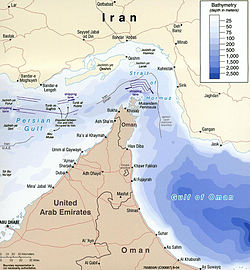
The strait is 34 kilometres (21 mi) wide at its narrowest point, forming a seaway passage between Iran and Oman. Its two unidirectional sea lanes facilitate the transit of around 20 million barrels of oil per day, representing roughly 20% of global seaborne oil trade, primarily from producers like Saudi Arabia, the United Arab Emirates, Iraq, and Qatar.[4][31] In 2024, an estimated 84% of crude oil and condensate shipments through the strait were destined for Asian markets,[2] with China receiving a third of its oil via the strait, and had about a billion barrels in oil reserve (a few months of supply).[32] Europe gets 12% to 14% of its LNG from Qatar, through the strait.[33]
The Persian Gulf is also a major hub for global fertilizer production and exports. In the 2020s the region has accounted for roughly 30% – 35% of global urea exports and around 20% – 30% of ammonia exports. Overall, up to 30% of internationally traded fertilizers normally transit the Strait of Hormuz.[34]
Geopolitical tensions
Tensions between Iran and the United States resulted in the 1988 Operation Praying Mantis, included some European countries in the 2011–2012 Strait of Hormuz dispute, and again in 2019.[35]
Tensions between Iran, the United States, and Israel escalated in the lead-up to 2026, stemming from failed nuclear negotiations in Geneva and a prior 12-day air conflict in 2025.[36] Iran had signaled potential disruptions to the Strait of Hormuz in response to threats, including a temporary partial closure earlier in the month as a warning.[36] From 15 to 20 February, Iran increased its oil export to three times its normal rate and reduced oil storage to reduce risk of disruptions. Saudi Arabia also attempted similar moves.[37] In the days before the strikes, war-risk ship insurance premiums for the strait increased from 0.125% to between 0.2% and 0.4% of the ship insurance value per transit. For very large oil tankers, this is an increase of a quarter of a million dollars.[38][39]
In briefings held before the February 2026 attacks, the Joint Chiefs of Staff warned President Trump that an attack could prompt Iran to close the strait. Trump acknowledged the warnings, but dismissed the possibility, telling his team that Iran would likely capitulate instead of closing the strait, and if they did, the US military could open it again.[40][41]
Escalation
On 28 February 2026, the United States and Israel initiated coordinated airstrikes on Iran under Operation Epic Fury, targeting military facilities, nuclear sites, and leadership, resulting in the death of Supreme Leader Ali Khamenei.[10][39] Iran responded with missile barrages on Israeli cities and US bases in the Gulf, including in the UAE, Qatar, and Bahrain, causing casualties and infrastructure damage.[42][43] The conflict expanded to Lebanon, where Iran-backed Hezbollah launched rockets into Israel, prompting Israeli counterstrikes.[44] On 9 March, Iran declared that they would bring more security passage to the countries that expels US and Israel ambassadors.[45] By 9 March, shipping insurance rates for the strait were reported to have increased by four to six times over the previous week, and the US government began to offer help to insurers under the Terrorism Risk Insurance Act,[46] while continuing to warn commercial shipping against the area.[47] The same day, Trump expressed his intent to seize control of the strait from Iran to keep it open for commercial activity.[48] On 27 March, he reaffirmed his goal in controlling the strait and also expressed interest in renaming it to either the "Strait of America" or the "Strait of Trump", later referencing the latter name in a speech.[49]
Iranian blockade
List of ships attacked by Iran
| # | Date | Name | Flag | Type | Result | Sources |
|---|---|---|---|---|---|---|
| 1 | 1 March 2026 | MT Skylight |  Palau Palau |
Oil tanker | Abandoned; 2 crew killed, including captain | [50][51][52] |
| 2 | 1 March 2026 | MKD VYOM |  Marshall Islands Marshall Islands |
Oil tanker | Abandoned; 1 crew killed | [53][54] |
| – | 1 March 2026 | Sea La Donna[a] |  Liberia Liberia |
Oil/chemical tanker | Unknown | [55] |
| 3 | 1 March 2026 | MT Hercules Star |  Gibraltar Gibraltar |
Oil tanker | Minor damage | [56] |
| 4 | 1 March 2026 | Ocean Electra | Liberia |
Tanker | Minor damage | [57] |
| 5 | 1–2 March 2026 | LCT Ayeh |  United Arab Emirates United Arab Emirates |
Oil tanker | Damaged | [58][59] |
| 6 | 2 March 2026 | Stena Imperative |  United States United States |
Products tanker | Damaged | [60] |
| 7 | 2 March 2026 | Athe Nova |  Honduras Honduras |
Bitumen tanker | Damaged | [61] |
| 8 | 2 March 2026 | Gold Oak |  Panama Panama |
Bulk carrier | Minor damage | [62][63] |
| 9 | 3 March 2026 | Pelagia |  Malta Malta |
Bulk carrier | Unharmed | [64] |
| 10 | 3 March 2026 | Libra Trader | Marshall Islands |
Crude oil tanker | Minor damage | [62][63] |
| 11 | 4 March 2026 | MSC Grace | Liberia |
Container ship | Unharmed | [62] |
| 12 | 4 March 2026 | Safeen Prestige | Malta |
Container ship | Abandoned | [65] |
| 13 | 4 March 2026 | Sonangol Namibe |  Bahamas Bahamas |
Oil tanker | Damaged | [66] |
| 14 | 6 March 2026 | Mussafah 2 | United Arab Emirates |
Tugboat | Sank; 4 crew dead | [67][68][69] |
| – | 7 March 2026 | Prima[b] | Malta |
Oil/chemical tanker | Unknown | [70] |
| – | 7 March 2026 | Louis P[b] | Marshall Islands |
Oil tanker | Unknown | [71] |
| 15 | 10 March 2026 | Unknown | N/A | Bulk carrier | Unharmed | [72] |
| 16 | 11 March 2026 | MV Mayuree Naree |  Thailand Thailand |
Bulk carrier | Aground; 3 crew killed | [73][74][75] |
| 17 | 11 March 2026 | One Majesty |  Japan Japan |
Container ship | Minor damage | [73] |
| 18 | 11 March 2026 | Star Gwyneth | Marshall Islands |
Bulk carrier | Damaged | [76] |
| – | 11 March 2026 | Express Rome[b] | Liberia |
Container ship | Unknown | [77] |
| 19 | 11 March 2026 | Safesea Vishnu | Marshall Islands |
Oil tanker | Set ablaze; abandoned; 1 crew killed | [78][79] |
| 20 | 11 March 2026 | Zefyros | Malta |
Oil tanker | Set ablaze; abandoned | [78] |
| 21 | 12 March 2026 | Source Blessing | Liberia |
Container ship | Minor damage | [80] |
| 22 | 17 March 2026 | Gas Al Ahmadiah |  Kuwait Kuwait |
Tanker | Minor damage | [81] |
| 23 | 18 March 2026 | Parimal | Palau |
Chemical tanker | Abandoned; captain missing | [82][83] |
| 24 | 19 March 2026 | Halul 69 |  Qatar Qatar |
Offshore vessel | Minor damage | [83] |
| 25 | 21 March 2026 | Unknown | N/A | Bulk carrier | Unknown | [84] |
| 26 | 30 March 2026 | Express Rome | Liberia |
Container ship | Unharmed | [85] |
| 27 | 31 March 2026 | Al Salmi | Kuwait |
Oil tanker | Damaged | [86] |
| 28 | 1 April 2026 | Aqua 1 | Panama |
Oil tanker | Damaged | [87] |
| – | 4 April 2026 | MSC Ishyka[b] | Liberia |
Container ship | Unknown | [88][89] |
| 29 | 18 April 2026 | Sanmar Herald |  India India |
Tanker | Unharmed | [90][91] |
| 30 | 18 April 2026 | CMA CGM Everglade |  France France |
Container ship | Damaged | [90][92] |
| 31 | 18 April 2026 | Mein Schiff 4 | Malta |
Cruise ship | Unharmed and escaped with 5 other cruise ships[which?] | [93][94] |
| 32 | 22 April 2026 | Epaminondas | Liberia |
Container ship | Captured | [95] |
| 33 | 22 April 2026 | MSC Francesca | Panama |
Container ship | Captured | [95] |
| 34 | 22 April 2026 | Euphoria | Panama |
Container ship | Unharmed | [95][96] |
Footnotes:
Tools for closure
Iran uses four methods of restricting traffic in the strait. Attacks from boats, missiles and drones are the physical way of keeping ships away.[97] Iran has laid mines as a hidden threat which could be anywhere.[98][99] Satellite spoofing and GNSS jamming makes navigation harder.[38] These three methods are easy to use and difficult to oppose, and drastically increase insurance cost,[100] preventing most shipowners from taking the risk of sailing through for a long time.[97]
Timeline
Within hours of the strikes, the IRGC transmitted warnings via VHF radio to vessels in the strait, stating that no ships would be permitted to pass.[2][5][101] Although the closure is not legally binding as Iran did not formally declare a blockade, military and industry sources say that safety cannot be guaranteed, and several ships stayed in port or turned back.[102] The threats led to a partial closure, with ship-tracking data first showing a 70% reduction in traffic.[4]
On 1 March, the oil tanker Skylight was struck by a projectile north of Khasab, Oman, killing two Indian crew members and injuring three others. The rest of its 20 crew evacuated. It was sanctioned by the US Department of Treasury for links to the Iranian shadow fleet. The MKD VYOM was struck by a drone boat, sparking a fire and an explosion in its engine room. An Indian sailor was killed, and its 21 crew evacuated on the Panama-flagged MV SAND.[53] Another Indian was critically wounded on the LCT Ayeh.[50][51]
On 2 March 2026, a senior official in the IRGC officially confirmed that the strait was closed, subsequently threatening any ship that passed through it.[103] The US-flagged Stena Imperative was struck twice at the port of Bahrain, causing a fire.[60] A port worker was killed and two others were hurt in the attack, although the ship's crew were unharmed.[104] The Athe Nova, which has links to Iran, was struck by two drones after attempting to illegally cross the Strait of Hormuz, according to the IRGC-linked Tasnim News Agency.[61]
Just after midnight on 2 March, no tankers in the strait broadcast automatic identification system signals, indicating low or no traffic,[100] however, with unreliable data and satellite navigation device basis.[38][105] Protection and indemnity insurance is critical for shipping. Its war risk was removed for 5 March, making the economic risk too high for ship owners to use the strait. The strait was declared a high-risk zone, yielding extra pay and the right of refusal for the crew. The strait remained technically open, but effectively closed.[100]
On 4 March, the IRGC claimed that they had achieved complete control of the strait.[106] By then, at least eight vessels had been damaged. A Malta-flagged ship, Safeen Prestige, was struck, forcing its crew to evacuate. Meanwhile, the Pola, which had earlier turned its AIS transponder off, managed to pass through the strait and deliver its cargo to the UAE, despite the blockade.[63] In the late night, a large explosion caused by a sea drone[107] struck the oil tanker Sonangol Namibe, which was anchored near Mubarak Al Kabeer Port in Kuwait more than 800 kilometres (500 mi) from the strait, representing a significant expansion of the conflict. The attack caused an oil spill that posed an environmental risk. A small vessel was observed leaving the scene following the attack.[66][108] The IRGC said that it hit a US oil tanker.[109] On 6 March, a tugboat dispatched to assist the Safeen Prestige was struck by two missiles and later sank, leaving at least three crew members missing.[67][68] On 7 March, the IRGC claimed that it hit the oil tanker Prima with a drone in the Persian Gulf,[70] and a US oil tanker, the Louis P, with a drone in the Strait of Hormuz.[71]
On 10 March, a bulk carrier reported a nearby splash followed by an explosion 36 nautical miles (67 km; 41 mi) off Abu Dhabi, in the first reported maritime incident in days.[110] Also that day, US military intelligence sources reported that Iran had begun planting naval mines in the Strait of Hormuz. Following the reports, US president Donald Trump demanded that Iran should immediately remove any mines it had planted, and the US military said it destroyed 16 Iranian minelayers.[98][111] A large wave of attacks on ships was carried out on 11 March, with at least three vessels sustaining damage.[73] Twenty crew members of the Thailand-flagged Mayuree Naree were rescued by the Royal Navy of Oman after the vessel caught fire, while three others were missing[112] and later confirmed dead.[75] An unverified attack was also claimed by the IRGC on the Express Rome.[77] Later that day, two oil tankers were attacked by an Iranian drone boat off the Port of Basra, Iraq, setting them on fire and killing at least one crew member. The State Company for Iraqi Ports rescued 38 crew members aboard both vessels.[113]
By 12 March, the UKMTO had received reports of 16 attacks on shipping and four 'suspicious incidents' in the Persian Gulf since the start of hostilities.[114] On 17 March, Kuwait-flagged liquified petroleum tanker Gas Al Ahmadiah was hit by a projectile while anchored east of Fujairah, causing minor damage.[81] The following day, Palau-flagged chemical tanker Parimal was struck east of Khor Fakkan, sparking a fire.[115][82] Fifteen of its crew were evacuated onto a Cook Islands-flagged tanker, although the captain was reported missing. On 19 March, Qatar-flagged offshore vessel Halul 69 was hit by debris off Ras Laffan Industrial City, damaging the bridge window.[83] On 21 March, a projectile exploded in the vicinity of an unidentified bulk carrier 15 nautical miles north of Sharjah, although no injuries were reported.[84]
On 26 March, Israeli defense minister Israel Katz said that Iranian navy commander Alireza Tangsiri was killed in an airstrike, accusing him of being directly responsible for the Strait of Hormuz closure.[116]
On 27 March, Mayuree Naree went aground on Qeshm Island.[117] The IRGC Navy also turned away three container ships from passing through the strait. The IRGC announced that movement through the strait for any vessel going "to and from" the ports of the US, Israel, and their allies is prohibited.[6] On 30 March, the Liberia-flagged container ship Express Rome reported that two projectiles splashed in the water nearby the ship within one hour, 22 nautical miles northeast of Ras Tanura, Saudi Arabia. No injuries or damage were reported.[85][118] Early on 31 March, Kuwaiti Very Large Crude Carrier Al Salmi was struck by an Iranian drone while anchored at the Port of Dubai, causing a fire. The vessel was at full capacity at the time, and the Kuwait Petroleum Corporation warned of an oil spill.[86][119] The fire was later contained, and no oil leak was reported.[120]
On 1 April, QatarEnergy owned oil tanker Aqua 1 was attacker by two projectiles north of Doha, causing a fire that was extinguished.[87] The IRGC claimed that the tanker was Israeli.[121] On 4 April, the IRGC claimed that it attacked the MSC Ishyka with a drone in the Strait of Hormuz, claiming it was linked to Israel. The attack was not verified.[89]
On 18 April, Iran said that it closed the Strait of Hormuz after threatening to do so in response to the US blockade of Iran.[122] Two Indian-flagged ships were targeted by gunfire in the strait and forced to turn back,[123] with the VLCC Sanmar Herald coming under fire from two Iranian gunboats despite receiving prior clearance to pass. Later, a container ship reported damage from a rocket attack off the coast of Oman; no fires or injuries were caused.[90] The vessel was later identified by French company CMA CGM as the CMA CGM Everglade.[92] The cruise ship Mein Schiff 4 reported a nearby splash while off Oman. The master said that the IRGC threatened to fire at and destroy the ship via VHF radio.[93]
On 22 April, an Iranian gunboat attacked the Greek-owned cargo ship Epaminondas off the coast of Oman, despite earlier giving it permission to cross the strait. The attack, consisting of gunfire and rocket-propelled grenades, caused significant damage to the bridge.[124] Another ship, MSC Francesca, was targeted off the coast of Iran and instructed to drop anchor, with damage occurring to its hull and accommodation.[125] Iran said that the ships ignored its warnings and were seized by the IRGC. The Greek Ministry of Shipping initially denied that the Epaminondas was captured, stating that it received extensive damage, but the ship's manager, Technomar, later confirmed that it was seized.[96][126] A third ship, the Euphoria, was targeted, with Iranian media reporting that it became "stranded on the Iranian coast".[95] It was later reported that the vessel was undamaged and resumed sailing after the attack.[96]
On 23 April, Trump ordered the US Navy to destroy any Iranian boats laying mines in the strait.[127]
Exceptions to the blockade
On 4 March, reports emerged that Iran would allow only Chinese vessels to pass through the strait, citing China's supportive stance towards Iran since the conflict intensified. China is the largest buyer of Iranian oil, and had stressed the importance of protecting global shipping routes.[128][129] Subsequently, on 5 March, the bulk carrier Iron Maiden, operated by Cetus Maritime Shanghai Ltd., transited the strait while signalling "CHINA OWNER". Earlier, the LPG tanker Bogazici had broadcast that it was a Muslim-owned and Turkish-operated vessel, and successfully passed through.[130] On 7 March, another bulk carrier, the Liberia-flagged Sino Ocean, broadcast its Chinese-owned-and-operated status to transit the strait after picking up its cargo from the UAE's Mina Saqr port.[131]
On 5 March, the IRGC announced that Iran would keep the Strait of Hormuz closed only to ships from the US, Israel and their Western allies. This was confirmed again on 8 March.[132][133] On 13 March, Turkish transport minister Abdulkadir Uraloğlu said that Iran approved the passage of a Turkish ship through the strait.[134] It was also reported that two Indian-flagged gas carriers and a Saudi oil tanker with 1 million barrels for India[135] were allowed to pass, as were several other ships.[136][137]
Between 14 and 24 March 5 Indian-flagged LPG carriers were evacuated from the Strait of Hormuz in three different occasions. They were escorted by Indian Navy warships through the Gulf of Oman after they crossed Hormuz under Operation Sankalp.[138][139][140]
On 26 March, the Foreign Minister of Iran, Abbas Araghchi, announced that ships owned by five nations, including China, Russia, India, Iraq and Pakistan, would be allowed to transit the Strait of Hormuz.[141] In addition, Malaysian and Thai vessels were granted access through the strait after successful talks with the President of Iran, Masoud Pezeshkian and Iran’s ambassador to Thailand respectively.[142] Iran also agreed to a request by the UN to allow humanitarian and fertilizer shipments through the strait on 27 March, to address the disruption to the fertilizer supply during the spring planting season.[143] On 2 April, Iran said it will allow Philippine-flagged vessels and Filipino seafarers to cross the strait following talks.[144][145][146] Russian superyacht Nord, owned by billionaire Alexey Mordashov, crossed out of the gulf on April 25 without trouble from the Iranian or American navies.[147]
Bypassing and escorting
The Iranian area of the strait is theoretically avoidable through the territorial waters of Oman and the UAE on the south. In particular, Oman's deep-water ports of Duqm, Salalah and Sohar in the Arabian Sea outside the strait allow tankers to bypass the choke point.[148] However, in March 2026 several drones struck Duqm and Salalah, with at least one fuel storage tank in Duqm damaged.[148] Sohar, in turn, fell within an insurer's war risk area, potentially increasing charter and insurance costs for ships.[148] The Joint War Committee of the London insurance market included waters around Oman into its list of high-risk maritime areas.[148]
As of 10 March, Saudi Arabia increasingly diverted oil to the Red Sea port of Yanbu via the East–West Crude Oil Pipeline, which runs from the eastern oil fields, while the UAE diverted oil via the Abu Dhabi Crude Oil Pipeline to the port of Fujairah on the Arabian Sea.[149][150] Iraq has an alternative route in the form of the Kirkuk–Ceyhan Oil Pipeline, going to the Mediterranean coast through Turkey.[151] The combined capacity of these pipelines is about 9 million barrels per day, less than the roughly 20 million barrels per day that can pass through the strait.[151][152] The Red Sea route is also vulnerable to possible Houthi attacks.[149]
In the short term, it is possible to escort 3–4 commercial ships a day with 7–8 destroyers providing air cover, depending on the risk from Iranian midget submarines;[153] however, doing so sustainably for months requires more resources.[154] India and Pakistan sent destroyers to escort tankers in the Gulf of Oman, although not in the Strait of Hormuz.[155] The Indian Navy is executing Operation Urja Suraksha as of 25 March under which over five frontline warships, including destroyers and frigates, were deployed to the region to escort over 20 Indian flagged cargo ships that are on the west of Hormuz.[156][157] On 11 April, it was reported that the US navy had begun an operation to clear naval mines laid by Iran during the war.[158][159]
United States blockade
On 11 April, Trump said that American forces had started "clearing" the strait.[160] Iran claimed that an American vessel on its way to the strait turned back after a warning.[161] The Wall Street Journal reported that several US Navy destroyers entered the Strait of Hormuz for the first time since the war began. A US official described it as an "operation that focused on freedom of navigation through International waters". Iran reportedly threatened to attack the ships, accusing the US of a ceasefire violation.[162][163] US Central Command said the ships were taking part in mine clearance operations.[164] According to one report, Iran lost track of mines it planted in the Strait of Hormuz, and it is therefore unable to fully open the strait.[165] On April 12, JD Vance announced that the talks between the US and Iran had failed.[166] Afterwards, Trump declared a US naval blockade of the Strait of Hormuz, announcing that the US Navy will prevent ships from entering or exiting the strait and intercept ships that have paid tolls to Iran.[167] CENTCOM clarified that the blockade will be enforced on all ships entering or leaving Iranian ports and coastal areas but "will not impede freedom of navigation for vessels transiting the Strait of Hormuz to and from non-Iranian ports."[168] The IRGC Navy said that any military vessel approaching the strait would be considered a ceasefire violation and would meet a "severe response."[169]
List of ships attacked by the United States
| # | Date | Name | Flag | Type | Result | Sources |
|---|---|---|---|---|---|---|
| 1 | 4 April 2026 | IRIS Dena |  Iran Iran |
Iranian Navy frigate | Sunk; Torpedoed by the USS Charlotte off Sri Lanka after finishing exercises under Indian naval operations. 104 Iranian sailors killed, 32 rescued. | [170] |
| 2 | April 2026 | Deep Sea | Iran |
Oil tanker | Captured; Intercepted off Malaysia. | [171] |
| 3 | 20 April 2026 | Dorena | Iran |
Supertanker | Captured; Intercepted off southern India. | [172][173] |
| 4 | April 2026 | Sevin | Iran |
Oil tanker | Captured; Intercepted off Malaysia. | [174] |
| 5 | April 2026 | Derya | Iran |
Oil tanker | Captured; Intercepted off western India. | [175] |
| 6 | 21 April 2026 | Tifani |  Botswana[176] Botswana[176] |
Supertanker | Captured; Intercepted in the Indian Ocean. | [177] |
| 7 | 22 April 2026 | M/T Majestic X |  Guyana[178] Guyana[178] |
Oil tanker | Captured; Intercepted in the Indian Ocean. | [179] |
| 8 | 24 April 2026 | Unknown | Iran |
Oil tanker | Captured; Intercepted in the Persian Gulf by USS Rafael Peralta, according to CENTCOM. | [180] |
| 9 | 25 April 2026 | M/V Sevan | Panama |
Propane and butane carrier | Captured; Intercepted in the Arabian Sea by an U.S. Navy helicopter with USS Pinckney. | [181] |
Impacts
Passage through the strait

Late on 28 February, outgoing traffic through the Strait of Hormuz was heavy, while incoming traffic was light.[183] At least three tankers were struck near the strait, including one off Oman that was set ablaze.[9][184] At least 17 oil tankers continued travelling through the strait.[185] On 1 and 2 March, no ships appeared in the strait.[100] Major container shipping companies, including Maersk, CMA CGM, and Hapag-Lloyd, suspended transits through the strait and related routes such as the Red Sea.[186][187] Houthi-controlled Yemen announced on 28 February that it would resume attacks on Israel and commercial ships in the Red Sea,[188] forcing Suez Canal traffic to be rerouted around Africa's Cape of Good Hope. This added weeks to transit times and increased shipping costs. The crisis disrupted global energy supplies and stranded tankers in the Persian Gulf.[189]
Cruise ships reduced activity in the Persian Gulf and stopped using the strait,[190] stranding 15,000 passengers on at least six major cruise ships: Saudi-based cruise line Aroya Cruises' eponymous Aroya; two ships owned by Celestyal Cruises, Celestyal Discovery and Celestyal Journey; MSC Euribia of MSC Cruises; and two TUI Cruises ships, Mein Schiff 4 and Mein Schiff 5.[191] On 15 March, an Iranian commander said that Iran would continue to use the Strait of Hormuz as a pressure point.[192] Several ships have passed the strait during the conflict, mostly petroleum ships bound for China and India.[137] On 16 March, a Pakistani oil tanker crossed the Strait of Hormuz with Iranian permission.[193] Iran set up its own shipping channel, north of Larak Island rather than the main channel south of the island. One ship paid $2 million to use Iran's channel.[194] Unaffected by the war, 20 Iranian vessels per day used the Iranian port of Bandar Abbas.[195] On 26 March, Malaysia said that Iran allowed its ships to pass through the strait.[196] According to Lloyd's List, payments were being assessed by the Iranian Revolutionary Guards in Chinese yuan.[197]
On 3 April, a French ship crossed the Strait of Hormuz.[198]
On 9 April, there was no sign that a recent agreement to lift the Iranian blockade of Strait of Hormuz was being implemented, with ships once again being prevented from passing through the strait.[199] Abu Dhabi National Oil Company CEO Sultan Al Jaber said on that day that the strait was still not open, despite the Iran war ceasefire, because Iran is restricting and conditioning traffic. He added that 230 loaded oil tankers are waiting inside the Gulf.[200]
Around 18 April, during a brief time window where both Iran and United States claimed the Strait was open, all six cruise ships sailed from the Persian Gulf through the Strait, into the Arabian Sea and beyond, resuming their commercial schedule elsewhere.[201][94]
On 19 April, Mohammad Rezaei-Kouchi, head of the Iranian parliament’s construction committee, said that the Iranian parliament was planning to pass a law that boats from "hostile" countries cannot pass the Strait, and that all others will need to pay tolls.[202] By 20 April, traffic through the Strait had dropped sharply again, as on 1 March.[203]
The International Maritime Organization reported on 21 April that about 20,000 mariners and 2,000 ships remain stranded in the Persian Gulf because of the closure.[7]
While passage through the strait is curtailed, small boat, particularly speedboat, commercial traffic across the strait continues.[204]
Global economy


The restriction of shipments by more than 90% (around 10 million barrels per day of oil production) raised energy and agricultural input costs worldwide.[34] Roughly 20% of the world's oil and natural gas normally passes through the strait, and the disruptions caused Brent crude prices to jump 10–13% in early trading, with analysts warning they could reach $100 per barrel or higher if disruptions persist.[206][9][207] The spike in prices is especially problematic in Asia, where major importers like China and India could face supply shortages and price volatility.[208] Natural gas prices in Europe also surged, rising from €30/MWh the past week, to €46/MWh on Monday, 2 March,[33] peaking above €60/MWh on Tuesday, 3 March (nearly double from previous week),[209] before decreasing again to €48/MWh on Wednesday, 4 March.[210][34] The shipping disruption contributed to volatility in United Kingdom energy markets, with analysts warning that wholesale gas price increases could raise household energy bills and expose the country's reliance on global fuel markets.[211]
The crisis has been described as the largest disruption to the energy supply since the 1970s oil crises[13] and the largest in the history of the global oil market.[14] Analysts from institutions like Barclays and Goldman Sachs highlighted risks of sustained high oil prices if the strait is restricted over a longer period.[39][10] The disruptions also raised concerns over inflation and potential economic downturns in oil-importing nations.[212]
OPEC+ pledged to increase oil output by 206,000 barrels per day to mitigate shortages.[9] Due to rising tensions in the Middle East, Japanese refiners have asked the government to release some of their stockpiled oil. The refiners obtain about 95% of their crude oil from Saudi Arabia, Kuwait, the United Arab Emirates, and Qatar. About 70% of this Middle Eastern oil is delivered to Japan by ships that pass through the Strait of Hormuz.[213] On 4 March, Pakistan, a country reliant on imported oil that was looking for alternative shipment routes due to the closure, officially requested that Saudi Arabia reroute oil supplies through port of Yanbu on the Red Sea, with Saudi Arabia providing assurances and arranging at least one crude shipment to bypass the closed strait. Saudi authorities also diverted some of their own crude exports via Yanbu to reduce the impact.[214]
On 3 March, Iraq started shutting down operations at the Rumaila oil field due to a lack of storage space, as tankers were unable to leave the strait.[215] On 6 March, Qatari Energy Minister Saad Sherida al-Kaabi warned that if the war continues, other Gulf energy producers may be forced to halt exports and declare force majeure, and that "this will bring down economies of the world". QatarEnergy had already stopped gas production on 2 March and declared force majeure on gas contracts on 4 March.[216][217] On 7 March, the Kuwait Petroleum Corporation declared force majeure and announced that it would be cutting its oil production.[218][152] Bahrain's Bapco Energies declared force majeure[152] and the United Arab Emirates lowered its oil production.[11] As of 8 March, production at the three main oil fields in southern Iraq had dropped by 70% since the start of the war, from 4.3 million barrels per day to 1.3 million.[11] As of 12 March the Gulf Arab states cut their production by at least 10 million barrels per day. On 13 March, Saudi Arabia reduced its oil production by 20%, from 10 million barrels per day to 8 million, after the shutdown of two of Saudi Aramco's offshore fields, including Safaniya.[219] The missing oil is mostly Medium and Heavy grades, which some Asian refineries depend on and cannot easily switch to lighter grades.[220] Oil exports from the region were 25 million barrels per day before the war, dropping 60% to around 10 million by 15 March.[221] Iraq declared force majeure on "all oilfields developed by foreign oil companies" on 17 March.[222]

On 8 March, crude oil prices surpassed US$100 per barrel for the first time in four years, since the 2022 Russian invasion of Ukraine, and reached a high of $126.[11] The price surge was faster than during any other conflict in recent history, such as the Ukraine war, the Gulf War, or the Iraq War.[8] On 11 March, the 32 International Energy Agency member states unanimously agreed to release 400 million barrels of oil, representing about four days worth of global consumption, from their emergency reserves.[223][34] The US enacted a suspension of the embargo of Russian oil during the Russo-Ukrainian war until 11 April for 30 Russia-connected petroleum tankers in Asia, carrying 19 million barrels of oil.[224] The crisis has also led to a slight increase in the number of ships traversing the Panama Canal.[225] In the second week of March, California's gasoline prices exceeded $5 per gallon due to the United States' conflict with Iran.[226] On 19 March, Dubai crude oil prices reached US$166, their highest on record.[227] On 23 March, in response to President Trump's comments on US–Iranian negotiations, Brent crude prices fell from US$114 to US$102 per barrel.[228] On 27 March, Brent crude increased to US$114 per barrel, after negotiations did not produce a ceasefire and the IRGC declared the strait to be closed.[229][230]
Industry
The US defense industry is affected by "near total" disruption of critical minerals supply, in particular sulfur, through the strait.[231] In face of sulfuric acid scarcity, China has banned exports impacting among other things copper production in Chile which imported sulfuric acid as consumable.[232] Aluminum prices experienced a slight increase, as the Gulf states account of 20% of raw aluminum exports and 8% of aluminum production.[16] Roughly one-third of the world's helium production is impacted by the crisis, due to both the disruption of natural gas production in Qatar and the very time-sensitve nature of helium transportation. Helium distributors are rationing deliveries as of early April.[17]
The Gulf region also produces nearly half of the world's urea and 30% of ammonia, with about one-third of the world's fertilizer passing through the strait.[16] Urea prices increased by 50% since the start of the war, as of late March 2026,[16] while other fertilizer prices, such as diammonium phosphate, also rose.[34] The LNG disruption is also a problem for the production of fertilizer, impacting the agriculture industry in the Northern Hemisphere. The price shock and the shortage of fertilizer during the spring planting season could reduce the planting and yields of corn in the US—the main feed stock for US beef, poultry, and dairy—and potentially increase global food prices into 2027.[16] Unlike oil, the fertilizer sector does not have internationally coordinated strategic reserves, making supply disruptions more difficult to manage. It is estimated that global fertilizer prices could average 15–20% higher during the first half of 2026 if the crisis continues.[34]
International responses
On 3 March, US president Donald Trump said that the US Navy would begin to escort tankers through the strait "as soon as possible".[233] On 22 March, Trump threatened to 'obliterate' Iranian power plants if they do not completely open the strait without 48 hours.[234] In response, the Iranian defense council threatened to lay mines throughout the Persian Gulf.[235] On 23 March, Trump postponed the ultimatum, citing "very good and productive conversations" with Iran.[236] On 30 March, Trump threatened to strike Iranian energy infrastructure if they do not reopen the strait.[237] On 31 March, Trump told countries that were having trouble getting fuel due to the closer to fend for themselves, saying that the US would not help them.[238] On 4 April, Trump reasserted the ultimatum, giving Iran another 48 hours to open the Strait or "face hell."[239] Trump later extended the ultimatum by one day, until 7 April at 8:00 p.m. Eastern Time.[240]
Iran denied having conducted any negotiations with Trump.[236] The state affiliated Tasnim news agency insisted that the strait would not return to pre-war levels of travel,[241] and it also suggested that the negotiations were an effort to sow discord within Iran.[242] At the same time, the Iranian Foreign Ministry acknowledged that it was reviewing a proposal it received from the United States.[243] According to an analysis in Iran International, Trump's statements succeeding in lowering oil prices while also "fracturing" the Iranian regime.[244]
On 7 April, US Ambassador to the United Nations Mike Waltz said that "no country gets to hold the world hostage for leverage just because they happen to sit next to a strait."[245]
On 7 March, the Indian Government proposed to deploy the Indian Navy to safeguard the oil supplies it receives.[246] On 9 March, French president Emmanuel Macron announced that France and several other states are setting up a "purely defensive, purely support" escort mission for merchant ships transiting the strait, in the framework of Operation Aspides, and that France is sending a dozen ships to the wider Middle East. The French Navy vowed to send two frigates to escort vessels through the strait.[247][248] As of 10 March, Britain, along with Germany and Italy, are working to support commercial shipping through the Strait of Hormuz.[249] Also on that day, US chairman of the Joint Chiefs of Staff General Dan Caine said that the US military was looking at a "range of options" for restoring tanker traffic.[250] The US sent the 31st Marine Expeditionary Unit to the region, where they are expected to try to secure the Strait of Hormuz.[251]

On 11 March, the G7 nations agreed to look into the possibility of escorting ships through the strait.[252] US Energy Secretary Chris Wright on 12 March said that the US Navy may be able to start escorting ships through the strait by the end of March, with the military still focused on "destroying Iran's offensive capabilities and the manufacturing industry that supplies their offensive capabilities."[233] On 15 March, British energy secretary Ed Miliband said that the UK was considering "any options" to secure the Strait of Hormuz.[253] Later that day, British prime minister Keir Starmer held phone conversations with US president Donald Trump and Canadian prime minister Mark Carney to discuss the possibility of opening the Strait of Hormuz.[254] British finance minister Rachel Reeves said that the lack of a plan for opening the strait is "frustrating."[255]
On 16 March, an Australian government minister stated that Australia would not send ships to the strait.[256] On the same day, Japan's Prime Minister Sanae Takaichi also ruled out any current plans to send Japanese navy ships to help escort oil tankers through the strait.[256][257] European Union foreign policy chief Kaja Kallas said that the EU was exploring the possibility of expanding the scope of its existing naval missions, Aspides and Atalanta, or establishing a framework for the strait similar to the Black Sea Grain Initiative.[258] She called for a diplomatic solution to the crisis.[259] Several EU members ruled out military involvement in the crisis: Germany,[260] Italy, Luxembourg, Romania,[258] Spain,[261] and the United Kingdom.[258] France emphasized that a naval escort mission would only take place when the war is over, with French officials saying that Greece, Italy and the Netherlands have shown interest in such a mission.[260] Also on 16 March, US Treasury Secretary Scott Bessent said that for now the United States is happy with the increasing number of ships transiting the strait.[262]
On 17 March, the Iraqi oil minister said that they are in contact with Iran to negotiate allowing ships to pass.[263] On 19 March, France, Germany, Italy, the Netherlands, the United Kingdom, and Japan announced in a joint statement that they are ready to participate in efforts to reopen the strait. On the same day, a meeting of EU leaders failed to reach an agreement on the subject, with a lack of support for expanding the European Union Naval Force in the Red Sea to cover the strait.[264][265] The joint statement on securing the strait was joined by other countries by 21 March, including: the UAE, Bahrain, Canada, South Korea, New Zealand, Denmark, Latvia, Slovenia, Estonia, Norway, Sweden, Finland, Czech Republic, Romania, Lithuania, and Australia.[266][267]
On 21 March, UN Secretary General António Guterres called for the strait to be opened, and suggested that the UN could help secure it.[268] China stated that the war should not have started, and criticised Iran for attacking other countries in the area.[269] On 29 March, Pakistan hosted a meeting with Egypt, Saudi Arabia, and Turkey, to discuss reopening the Strait of Hormuz.[270] On 30 March, Scott Bessent said that the US would gradually "take control" over the Strait of Hormuz.[271]
On 30 March, President Volodymyr Zelensky offered Ukraine's expertise to unblock the strait. Ukraine has managed to keep its ports open by creating a safe corridor through the Black Sea despite constant Russian attacks. Ukrainian strategy includes sharing insurance costs with providers as well as using a combination of armed surface drones, coastal artillery, and air force to repel Russian attacks.[272][273] On 5 April, French president Emmanuel Macron and South Korean president Lee Jae Myung agreed to work together towards opening the Strait of Hormuz.[274] Also on 5 April, the UAE said that it would support a US military operation to take control of the Strait of Hormuz.[275]
On 4 April, the vote on Bahrain's proposal at the UN Security Council calling on states to ensure safety in the strait is uncertain because of divisions among major powers. While many countries support keeping the Strait of Hormuz open for global shipping, countries like Russia and China are concerned the resolution could justify military action near Iran and risk escalation, even though Bahrain had already weakened the proposal by removing stronger language that allowed force. The disagreement remains as Russia and China have veto power.[276][277] On 7 April, Russia and China vetoed Bahrain's proposal, saying that it was biased against Iran and that it was the wrong message to send after the US president's recent statement threatening the survival of a civilization. Their decision was praised by the Iranian ambassador, and condemned by the US and French ambassadors.[278]
On 9 April, UK Foreign Secretary Yvette Cooper rejected the idea that Iran could charge tolls to ships transiting the Strait.[279] On 10 April, Prime Minister Keir Starmer said that he and President Trump discussed assembling a political and diplomatic coalition for reopening the Strait of Hormuz on a phone call the previous day, and that they also spoke about military options.[280]
On 12 April, a UK government spokesperson said that the UK is working with France and others to ensure that ships can pass through the Strait.[281] The next day, French president Emmanuel Macron said that he was organizing a conference with the British to discuss a strategy.[282] On 14 April, French president Emmanuel Macron and British prime minister Keir Starmer announced that they are holding an online meeting on 17 April for countries interested in being involved in a "defensive multilateral mission" to maintaining the Strait of Hormuz open.[283] On 13 April, Admiral Mark Hammond said that the Australian navy is ready to open the Strait if the government decides that they should do so.[284] On 16 April, Canada condemned Iran's attacks and said that it is important to keep th eStrait of Hormuz open.[285] While the efforts by the U.S. were occurring to re-open the Straits of Hormuz waterway, China moved to block the Scarborough Shoal in the South China Sea.[286] On 21 April, during a call with Saudi Crown Prince Mohammed bin Salman, Chinese leader Xi Jinping said "The Strait of Hormuz should remain open to normal navigation, which is in the common interest of regional countries and the international community".[287] On 22-23 April, the United Kingdom is hosted a conference of 50 countries about a plan to re-open the Strait.[288]
International law
The potential closure of the Strait of Hormuz is, according to some analysts, a violation of international law. According to Majid Rafizadeh, the blocking of the strait by Iran amounts to a violation of the UN Convention on the Law of the Sea (UNCLOS), since it violates the right to transit passage through a "strait used for international navigation".[289][290] The placement of sea mines in the strait by Iran is seen by Just Security as a violation of the law of the sea, violating the Hague VIII convention.[291]
The UNCLOS regime of innocent passage through territorial waters prohibits imposing a fee on passing ships, unless they receive specific services.[292] However, UNCLOS also says that "every State has the right to establish the breadth of its territorial sea up to a limit not exceeding 12 nautical miles."[293]
Scrapped opening of the Strait
On 17 April, Iran's foreign minister Abbas Araghchi announced that the Strait of Hormuz was open to all shipping traffic. Iran said that the strait would remain open for the duration of the ceasefire in Lebanon.[294] Following the announcement, oil prices dropped sharply, losing 11% in the immediate aftermath of the announcement.[295] Although the strait has been declared to be open, commercial traffic is unlikely to return to pre-war levels immediately after the ceasefire.[296] Shortly after this announcement, President Trump made a Truth Social post, saying that the strait is completely open, but that the US naval blockade will remain until negotiations with Iran have concluded.[297] On 18 April, Iran said that it closed the Strait of Hormuz again in response to the US refusing to lift its naval blockade.[298]
Islands near the Strait of Hormuz

- Qeshm
- Hormuz
- Hengam
- Larak
- Siri Island
- Faror Island
- Abu Musa (Administered by Iran, claimed by Iran and the United Arab Emirates)
- Greater and Lesser Tunbs (Administered by Iran, claimed by Iran and the United Arab Emirates)[299]
- Quoin Islands (claimed by Oman)
- Umm al-Fayyarin (claimed by Oman)
See also
- Closure of the Suez Canal (1967–1975)
- Economic impact of the 2026 Iran war
- Elphinstone Inlet
- European Maritime Awareness in the Strait of Hormuz
- Red Sea crisis
- Tanker war
- American expansionism under Donald Trump
- Energy transition
- Trump Always Chickens Out
References
- ^ "Crew member killed after projectile hits tanker off Oman, manager says". CNA. Archived from the original on 1 March 2026. Retrieved 2 March 2026.
- ^ a b c "How US-Israel attacks on Iran threaten the Strait of Hormuz, oil markets". Al Jazeera. 1 March 2026. Retrieved 2 March 2026.
- ^ "Oil and gas majors and traders suspend shipments via Hormuz, sources say". Reuters. 28 February 2026. Retrieved 2 March 2026.
- ^ a b c Triebert, Christiaan and Cardia, Alexander (28 February 2026). "After Iran Attacks, Ship Traffic Plummets in Strait of Hormuz". The New York Times. Retrieved 2 March 2026.
- ^ a b c "Oil prices rise as Iran war threatens shipping through strait of Hormuz". The Guardian. 2 March 2026. Retrieved 2 March 2026.
- ^ a b "Iran says Hormuz closed for shipping to and from 'enemy' ports". Agence France Press via South China Morning Post. 27 March 2026. Retrieved 27 March 2026.
- ^ a b "UN maritime agency urges help for seafarers stranded in Gulf". Al Jazeera. 21 April 2026. Retrieved 21 April 2026.
- ^ a b Lipsky, Josh; Piasecki, Bart; Yin, Jessie (18 March 2026). "The Iran oil shock may be diffrent from other price spikes". Atlantic Council. Retrieved 18 March 2026.
- ^ a b c d "Oil jumps 10% on Iran conflict and could spike to $100 a barrel, analysts say". Reuters. 1 March 2026. Retrieved 2 March 2026.
- ^ a b c "Oil surges and stock futures sink after war in Iran disrupts crude supply". CNN. 1 March 2026. Archived from the original on 2 March 2026. Retrieved 2 March 2026.
- ^ a b c d Kimball, Spencer (8 March 2026). "Oil surges above $100 a barrel; Trump says 'small price to pay' for defeating Iran". CNBC. Archived from the original on 8 March 2026. Retrieved 8 March 2026.
- ^ Sheen, Mike; Shan, Lee Ying (14 April 2026). "Oil falls as IEA predicts 'demand destruction will spread' and hopes for fresh Iran talks grow". CNBC. Retrieved 14 April 2026.
- ^ a b Burke, Jason (11 March 2026). "Iran escalates attacks on infrastructure and transport networks across the Gulf". The Guardian. Retrieved 11 March 2026.
- ^ a b Karma, Rogé (13 March 2026). "'We Would Be Entering a Completely Different World'". The Atlantic. Retrieved 13 March 2026.
- ^ Burton, Mark (15 March 2026). "Bahrain starts output cuts at world's top aluminum smelter". Fortune. Retrieved 21 March 2026.
- ^ a b c d e Gomez Horta, Eduardo; Mohseni-Cheraghlou, Amin (27 March 2026). "The Iran war's economic fallout won't stop at oil—agriculture and aluminum are next". Atlantic Council. Retrieved 27 March 2026.
- ^ a b Lotz, Avery (7 April 2026). "Iran war deflates critical helium production supplies". Axios. Retrieved 7 April 2026.
- ^ Buchanan, Naomi (21 March 2026). "It's not just oil: 3 critical supply chains being upended by the war in Iran". Business Insider. Retrieved 21 March 2026.
- ^ "Trump says "the war is very complete," and he's considering taking over Strait of Hormuz". CBS News. 9 March 2026.
- ^ "Trump draws backlash for comment on Iran war: 'Maybe we shouldn't even be there'". The Guardian. 16 March 2026.
- ^ "Oil, strait of Hormuz and empty threats: a timeline of Trump's flip-flopping on the Iran war". The Guardian. 4 April 2026. Archived from the original on 4 April 2026.
- ^ Seligman, Lara; Ward, Alexander; Gordon, Michael R. (9 April 2026). "Trump Allies, U.S. Officials Fear Iran Victory Lap Is Premature". The Wall Street Journal. Retrieved 9 April 2026.
- ^ "Trump says U.S. will blockade Strait of Hormuz and intercept ships that paid tolls to Iran". CBS News. 12 April 2026. Archived from the original on 12 April 2026. Retrieved 12 April 2026.
- ^ "U.S. to Blockade Ships Entering or Exiting Iranian Ports", press release, April 12, 2026, U. S. Central Command. Accessed Apr. 14, 2026.
- ^ "Trump claims US has total control over strait of Hormuz after Iran seizes two container ships". The Guardian. 24 April 2026. Archived from the original on 23 April 2026.
- ^ "Iran declares Strait of Hormuz 'completely open'; Trump says U.S. blockade 'will remain in full force' until peace deal". NBC News. 18 April 2026. Retrieved 25 April 2026.
- ^ Loria, Michael; Cann, Christopher; Riquier, Andrea (17 April 2026). "Strait of Hormuz won't reopen, Iranian leader tells Trump". USA Today. Archived from the original on 17 April 2026. Retrieved 18 April 2026.
- ^ Kendall, Spencer (17 April 2026). "Video shows ships turning away from the Strait of Hormuz as confusion persists over whether sea lane is really open". CNBC. Archived from the original on 18 April 2026. Retrieved 18 April 2026.
- ^ "Iran Shuts Hormuz Again, Accuses US Of Violating Deal To Reopen It". NDTV. 18 April 2026. Retrieved 25 April 2026.
- ^ Slav, Irina (15 March 2026). "Asia's LNG Lifeline Takes a Hit". OilPrice.com.
- ^ "What is the strait of Hormuz and why is it crucial for oil supplies?". The Guardian. 1 March 2026. Retrieved 2 March 2026.
- ^ Li, Emma (9 March 2026). "China's crude import stress resistance in a Hormuz crisis | Vortexa". vortexa.com.
- ^ a b "European gas prices surge by up to 45% as Qatar stops LNG production". euronews. 2 March 2026. Archived from the original on 3 March 2026. Retrieved 2 March 2026.
- ^ a b c d e f Global Agrifood Implications of the 2026 Conflict in the Middle East. openknowledge.fao.org (Report). 2026.
- ^ "Strait of Hormuz: the world's most important oil artery". Reuters. 23 April 2019. Retrieved 30 April 2025.
- ^ a b "Iran-US tensions: What would blocking Strait of Hormuz mean for oil, LNG?". Al Jazeera. 22 February 2026. Retrieved 2 March 2026.
- ^ Paraskova, Tsvetana (26 February 2026). "Iran Rushes to Ship Oil Ahead of Possible U.S. Strike". OilPrice.com.
- ^ a b c "AIS Ship Tracking in the Strait of Hormuz: Inside the Crisis Shutting Down Global Oil". Worldwide AIS Network. 28 February 2026.
- ^ a b c "Crude oil on edge as Middle East conflict deepens, will crude prices surge toward $100 per barrel?". The Times of India. 1 March 2026. Archived from the original on 2 March 2026. Retrieved 2 March 2026.
- ^ Ward, Alexander; Seligman, Lara; Leary, Alex; Bergengruen, Vera (14 March 2026). "Trump Knew the Risk of Iran Blocking the Strait of Hormuz. He Still Went to War". The Wall Street Journal. Retrieved 13 April 2026.
- ^ Cohen, Zachary; Mattingly, Phil; Liptak, Kevin; Atwood, Kylie (13 March 2026). "Trump administration underestimated Iran war's impact on Strait of Hormuz | CNN Politics". CNN. Retrieved 13 April 2026.
- ^ "After Iran's salvo hit their skylines, will Gulf states enter the war?". Al Jazeera. 2 March 2026. Retrieved 2 March 2026.
- ^ Fulton, Adam; Campbell, Lucy; Lawther, Fran; Ambrose, Tom; and Lowe, Yohannes (2 March 2026). "Fire at US embassy in Riyadh after drone strike – as it happened". The Guardian. Retrieved 11 April 2026.
- ^ "Live Updates: Israel Strikes Hezbollah in Lebanon as War With Iran Escalates". The New York Times. 1 March 2026. Retrieved 2 March 2026.
- ^ "Iran signals Hormuz safe passage to countries expelling U.S. and Israeli diplomats". News & Analysis for Stocks, Crypto & Forex. Archived from the original on 10 March 2026. Retrieved 10 March 2026.
- ^ Brewer, Contessa (9 March 2026). "There's another big reason why shipping companies and insurers aren't willing to risk the Strait of Hormuz". CNBC News. Archived from the original on 9 March 2026. Retrieved 11 March 2026.
- ^ "2026-0001B-Strait of Hormuz, Persian Gulf, Gulf of Oman, and Arabian Sea-Military Operations and Potential Retaliatory Strikes by Iranian Forces and Proxy Forces". United States Maritime Service. 6 March 2026.
- ^ Jiang, Weijia (9 March 2026). "Trump says "the war is very complete," and he's considering taking over Strait of Hormuz". CBS News. Retrieved 27 March 2026.
- ^ Breuninger, Kevin (27 March 2026). "Trump calls Strait of Hormuz the 'Strait of Trump'". CNBC. Retrieved 12 April 2026.
- ^ a b "3 Indians killed in Iranian attacks off Oman; 20 injured across West Asia". Hindustan Times. 2 March 2026. Retrieved 4 March 2026.
- ^ a b Epstein, Jake; Baker, Sinéad. "Fighting with Iran has spread to tankers at sea. Ships are coming under fire around the busy Strait of Hormuz". Business Insider. Retrieved 4 March 2026.
- ^ "2 Indians Killed In Iran Attack On Oil Tanker 'Skylight' In Strait Of Hormuz". ndtv.com.
- ^ a b "Another oil tanker hit by drone boat as Strait of Hormuz tensions rise". Euronews. 2 March 2026. Retrieved 19 March 2026.
- ^ "Crew member killed after projectile hits MKD VYOM tanker off Oman, manager says". Reuters. 1 March 2026. Retrieved 19 March 2026.
- ^ "Maritime security update: Gulf Region / Strait of Hormuz and Red Sea". skuld.com. 4 March 2026. Retrieved 4 March 2026.
- ^ "Peninsula-Chartered Tanker Sustains 'Minor Damage' in Iranian Attack". Ship & Bunker. 2 March 2026. Retrieved 4 March 2026.
- ^ G, Arthur (1 March 2026). "Greek-owned tanker among four vessels attacked near Strait of Hormuz Greek City Times". Greek City Times. Archived from the original on 3 March 2026. Retrieved 4 March 2026.
- ^ Bhattacherjee, Kallol (3 March 2026). "Iran-Israel war: India cannot remain 'impervious' if Indians are hurt in the Gulf conflict, says MEA". The Hindu. ISSN 0971-751X. Archived from the original on 4 March 2026. Retrieved 4 March 2026.
- ^ "39 Indian flag ships and some 23,000-crew stranded in Iran, Strait of Hormuz and Persian Gulf". ETInfra.com. Retrieved 5 March 2026.
- ^ a b "US flagged products tanker hit by unknown projectiles in Bahrain port, sources say". Reuters. 2 March 2026. Retrieved 4 March 2026.
- ^ a b "Iran Claims Strike on Iran-Linked Bitumen Tanker". The Maritime Executive. Retrieved 4 March 2026.
- ^ a b c "Oman Rescues Crew of UAE Containership Struck by Missile". The Maritime Executive. Retrieved 4 March 2026.
- ^ a b c "Gulf shipping crisis deepens as tankers stranded for fifth day, US sinks Iranian warship". Reuters. 4 March 2026. Retrieved 4 March 2026.
- ^ "Tanker struck off Kuwait, spilling oil". Seatrade Maritime News. Retrieved 5 March 2026.
- ^ "Malta-flagged container ship hit by projectile in Hormuz, vessel abandoned, sources say". Reuters. 4 March 2026. Retrieved 4 March 2026.
- ^ a b "Explosion reported off tanker near Kuwait, crew safe, UKMTO says". Reuters. 4 March 2026. Retrieved 5 March 2026.
- ^ a b "Salvage Tug Reported Attacked Near Straits of Hormuz with Crew Feared Dead". The Maritime Executive. Retrieved 7 March 2026.
- ^ a b "Three Indonesian crew missing after UAE tugboat sinks in Strait of Hormuz". The New Arab. 8 March 2026. Retrieved 8 March 2026.
- ^ "Three Indonesian crew missing after tugboat sinks in Strait of Hormuz". The Jakarta Post. 9 March 2026. Retrieved 17 March 2026.
- ^ a b "Iran attacks Malta-flagged tanker in Gulf near Strait of Hormuz". Al Jazeera. 7 March 2026. Retrieved 7 March 2026.
- ^ a b "Iran says it hit tanker in Strait of Hormuz". DW. Archived from the original on 7 March 2026. Retrieved 7 March 2026.
- ^ "Iran keeps up attacks on Gulf states, says not a 'single liter of oil' will ship out | The Times of Israel". The Times of Israel. Retrieved 10 March 2026.
- ^ a b c "Three vessels hit by projectiles in Strait of Hormuz". Reuters. 11 March 2026. Retrieved 11 March 2026.
- ^ Tanakasempipat, Patpicha; Yuvejwattana, Suttinee (11 March 2026). "Thai Cargo Ship Hit in Strait of Hormuz; Three Crew Missing". Bloomberg Business News. Retrieved 19 March 2026.
- ^ a b "Thailand confirms three deaths from vessel attacked in Strait of Hormuz". Reuters. 8 April 2026. Retrieved 18 April 2026.
- ^ Chambers, Sam (11 March 2026). "Multiple ships hit on day 12 of Iran war". Splash247. Retrieved 11 March 2026.
- ^ a b "Three crew believed trapped on Thai ship hit in Strait of Hormuz". Seatrade Maritime News. Retrieved 12 March 2026.
- ^ a b "Strait of Hormuz in crosshairs of Iran conflict as attacks on ships escalate". CNN. 11 March 2026. Archived from the original on 12 March 2026. Retrieved 11 March 2026.
- ^ "Indian crew member dies in attack by Iran against US-owned oil tanker Safesea Vishnu". deccanherald.com.
- ^ "Projectile fragments hit Hapag-Lloyd container vessel near Strait of Hormuz". Reuters. 12 March 2026.
- ^ a b "Projectile hits Kuwait-flagged gas tanker off UAE's Fujairah". Reuters. 16 March 2026. Retrieved 17 March 2026.
- ^ a b "Tanker struck near Strait of Hormuz off UAE, monitors say". The Manila Times. 20 March 2026. Retrieved 19 March 2026.
- ^ a b c "Vessel ablaze after strike off UAE, crew abandon ship". Seatrade Maritime News. Retrieved 19 March 2026.
- ^ a b "Explosion reported near bulk carrier off UAE coast". Argus Media. 22 March 2026. Retrieved 27 March 2026.
- ^ a b "Facts about Strait of Hormuz shipping blockade". France 24. 30 March 2026. Retrieved 30 March 2026.
- ^ a b "Kuwaiti tanker 'Al Salmi' attacked by Iranian forces off Dubai coast". Gulf News. 31 March 2026. Retrieved 30 March 2026.
- ^ a b "QatarEnergy tanker hit causing a fire". Seatrade Maritime News. 1 April 2026. Retrieved 1 April 2026.
- ^ "Iran Claims to Have Hit an MSC Container Ship in the Mideast". The Maritime Executive. 5 April 2026.
- ^ a b "10 impact sites after Iran fires cluster missile; Tehran claims strike on 'Israel-linked ship'". Ynetglobal. 4 April 2026. Retrieved 4 April 2026.
- ^ a b c "Tanker fired on by Iran in Hormuz Strait, container ship struck". Seatrade Maritime News. Retrieved 18 April 2026.
- ^ "Top updates: Iran closes Strait of Hormuz again". Scroll.in. Retrieved 19 April 2026.
- ^ a b Petrequin, Samuel (19 April 2026). "French shipping company says one of its ships was targeted". AP News. Retrieved 19 April 2026.
- ^ a b "Trade ships hit in Hormuz as Iran recloses strait". France 24. 18 April 2026. Retrieved 18 April 2026.
- ^ a b "Aroya, last Gulf-stranded cruise ship, clears Hormuz". Seatrade Cruise News. 20 April 2026.
- ^ a b c d "3 ships attacked in Strait of Hormuz, complicating efforts to resume U.S.-Iran talks". CBC. 22 April 2026. Retrieved 22 April 2026.
- ^ a b c "Iran claims seizure of two MSC-operated boxships while transiting the Strait of Hormuz". Lloyd's List. 22 April 2026. Retrieved 22 April 2026.
- ^ a b "Why Military Force May Not Be Enough to Reopen the Strait of Hormuz". OilPrice.com. Radio Free Europe/Radio Liberty. 23 March 2026.
- ^ a b Bertrand, Natasha (10 March 2026). "Iran begins laying mines in Strait of Hormuz, sources say". CNN. Archived from the original on 10 March 2026. Retrieved 11 March 2026.
- ^ "Report: Two Types of Iranian Mines Detected in Strait of Hormuz". The Maritime Executive. 23 March 2026.
- ^ a b c d
"Tanker Traffic in Hormuz Drops to Zero as P&I Clubs Pull War Risk Cover". The Maritime Executive. 2 March 2026.
The Strait is technically open, but commercial tanker passage has effectively ceased
- ^ "Iran's revolutionary guards tell ships passage through Strait of Hormuz 'not allowed', EU naval mission official says". Reuters. 28 February 2026. Retrieved 28 February 2026.
- ^ "Iran closes Strait of Hormuz after US-Israel strikes, reports say". The Independent. 28 February 2026. Archived from the original on 2 March 2026. Retrieved 2 March 2026.
- ^ "Iran threatens to set ships on fire if they enter Strait of Hormuz". Global News. 2 March 2026. Archived from the original on 2 March 2026. Retrieved 2 March 2026.
- ^ Mongilio, Heather (2 March 2026). "Shipyard Worker Dead, Fire Breaks Out on U.S.-Flagged Tanker After Iranian Attack on Bahrain Port". USNI News. Retrieved 4 March 2026.
- ^ "Iran Tries to Intimidate Shipping With Attacks in the Strait of Hormuz". The Maritime Executive. euronews. 1 March 2026. Archived from the original on 3 March 2026. Retrieved 2 March 2026.
- ^ "Iran's IRGC say they have 'complete control' over Strait of Hormuz". The Times of Israel. Agence France-Presse. 4 March 2026. ISSN 0040-7909. Retrieved 4 March 2026.
- ^ "Sea drones target oil tankers in the Middle East as conflict risks widen". Reuters. 11 March 2026. Retrieved 11 March 2026.
- ^ "Explosion Hits Tanker Off Kuwait, Causing Oil Spill as Regional War Expands Across Middle East". Kurdistan24. 5 March 2026. Retrieved 5 March 2026.
- ^ "Suezmax tanker attacked in Middle East Gulf". Lloyd's List. 5 March 2026. Retrieved 5 March 2026.
- ^ Guerry, Yannick (10 March 2026). "Ship master reports 'loud bang and splash' north of Abu Dhabi". Tradewinds. Retrieved 10 March 2026.
- ^ "US says 16 Iranian mine-laying ships 'eliminated', as Iran launches attacks across region". BBC News. 11 March 2026. Archived from the original on 11 March 2026. Retrieved 11 March 2026.
- ^ "Thailand says 3 crew missing after ship hit by projectiles in Strait of Hormuz". Reuters. 11 March 2026. Retrieved 11 March 2026.
- ^ "1 dead and 38 rescued from oil tankers ablaze in Gulf as Iran claims responsibility". CNN. 11 March 2026. Retrieved 12 March 2026.
- ^ "UKMTO". ukmto.org. Archived from the original on 11 March 2026. Retrieved 12 March 2026.
- ^ Regan, Helen (18 March 2026). "Fire onboard after vessel struck near United Arab Emirates, UKMTO says". CNN. Retrieved 19 March 2026.
- ^ "Iranian naval commander Alireza Tangsiri killed in attack, Israel says". Al Jazeera. Retrieved 26 March 2026.
- ^ "Iran-Hit Thai Ship Drifts Ashore in Hormuz, Crew Still Missing". Bloomberg. 27 March 2026. Retrieved 27 March 2026.
- ^ "UKMTO: Projectiles Near Ship Off Ras Tanura, Saudi Arabia". Mathrubhumi English. Retrieved 30 March 2026.
- ^ Fulton, Adam; Campbell, Lucy; Gecsoyler, Sammy; Ambrose, Tom; Lowe, Yohannes; Graham, Vicky (30 March 2026). "Middle East crisis live: Kuwait issues oil spill warning after tanker attacked in Dubai port". the Guardian. ISSN 0261-3077. Retrieved 30 March 2026.
- ^ "Drone attack sparks fire on Kuwaiti tanker in UAE amid Iran's Gulf attacks". Al Jazeera. Retrieved 1 April 2026.
- ^ "IRGC claims to hit oil tanker in Gulf that belongs to Israel". The Times of Israel. 1 April 2026. ISSN 0040-7909. Retrieved 1 April 2026.
- ^ "Iran closes Strait of Hormuz once again, fires on tankers". Axios. 18 April 2026. Retrieved 18 April 2026.
- ^ "App 2 Indian-Flagged Vessels Attacked By Iran Gunboats In Hormuz, Crew Safe: Sources". NDTV. 18 April 2026. Retrieved 18 April 2026.
- ^ "Three vessels hit by gunfire in Strait of Hormuz, crews safe". Reuters. 22 April 2026. Retrieved 22 April 2026.
- ^ "Iran says it has seized two ships in Strait of Hormuz after vessels attacked". BBC. 22 April 2026. Retrieved 22 April 2026.
- ^ "Greek-managed vessel confirmed seized by Iran in Hormuz Strait". eKathimerini.com. 23 April 2026. Retrieved 23 April 2026.
- ^ "Trump orders US military to 'shoot and kill' Iranian boats in Hormuz". Telangana Today. Associated Press. 23 April 2026. Retrieved 23 April 2026.
- ^ "Iran to allow only Chinese vessels through Strait of Hormuz amid escalating conflict". Business Today. 4 March 2026. Archived from the original on 8 March 2026. Retrieved 8 March 2026.
- ^ Kaul, Aditya Raj (4 March 2026). "Iran To Allow Only Chinese Vessels Through Strait Of Hormuz: Sources". NDTV. Archived from the original on 5 March 2026. Retrieved 8 March 2026.
- ^ Gemmell, Katherine; Soon, Weilun (5 March 2026). "Bulk carrier claiming to be Chinese passes through Hormuz Strait". The Economic Times. Archived from the original on 6 March 2026. Retrieved 8 March 2026.
- ^ Cheong, Serene (8 March 2026). "Second Bulk Carrier Claiming To Be Chinese Passes Through Strait Of Hormuz". Bloomberg News. NDTV. Archived from the original on 9 March 2026. Retrieved 8 March 2026.
- ^ Mishra, Samiran (5 March 2026). "Oil Hope For India? Iran Says Hormuz Strait Only Closed To US, Israel, Europe". NDTV. Archived from the original on 5 March 2026. Retrieved 8 March 2026.
- ^ Shankar, Priyanka (8 March 2026). "Iran war: What is happening on day nine of US-Israel attacks?". Al Jazeera. Archived from the original on 8 March 2026. Retrieved 8 March 2026.
- ^ "Turkish-owned ship allowed to pass through Strait of Hormuz, minister says". Reuters. 13 March 2026. Retrieved 13 March 2026.
- ^ "West Asia conflict: Saudi oil tanker reaches Mumbai after crossing Strait of Hormuz". The Hindu. 12 March 2026.
- ^ "Exclusive: Iran allows two gas tankers to sail to India through Hormuz, sources say". Reuters. 13 March 2026. Retrieved 13 March 2026.
- ^ a b "Iran is Making Unimpeded Use of the Strait of Hormuz". The Maritime Executive. 15 March 2026.
- ^ Sharma, Nikita (14 March 2026). "2 Indian LPG carriers, Shivalik and Nanda Devi, cross Strait of Hormuz amid West Asia war". Hindustan Times. Retrieved 15 March 2026.
- ^ Pubby, Manu (17 March 2026). "India's oil supply gets naval shield near Hormuz amid Gulf conflict". The Economic Times. ISSN 0013-0389. Retrieved 26 March 2026.
- ^ "Two Indian LPG carriers transit Strait of Hormuz amid LPG crisis". The Economic Times. 23 March 2026. ISSN 0013-0389. Retrieved 26 March 2026.
- ^ PTI (26 March 2026). "India among five nations granted passage through Strait of Hormuz by Iran". The Hindu. ISSN 0971-751X. Retrieved 26 March 2026.
- ^ "Malaysian vessels permitted to travel through strait of Hormuz, country's PM says after Iran talks". The Guardian. 27 March 2026. Retrieved 27 March 2026.
- ^ Ghosal, Aniruddha; Olingo, Allan (27 March 2026). "'The planting season is now,' but war in Iran has sparked a global fertilizer shortage". PBS. Retrieved 27 March 2026.
- ^ Cabalza, Dexter (2 April 2026). "Iran assures safe passage of PH vessels via Strait of Hormuz — DFA". Philippine Daily Inquirer. Retrieved 2 April 2026.
- ^ "Iran to allow safe passage of Philippine ships, fuel supply through Strait of Hormuz, says Manila". Reuters. 2 April 2026. Retrieved 2 April 2026.
- ^ Chia, Osmond (6 April 2026). "Which Asian countries' ships are passing through the Strait of Hormuz?". BBC. Retrieved 13 April 2026.
- ^ "Iran and US allowed Russian superyacht to cross Strait of Hormuz, source says". Reuters. 28 April 2026. Retrieved 28 April 2026.
- ^ a b c d "Drone attacks test Oman's bid as Hormuz bypass". Argus Media. 9 March 2026. Archived from the original on 9 March 2026. Retrieved 11 March 2026.
- ^ a b "Oil tanker 'armada' moves to Red Sea with closure". Middle East Eye. 12 March 2026. Retrieved 12 March 2026.
- ^ Farley, Clare; Funakoshi, Minami; Kongkunakornkul, Pasit; Jayaram, Kripa; Sen, Sumanta; Webb, Simon (11 March 2026). "How the Strait of Hormuz closure affects global oil supply". Reuters. Retrieved 13 March 2026.
- ^ a b Shamim, Sarah (27 March 2026). "Saudi, UAE, Iraq: Can three pipelines help oil escape Strait of Hormuz?". Al Jazeera. Retrieved 27 March 2026.
- ^ a b c Alhasan, Hasan (16 March 2026). "The Gulf states' offensive options against Iran". International Institute for Strategic Studies. Retrieved 16 March 2026.
- ^ "What are the challenges in securing shipping through the Strait of Hormuz?". Reuters. 10 March 2026. Retrieved 11 March 2026.
- ^ "Naval escorts would cap tanker transits at under 10% of normal volumes". Lloyd's List. 11 March 2026.
- ^ "India and Pakistan Offering Escorts as Ships Pass Through Strait of Hormuz". The Maritime Executive. 16 March 2026.
- ^ Network, MI News (25 March 2026). "Indian Navy Launches 'Operation Urja Suraksha' To Secure India-Bound Ships Passing Through Strait of Hormuz". Marine Insight. Retrieved 26 March 2026.
- ^ "Op Urja Suraksha: Navy deploys 5 warships to guide cargo vessels exiting troubled Strait of Hormuz". The Times of India. 26 March 2026. ISSN 0971-8257. Retrieved 26 March 2026.
- ^ "US military says two of its ships crossed through Strait of Hormuz". 2026.
- ^ "US military 'setting conditions' to clear mines from Strait of Hormuz". 2026.
- ^ "Trump says U.S. forces are 'clearing' Strait of Hormuz". The Hindu. Reuters. 11 April 2026. ISSN 0971-751X. Retrieved 11 April 2026.
- ^ "US military ship turns back from Hormuz route after Iran's 30-min warning". Hindustan Times. 11 April 2026. Retrieved 11 April 2026.
- ^ "U.S. Warships Transit Hormuz as U.S.-Iran Meet Face-to-Face for Peace Talks". The Wall Street Journal. 11 April 2026.
- ^ Ravid, Barak (11 April 2026). "U.S. warships cross Strait of Hormuz for first time since Iran war began". Axios.
- ^ "US military 'setting conditions' to clear mines from Strait of Hormuz". Reuters. 11 April 2026.
- ^ Manjiri, Chitre, ed. (11 April 2026). "Iran Unable To Reopen Hormuz As It Lost Track Of Mines Planted To Block Route". NDTV. Retrieved 12 April 2026.
- ^ "No Deal: U.S.-Iran peace talks in Islamabad collapse". NPR News. 12 April 2026.
- ^ "Trump says U.S. will blockade Strait of Hormuz and intercept ships that paid tolls to Iran". CBS News. 12 April 2026. Retrieved 12 April 2026.
- ^ "Trump announces naval blockade of Iran after Islamabad talks yield no deal". The Washington Post. 12 April 2026. ISSN 0190-8286. Retrieved 13 April 2026.
- ^ "Update by Parin Behrooz". The New York Times. 12 April 2026. ISSN 0362-4331. Retrieved 12 April 2026.
- ^ https://www.bbc.com/news/articles/c9qdd318qd9o
- ^ https://www.afr.com/world/asia/us-intercepts-three-iranian-oil-tankers-in-asian-waters-sources-say-20260423-p5zqag
- ^ https://www.afr.com/world/asia/us-intercepts-three-iranian-oil-tankers-in-asian-waters-sources-say-20260423-p5zqag
- ^ https://www.nationthailand.com/news/world/40065398
- ^ https://www.marinelink.com/news/us-intercepts-three-iranian-tankers-asian-538378
- ^ https://www.nationthailand.com/news/world/40065398
- ^ https://www.vesselfinder.com/vessels/details/9273337
- ^ https://www.vesselfinder.com/vessels/details/9273337
- ^ https://www.vesselfinder.com/vessels/details/9198317
- ^ https://www.seatrade-maritime.com/security/us-seizes-iran-linked-tanker-majestic-x
- ^ https://english.news.cn/20260425/ca47ecc3b6684f4ab79193106d1ede79/c.html
- ^ https://kyivindependent.com/us-intercepted-russian-shadow-fleet-vessel-in-arabian-sea-us-central-command-says/
- ^ "Trade disruptions in the Strait of Hormuz until 12 April, due to attacks on commercial ships". PortWatch. International Monetary Fund. Retrieved 21 April 2026.
- ^ "Iranian Naval Response to "Operation Epic Fury" Unclear". The Maritime Executive. 28 February 2026. Archived from the original on 1 March 2026. Retrieved 2 March 2026.
- ^ "Black smoke pours from oil tanker near Strait of Hormuz". Al Jazeera. 1 March 2026. Archived from the original on 1 March 2026. Retrieved 2 March 2026.
- ^ "Oil Tankers Avoiding Vital Hormuz Strait After U.S. Bombs Iran". SupplyChainBrain. 28 February 2026.
- ^ "Maersk to Halt Some Red Sea Shipping in Sign of War's Disruption to Global Supply Chain". The New York Times. 1 March 2026. Retrieved 2 March 2026.
- ^ "Japan shippers halt Hormuz operations after US, Israel strikes on Iran". Reuters. 1 March 2026. Retrieved 2 March 2026.
- ^ "Boycotts and arrests: Houthi rebels focus inward after halting attacks on Israel". The Times of Israel. Associated Press. 28 February 2026. Retrieved 1 March 2026.
- ^ "The Whole World Is Watching This Critical Energy Chokepoint As Iran Conflict Enters More Dangerous Phase". Real News Hub. 2 March 2026. Retrieved 2 March 2026.
- ^ "Cruise Lines Navigate Gulf Conflict Amidst Continued Iranian Strikes". The Maritime Executive. 1 March 2026. Archived from the original on 2 March 2026. Retrieved 2 March 2026.
- ^ Yeğinsu, Ceylan (6 March 2026). "MSC Steps Up to Return Cruise Passengers Stranded in Dubai". The New York Times. ISSN 0362-4331.
- ^ "Iran commander says Tehran will keep using Hormuz as pressure point". Iran International. 15 March 2026. Retrieved 15 March 2026.
- ^ "Pakistan tanker transits Strait of Hormuz after sailing near Iran coast – Bloomberg". Iran International. 16 March 2026. Retrieved 16 March 2026.
- ^ "As IMO Meets to Discuss Hormuz, Iran Sets Up its Own Shipping Corridor". The Maritime Executive. 18 March 2026.
- ^ "Amidst War, Iran's Merchant Fleet is Enjoying Boom Times". The Maritime Executive. 5 April 2026.
- ^ "Malaysia says its vessels allowed through Strait of Hormuz after talks with Iran". Iran International. 26 March 2026. Retrieved 26 March 2026.
- ^ David McHugh; Jon Gambrel (26 March 2026). "Iran starts to formalize its chokehold on the Strait of Hormuz with a 'toll booth' regime". Associated Press News.
- ^ "French-owned ship transits Hormuz for first time since war - Bloomberg". Iran International. 3 April 2026. Retrieved 5 April 2026.
- ^ "Live updates: Iran warns of 'strong responses' as Israel's attacks on Lebanon threaten ceasefire". NBC News. 9 April 2026. Retrieved 9 April 2026.
- ^ Kimball, Spencer (9 April 2026). "Strait of Hormuz not open, restricting access: UAE oil CEO". CNBC. Retrieved 9 April 2026.
- ^ "Five Gulf-stranded cruise ships clear Strait of Hormuz". Seatrade Cruise News. 18 April 2026.
- ^ "Iranian lawmaker says Hormuz bill nears completion - Fars News". Iran International. 19 April 2026. Retrieved 20 April 2026.
- ^ "Video: Hormuz shipping drops sharply after Iran reimposes closure". Iran International. 20 April 2026. Retrieved 20 April 2026.
- ^ Blomfield, Adrian (28 April 2026). "Here in the Strait, Iran's mosquito fleet renders Trump blockade futile". The Telegraph. London. Retrieved 28 April 2026.
- ^ Praiwan, Yuthana (21 March 2026). "Getting a handle on the oil confusion". Bangkok Post.
- ^ "Oil price expected to surge after Iran strikes and strait of Hormuz closure". The Guardian. 1 March 2026. Retrieved 2 March 2026.
- ^ "Oil Prices Climb After Iran Attack, Pointing to Economic Risks". The New York Times. 1 March 2026. Retrieved 2 March 2026.
- ^ "War with Iran chokes flows of oil and natural gas, highlighting energy security risks for Asia". Associated Press News. 4 March 2026. Retrieved 5 March 2026.
- ^ "Passage denied: Oil and gas prices swing wildly as Hormuz crisis drags on". euronews. 3 March 2026.
- ^ "Passage denied: Oil and gas swing wildly as Hormuz crisis drags on". euronews. 4 March 2026.
- ^ Ambrose, Jillian; Elgot, Jessica (4 March 2026). "Energy bills could rise by £160 after Iran conflict pushes gas prices higher". The Guardian. ISSN 0261-3077. Retrieved 9 March 2026.
- ^ "Iran war throws oil market into biggest crisis in decades". Reuters. 28 February 2026. Retrieved 2 March 2026.
- ^ "Japan Oil Refiners Ask Government to Tap Strategic Reserves". Bloomberg L.P. 5 March 2026. Retrieved 6 March 2026.
- ^ "Pakistan seeks Saudi oil supplies via Yanbu port after Hormuz disruption". Reuters. 4 March 2026. Retrieved 5 March 2026.
- ^ El Wardany, Salma; Smith, Grant (3 March 2026). "Iraq Starts Shutting Oil Output at Rumaila as Storage Fills Up". Bloomberg L.P.
- ^ England, Andrew; Moore, Malcolm (6 March 2026). "Qatar warns war will force Gulf to stop energy exports 'within days'". Financial Times. Retrieved 6 March 2026.
- ^ Crew, Jemma (6 March 2026). "Oil price jumps after Qatar minister warns all Gulf production could stop". BBC News. Retrieved 6 March 2026.
- ^ "Kuwait declares force majeure, cuts crude oil output due to Middle East conflict". Reuters. 7 March 2026. Retrieved 8 March 2026.
- ^ Zhdannikov, Dmitry; Saba, Yousef; Lawler, Alex (13 March 2026). Fenton, Susan (ed.). "Saudi Arabia cuts oil output 20% to 8 million bpd amid Iran war, sources say". Reuters. Retrieved 13 March 2026.
- ^ "The Disappearance of Arab Heavy and Medium Crude Hits Asian Refineries Hard". OilPrice.com. 16 March 2026.
- ^ Ghaddar, Ahmad; Lawler, Alex. "Middle East oil exports drop at least 60% as Hormuz stays mostly closed, data shows". zawya.com. Reuters.
- ^ Mohammed, Aref; Rasheed, Ahmed (20 March 2026). Heavens, Louise; Craft, Diane (eds.). "Exclusive: Iraq declares force majeure on foreign-operated oilfields over Hormuz disruption, sources say". Reuters. Writing by Muhammad Al Gebaly. Written at Baghdad. Retrieved 21 March 2026.
- ^ Elliott, Rebecca F. and Lindner, Emmett (11 March 2026). "World Leaders Will Release 400 Million Barrels of Oil to Stabilize Prices". The New York Times. ISSN 0362-4331. Retrieved 11 March 2026.
- ^ Paraskova, Tsvetana (13 March 2026). "19 Million Barrels of Russian Crude Cleared for Sale in Asia". OilPrice.com.
- ^ Saltman, Max; González, Elizabeth (12 March 2026). "With the Strait of Hormuz choked by war, the Panama Canal reaps the benefits". CNN. Retrieved 14 March 2026.
- ^ Anguiano, Dani (9 March 2026). "California gas prices rise above $5 a gallon amid US war with Iran". The Guardian. Retrieved 16 March 2026.
- ^ Harring, Alex (19 March 2026). "$166 a barrel? Middle East oil gives clue to where all prices could be headed if Iran war drags on". CNBC. Retrieved 20 March 2026.
- ^ Ziady, Hanna; Regan, Helen (23 March 2026). "Oil prices fall as Trump hails 'productive' conversations with Iran on an end to the war | CNN Business". CNN. Retrieved 23 March 2026.
- ^ "Brent oil prices exceed $114, up 5.7%". Anadolu Agency. 27 March 2026. Retrieved 27 March 2026.
- ^ Fisher, Joe (27 March 2026). "Oil prices surpass $110 per barrel despite Trump claim of Iran talks". United Press International. Retrieved 27 March 2026.
- ^ Wilson, Jason (19 March 2026). "West Point analysis warns that strait of Hormuz blockade will strangle US defense industry". The Guardian. Retrieved 22 March 2026.
- ^ Recabarren Ortiz, Cristian (12 April 2026). "Ácido sulfúrico: China frenará exportaciones y presiona al cobre chileno en plena crisis global". Redimin (in Spanish). Retrieved 15 April 2026.
- ^ a b Kimball, Spencer (12 March 2026). "Energy Secretary says U.S. "not ready' to escort oil tankers". CNBC. Retrieved 12 March 2026.
- ^ "Trump threatens to 'obliterate' Iran's power plants if Hormuz not reopened in 48 hours". Iran International. 21 March 2026. Retrieved 22 March 2026.
- ^ "Iran says coastal attack will lead to Persian Gulf closure, mine-laying". Iran International. 23 March 2026. Retrieved 23 March 2026.
- ^ a b "IRGC media denies talks with Trump after extension of Hormuz ultimatum". Iran International. 23 March 2026. Retrieved 23 March 2026.
- ^ "Trump warns of strikes on Iran energy infrastructure if Hormuz not reopened". Iran International. 30 March 2026. Retrieved 30 March 2026.
- ^ "Iran International". Iran International. 31 March 2026. Retrieved 3 April 2026.
- ^ "Trump says Iran has '48 hours' to make deal or face 'hell'". Iran International. 4 April 2026. Retrieved 5 April 2026.
- ^ "Trump extends deadline for reaching Iran deal, opening Hormuz by 24 hours". Iran International. 5 April 2026. Retrieved 6 April 2026.
- ^ "Tasnim says Hormuz won't return to pre-war conditions, no talks with US". Iran International. 23 March 2026. Retrieved 23 March 2026.
- ^ "US claims of Iran talks aim to sow divisions – Tasnim". Iran International. 24 March 2026. Retrieved 24 March 2026.
- ^ "Iran says it's 'reviewing' a US proposal – CBS". Iran International. 23 March 2026. Retrieved 24 March 2026.
- ^ Parpanchi, Mehdi (23 March 2026). "Weaponizing ambiguity: how US shadow diplomacy may be fracturing Iran regime". Iran International. Retrieved 24 March 2026.
- ^ "US envoy says no country can hold world hostage over straits". Iran International. 7 April 2026. Retrieved 9 April 2026.
- ^ Ghosh, M. Kalyanaraman & Saptaparno (7 March 2026). "Govt. mulling deploying Indian Navy to escort ships stranded in Persian Gulf, says source". The Hindu. ISSN 0971-751X. Retrieved 8 March 2026.
- ^ Mahadzir, Dzirhan (9 March 2026). "French Navy Pledges 10 Additional Warships to Middle East, Escorts for Strait of Hormuz". USNI News. Retrieved 10 March 2026.
- ^ Porter, Catherine; Castelain, Ana (9 March 2026). "France Is Sending a Large Naval Force to the Middle East". The New York Times. Retrieved 10 March 2026.
- ^ Smout, Alistair; Demony, Catarina (10 March 2026). Young, Sarah; Singleton, Sharon (eds.). "Britain working with allies to support shipping through Strait of Hormuz". Reuters. London, England. Retrieved 10 March 2026.
- ^ Cook, Ellie (12 March 2026). "'It's Complicated': US Navy's Huge Challenge To Open Up Strait of Hormuz". Newsweek. Retrieved 12 March 2026.
- ^ "US Marines could be used to reopen Strait of Hormuz – WSJ". Iran International. 19 March 2026. Retrieved 19 March 2026.
- ^ Hafezi, Parisa; Cornwell, Alexander; Erickson, Bo (11 March 2026). Brunnstrom, David; Feast, Lincoln (eds.). "Trump and Iran signal no quick end to war as tankers burn in Iraqi waters". Reuters. Retrieved 11 March 2026.
- ^ "UK reviewing options to secure Strait of Hormuz". Iran International. 15 March 2026. Retrieved 15 March 2026.
- ^ "Starmer discusses Strait of Hormuz with Trump, Carney, Downing Street says". Iran International. 15 March 2026. Retrieved 16 March 2026.
- ^ "UK says lack of plan on Hormuz Strait closure is frustrating". Iran International. 18 March 2026. Retrieved 18 March 2026.
- ^ a b Sharma, Yashraj (15 March 2026). "Trump seeks naval coalition to open Strait of Hormuz: Is anyone joining?". Al Jazeera. Retrieved 16 March 2026.
- ^ "Japan rules out naval escorts in Hormuz for now". Iran International. 16 March 2026. Retrieved 16 March 2026.
- ^ a b c Vinocur, Nicholas; Starcevic, Sebastian (16 March 2026). "Top EU diplomat to Trump: Europe exploring ways to secure Strait of Hormuz". Politico. Retrieved 16 March 2026.
- ^ "Diplomacy needed to keep Hormuz open, Kallas says". Iran International. 17 March 2026. Retrieved 17 March 2026.
- ^ a b "Germany says Iran war 'not a matter for NATO', as Trump demands Strait of Hormuz help". ABC News Australia. 16 March 2026. Retrieved 16 March 2026.
- ^ "Spain rules out participating in military operations in Strait of Hormuz". Reuters. 16 March 2026. Retrieved 16 March 2026.
- ^ "Bessent says US fine with some ships transiting Strait of Hormuz for now". Iran International. 16 March 2026. Retrieved 16 March 2026.
- ^ "Iraq in talks with Iran to allow tankers through Hormuz, minister says". Iran International. 17 March 2026. Retrieved 17 March 2026.
- ^ Ventura, Tiago (19 March 2026). "Europe and Japan Ready to Join Efforts to Secure Strait of Hormuz as Energy Prices Surge Amid Iran War". TIME. Retrieved 19 March 2026.
- ^ McNeil, Sam; Cook, Lorne (19 March 2026). "EU leaders balk at joining Middle East fight, grapple with high energy prices". Associated Press. Retrieved 19 March 2026.
- ^ Abushamala, Rania (21 March 2026). "Bahrain, UAE join 20 other countries in pledging 'readiness' to safeguard Strait of Hormuz". Anadolu Agency. Retrieved 21 March 2026.
- ^ "Western and regional states condemn Iran over Hormuz disruption". Iran International. 21 March 2026. Retrieved 22 March 2026.
- ^ "UN chief urges end to Hormuz closure, offers UN role". Iran International. 21 March 2026. Retrieved 22 March 2026.
- ^ "China Warns of "Uncontrollable" Escalation as Hormuz Crisis Deepens". OilPrice.com. Radio Free Europe/Radio Liberty. 24 March 2026.
- ^ "Pakistan hosts regional powers for talks on reopening Hormuz – Reuters". Iran International. 29 March 2026. Retrieved 29 March 2026.
- ^ "US says will take control of Strait over time, sees oil market well supplied". Iran International. 30 March 2026. Retrieved 30 March 2026.
- ^ "Ukraine to help open Strait of Hormuz as part of Gulf weapons deals, Zelensky says". The Kyiv Independent. 30 March 2026. Retrieved 1 April 2026.
- ^ "Zelenskyy offers Ukraine's help to unblock Hormuz". POLITICO. 30 March 2026. Retrieved 1 April 2026.
- ^ "France, South Korea agree to work on reopening Strait of Hormuz". Iran International. 3 April 2026. Retrieved 5 April 2026.
- ^ "UAE says its ready support US military campaign to regain control of Hormuz". Iran International. 5 April 2026. Retrieved 6 April 2026.
- ^ "Bahrain waters down UN proposal over opposition to allowing force to open Strait of Hormuz". AP News. 3 April 2026. Retrieved 3 April 2026.
- ^ "UN to vote on Hormuz resolution as China opposes authorization of force". 2026.
- ^ "Russia and China block UN resolution on Strait of Hormuz". Reuters via Al Jazeera. 7 April 2026. Retrieved 7 April 2026.
- ^ "UK foreign minister rejects idea of Iran imposing tolls in Strait of Hormuz". Iran International. 9 April 2026. Retrieved 10 April 2026.
- ^ "UK's Starmer and Trump discussed military options for Strait of Hormuz". Reuters. 10 April 2026. Retrieved 10 April 2026.
- ^ "UK working with France on Hormuz coalition to ensure navigation - CNN". Iran International. Retrieved 13 April 2026.
- ^ "France, UK to hold Hormuz conference on navigation mission, Macron says". Iran International. 13 April 2026. Retrieved 13 April 2026.
- ^ "France, Britain to chair Hormuz video conference on Friday - Macron's office". Iran International. Retrieved 14 April 2026.
- ^ "Australia ready for Hormuz mission if asked, new defense chief says". Iran International. Retrieved 13 April 2026.
- ^ "Canada condemns Iran's attacks, calls for free navigation in Strait of Hormuz". Iran International. 16 April 2026. Retrieved 17 April 2026.
- ^ Torode, Greg and Lema, Karen "Exclusive: China moves to block entrance to disputed South China Sea shoal, images show", Reuters, 15 April 2026
- ^ Pierson, David; Kong, Berry WangReporting from Hong (21 April 2026). "Xi Calls For Hormuz to Reopen as China Balances Its Gulf Interests". The New York Times. ISSN 0362-4331. Retrieved 21 April 2026.
- ^ "UK to host military talks on plan to reopen Strait of Hormuz - Reuters". Iran International. 21 April 2026. Retrieved 23 April 2026.
- ^ Asim Rafiq, Muhammad; Riaz, Kanwal; Chandia, M. Abu Bakar (12 August 2025). "The Strait of Hormuz and the Law of the Sea: The Strait of Hormuz Between Sovereignty, Diplomacy, and International Maritime Law" (PDF). International Journal of Research and Innovation in Social Science: 3176–3184. doi:10.47772/IJRISS.2025.907000258. Retrieved 10 April 2026.
- ^ "Iran's blatant violations of international maritime laws". Arab News. 25 July 2019. Retrieved 18 March 2026.
- ^ Nevitt, Mark (15 March 2026). "Legal and Operational Issues in the Strait of Hormuz: Transit Passage Under Fire". Just Security. Retrieved 18 March 2026.
- ^ UNCLOS, Part II, Section 3, Article 26
- ^ https://www.un.org/depts/los/convention_agreements/texts/unclos/part2.htm
- ^ Chehayeb, Kareem; Sewell, Abby; español, MELANIE LIDMAN Leer en (17 April 2026). "Trump and Iranian foreign minister say Strait of Hormuz is fully open". AP News. Retrieved 17 April 2026.
- ^ "Oil tumbles 10% as Wall Street rallies to another record after Iran reopens the Strait of Hormuz". AP News. 17 April 2026. Retrieved 17 April 2026.
- ^ "Strait of Hormuz open to commercial ships for remainder of ceasefire, Iran says - follow live". BBC News. 17 April 2026. Retrieved 17 April 2026.
- ^ "Trump: Strait of Hormuz completely open for business, but US blockade of Iran's ports will remain in place". BBC. 17 April 2026.
- ^ "Iran reimposes restrictions on Hormuz, accuses US of violating deal". Business Standard. Associated Press. 18 April 2026. Retrieved 18 April 2026.
- ^ Haddad, Mohammed (2 April 2026). "A visual guide to Iran's coastline and strategic islands". Al Jazeera. Retrieved 8 April 2026.
Sources
 This article incorporates text from a free content work. Licensed under CC BY 4.0 (license statement/permission). Text taken from Global Agrifood Implications of the 2026 Conflict in the Middle East, Impacts on energy and fertilizer trade, and food security. Food and Agriculture Organization of the United Nations.
External links

- Strait of Hormuz disruptions: Implications for global trade and development overview by UN Trade and Development
|
Second presidency of Donald Trump
|
|||||||||||||||
|---|---|---|---|---|---|---|---|---|---|---|---|---|---|---|---|
| General |
|
||||||||||||||
| Events |
|
||||||||||||||
| Policies |
|
||||||||||||||
| Democratic backsliding |
|
||||||||||||||
| Protests |
|
||||||||||||||
| Related |
|
||||||||||||||
|
|||||||||||||||
