 |
|
| Tournament details | |
|---|---|
| Host country | Australia |
| Dates | 1–21 March 2026 |
| Teams | 12 (from 1 confederation) |
| Venue | 5 (in 3 host cities) |
| Final positions | |
| Champions |  Japan (3rd title) Japan (3rd title) |
| Runners-up |  Australia Australia |
| Tournament statistics | |
| Matches played | 27 |
| Goals scored | 97 (3.59 per match) |
| Attendance | 358,414 (13,275 per match) |
| Top scorer(s) | Riko Ueki (6 goals) |
| Best player | Alanna Kennedy |
| Best goalkeeper | Ayaka Yamashita |
| Fair play award | Japan |
|
← 2022
2029 →
|
|
The 2026 AFC Women's Asian Cup was the 21st edition of the AFC Women's Asian Cup, the quadrennial international football tournament in Asia competed by the women's national teams in the Asian Football Confederation (AFC).
Australia was officially selected as the host nation by the AFC Women's Football Committee on 15 May 2024.[1]
The tournament served as the final stage of Asian qualification for the 2027 FIFA Women's World Cup in Brazil. This will be the last time the qualifications will be linked, as a standalone qualifier for the FIFA Women's World Cup will be held starting from the 2031 edition onwards. For the first time, the tournament also served as the penultimate stage of Asian qualification for the 2028 Summer Olympics in Los Angeles, with all eight quarter-finalists qualifying for the 2028 AFC Women's Olympic Qualifying Tournament.[2]
China were the defending champions, but were eliminated in the semi-finals by hosts Australia. Japan won the tournament for the third time by defeating Australia in the final.
Host selection
The following four football associations submitted their interest to host the tournament by the 31 July 2022 deadline.[3] Australia was selected as the host nation by the AFC Women's Football Committee on 15 March 2024 following the withdrawals of Jordan, Saudi Arabia and Uzbekistan.[4]
 Australia – Australia submitted its interest in hosting the tournament also on 31 July. The country has previously hosted the 2006 AFC Women's Asian Cup, where they finished runners-up. Australia also hosted the 2023 FIFA Women's World Cup alongside New Zealand, which is the first FIFA Women's World Cup to be hosted by two nations. The country also hosted the 2015 Men's AFC Asian Cup.
Cancelled bids
 Jordan – Jordan previously hosted the 2018 AFC Women's Asian Cup, where they finished bottom of the group stage. Jordan also hosted the 2016 FIFA U-17 Women's World Cup, the first in an Arab country.

 Saudi Arabia – On 21 April 2022, Saudi Arabia submitted its bid to host the tournament. Saudi Arabia had never hosted any major women's football tournament, although it hosted the men's FIFA Confederations Cup from 1992 to 1997 and will host the men's Asian Cup in 2027.[5] On 2 December, the Saudi delegation submitted its bid to host the 2026 edition.[6] On 23 February 2024, Saudi Arabia withdrew their bid.[7]

 Uzbekistan – The Central Asian nation submitted its interest on 21 April 2022. The country had never hosted a major women's football tournament before, though it has played in the women's Asian Cup five times. The country has hosted various men's youth competitions, such as the 2008 and 2010 AFC U-16 Championships, the 2022 AFC U-23 Asian Cup and the 2023 AFC U-20 Asian Cup. On 23 February 2024, Uzbekistan withdrew their bid.[7] The AFC ultimately awarded Uzbekistan the 2029 AFC Women's Asian Cup hosting rights, as the sole bidder.[1]
Qualification
The host country Australia qualified automatically, along with the top three teams from the 2022 AFC Women's Asian Cup.[8]

Qualified teams
The following teams qualified for the tournament:
| Team | Method of qualification |
Date of qualification |
Finals appearance |
Last appearance |
Previous best performance |
|---|---|---|---|---|---|
| Australia |
Hosts | 15 May 2024 | 7th | 2022 | Champions (2010) |
 China China |
2022 champions | 18 December 2024 | 16th | 2022 | Champions (1986, 1989, 1991, 1993, 1995, 1997, 1999, 2006, 2022) |
 South Korea South Korea |
2022 runners-up | 18 December 2024 | 14th | 2022 | Runners-up (2022) |
| Japan |
2022 third place | 18 December 2024 | 18th | 2022 | Champions (2014, 2018) |
 Iran Iran |
Group A winners | 19 July 2025 | 2nd | 2022 | Group stage (2022) |
 India India |
Group B winners | 5 July 2025 | 10th | 2022 | Runners-up (1979, 1983) |
 Bangladesh Bangladesh |
Group C winners | 2 July 2025 | 1st | N/a | Debut |
 Chinese Taipei Chinese Taipei |
Group D winners | 5 July 2025 | 15th | 2022 | Champions (1977, 1979, 1981) |
 Vietnam Vietnam |
Group E winners | 5 July 2025 | 10th | 2022 | Sixth place (2014) |
 Uzbekistan Uzbekistan |
Group F winners | 5 July 2025 | 6th | 2003 | Group stage (1995, 1997, 1999, 2001, 2003) |
 Philippines Philippines |
Group G winners | 5 July 2025 | 11th | 2022 | Semi-finals (2022) |
 North Korea North Korea |
Group H winners | 5 July 2025 | 11th | 2010 | Champions (2001, 2003, 2008) |
Venues


621miles

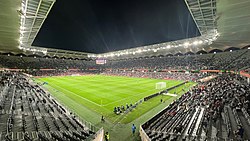
All matches were held in venues across New South Wales, Queensland and Western Australia.[9] The five selected venues were officially recommended for formal ratification by the AFC on 12 November 2024, including one venue (Stadium Australia) used in the 2015 men's Asian Cup and two venues (Stadium Australia and Perth Rectangular Stadium) used in the 2023 Women's World Cup.[10]
On 27 February 2025, it was confirmed the opening game would be held at Perth Stadium, with the final held at Stadium Australia.[11]
| Sydney | |
|---|---|
| Stadium Australia | Western Sydney Stadium |
| Capacity: 79,500 | Capacity: 30,000 |
 |
 |
| Perth | |
| Perth Stadium | Perth Rectangular Stadium |
| Capacity: 60,000 | Capacity: 19,500 |
 |
 |
| Gold Coast | |
| Gold Coast Stadium |  |
| Capacity: 28,000 | |
- Note
- Table shows AFC's stated capacities and may differ from the stadium's actual capacity[12]
Draw
The draw was held on 29 July 2025 in Sydney.[13] The seeding was based on the June 2025 FIFA Women's World Ranking.[14]
| Pot 1 | Pot 2 | Pot 3 | Pot 4 |
|---|---|---|---|
|
|
|
|
Squads
Each team had to register a squad of a minimum of 18 players and maximum of 26 players, at least three of whom had to be goalkeepers (Regulations Article 24.4).
Match officials
On 7 October 2025, the AFC announced the list of 14 referees, 16 assistant referees, two stand-by referees, two stand-by assistant referees and eleven video match officials for the tournament.[15][16] Video assistant referees (VAR) would be used from the group stage for the first time in the competition's history.
Abdulla Al-Marri (Qatar), Abdullah Al-Shehri (Saudi Arabia), Khuloud Al-Zaabi (United Arab Emirates), and Ramina Tsoi (Kyrgyzstan) were selected for the tournament, however, they did not officiate in any matches. Sabreen Ala'badi (Jordan), who was originally selected as a standby assistant referee, replaced Tsoi. Mamdouh Al-Shadan (Saudi Arabia) and Meshari Al-Shammari (Qatar), who were not selected for the tournament, replaced Al-Marri and Al-Shehri.
- Referees
- Casey Reibelt
- Lara Lee
 Dong Fangyu
- Tian Jin
 Mahnaz Zokaee
 Yoshimi Yamashita
- Asaka Koizumi
 Oh Hyeon-jeong
- Kim Yu-jeong
 Veronika Bernatskaia
 Doumouh Al Bakkar
 Pansa Chaisanit
- Supiree Testhomya
 Lê Thị Ly


- Assistant referees
- Madelaine Allum
- Emma Kocbek
- Bao Mengxiao
- Xie Lijun
 Riiohlang Dhar
- Makoto Bozono
- Chihiro Ikki
- Sabreen Ala'badi
- Park Mi-suk
- Lee Soo-bin
 Heba Saadia
 Hyon Un-mi
- Supawan Hinthong
- Nuannid Donjangreed
 Amal Badhafari
- Hà Thị Phượng


- Video assistant referees
- Kate Jacewicz
- Fu Ming
 Law Bik Chi
- Jumpei Iida
- Kim Hee-gon
- Mamdouh Al-Shadan
 Meshari Al-Shammari
 Muhammad Taqi
- Sivakorn Pu-udom
- Edita Mirabidova


- Stand-by referees
 Zainal Nurul Ain Izatty
- Bùi Thị Thu Trang

- Stand-by assistant referees
- Bahareh Seifinahavandi
Ceremonies
Opening ceremony
On 27 January 2026, the organising committee announced that Audrey Nuna would be performing at the opening ceremony ahead of the first game at Perth Stadium on 1 March.[17][18] She also performed an exclusive half-time performance that was not broadcast.[19][20]
As well as Nuna's performance, the ceremony also featured Torres Strait Islander artist Zipporah performing the tournament's first-ever official anthem called "That's How We Win" which was written by Nat Dunn, and a Welcome to Country.[20] Representatives from all competing nations were officially welcomed in their respective native languages.[21]
Closing ceremony
On 14 March 2026, it was announced that Australian artist G Flip would be performing at the closing ceremony, to take place before the Final at Stadium Australia on 21 March.[22]
Group stage
The top two teams of each group and the two best third-placed teams qualified for the quarter-finals.[23]
- Tiebreakers
Teams were ranked according to points (3 points for a win, 1 point for a draw, 0 points for a loss), and if tied on points, the following tiebreaking criteria were applied, in the order given, to determine the rankings:[23]
- Points in head-to-head matches among tied teams;
- Goal difference in head-to-head matches among tied teams;
- Goals scored in head-to-head matches among tied teams;
- If more than two teams were tied, and after applying all head-to-head criteria above, a subset of teams were still tied, all head-to-head criteria above were reapplied exclusively to this subset of teams;
- Goal difference in all group matches;
- Goals scored in all group matches;
- Penalty shoot-out if only two teams were tied and they met in the last round of the group;
- Disciplinary points (yellow card = 1 point, red card as a result of two yellow cards = 3 points, direct red card = 3 points, yellow card followed by direct red card = 4 points);
- Drawing of lots.
All times are local.[24]
Group A
| Pos | Team | Pld | W | D | L | GF | GA | GD | Pts | Qualification |
|---|---|---|---|---|---|---|---|---|---|---|
| 1 | South Korea |
3 | 2 | 1 | 0 | 9 | 3 | +6 | 7 | Advance to knockout stage |
| 2 | Australia (H) |
3 | 2 | 1 | 0 | 8 | 3 | +5 | 7 | |
| 3 | Philippines |
3 | 1 | 0 | 2 | 2 | 4 | −2 | 3 | |
| 4 | Iran |
3 | 0 | 0 | 3 | 0 | 9 | −9 | 0 |
| Australia |
1–0 | Philippines |
|---|---|---|
Kerr
 14' 14' |
Report (AFC) Report (FIFA) |
| South Korea |
3–0 | Iran |
|---|---|---|
|
Report (AFC) Report (FIFA) |
| Philippines |
0–3 | South Korea |
|---|---|---|
| Report (AFC) Report (FIFA) |
|
| Iran |
0–4 | Australia |
|---|---|---|
| Report (AFC) Report (FIFA) |
|
| Iran |
0–2 | Philippines |
|---|---|---|
| Report (AFC) Report (FIFA) |
|
| Australia |
3–3 | South Korea |
|---|---|---|
|
Report (AFC) Report (FIFA) |
|
Group B
| Pos | Team | Pld | W | D | L | GF | GA | GD | Pts | Qualification |
|---|---|---|---|---|---|---|---|---|---|---|
| 1 | China |
3 | 3 | 0 | 0 | 7 | 1 | +6 | 9 | Advance to knockout stage |
| 2 | North Korea |
3 | 2 | 0 | 1 | 9 | 2 | +7 | 6 | |
| 3 | Uzbekistan |
3 | 1 | 0 | 2 | 4 | 6 | −2 | 3 | |
| 4 | Bangladesh |
3 | 0 | 0 | 3 | 0 | 11 | −11 | 0 |
| North Korea |
3–0 | Uzbekistan |
|---|---|---|
|
Report (AFC) Report (FIFA) |
| China |
2–0 | Bangladesh |
|---|---|---|
|
Report (AFC) Report (FIFA) |
| Bangladesh |
0–5 | North Korea |
|---|---|---|
| Report (AFC) Report (FIFA) |
|
| Uzbekistan |
0–3 | China |
|---|---|---|
| Report (AFC) Report (FIFA) |
|
| Bangladesh |
0–4 | Uzbekistan |
|---|---|---|
| Report (AFC) Report (FIFA) |
|
| North Korea |
1–2 | China |
|---|---|---|
|
Report (AFC) Report (FIFA) |
|
Group C

| Pos | Team | Pld | W | D | L | GF | GA | GD | Pts | Qualification |
|---|---|---|---|---|---|---|---|---|---|---|
| 1 | Japan |
3 | 3 | 0 | 0 | 17 | 0 | +17 | 9 | Advance to knockout stage |
| 2 | Chinese Taipei |
3 | 2 | 0 | 1 | 4 | 3 | +1 | 6 | |
| 3 | Vietnam |
3 | 1 | 0 | 2 | 2 | 6 | −4 | 3 | |
| 4 | India |
3 | 0 | 0 | 3 | 2 | 16 | −14 | 0 |
| Japan |
2–0 | Chinese Taipei |
|---|---|---|
|
Report (AFC) Report (FIFA) |
| Vietnam |
2–1 | India |
|---|---|---|
|
Report (AFC) Report (FIFA) |
|
| Chinese Taipei |
1–0 | Vietnam |
|---|---|---|
|
Report (AFC) Report (FIFA) |
| India |
0–11 | Japan |
|---|---|---|
| Report (AFC) Report (FIFA) |
|
| Japan |
4–0 | Vietnam |
|---|---|---|
|
Report (AFC) Report (FIFA) |
| India |
1–3 | Chinese Taipei |
|---|---|---|
|
Report (AFC) Report (FIFA) |
|
Ranking of third-placed teams
| Pos | Grp | Team | Pld | W | D | L | GF | GA | GD | Pts | Qualification |
|---|---|---|---|---|---|---|---|---|---|---|---|
| 1 | B | Uzbekistan |
3 | 1 | 0 | 2 | 4 | 6 | −2 | 3 | Advance to knockout stage |
| 2 | A | Philippines |
3 | 1 | 0 | 2 | 2 | 4 | −2 | 3 | |
| 3 | C | Vietnam |
3 | 1 | 0 | 2 | 2 | 6 | −4 | 3 |
Rules for classification: 1) Points; 2) Goal difference; 3) Goals scored; 4) Disciplinary points; 5) Drawing of lots.[25]
Knockout stage
The four quarter-final winners qualified directly for the 2027 Women's World Cup, while the four quarter-final losers competed in the play-in matches to determine the final two direct qualifiers, and the two Asian representatives in the inter-confederation play-offs. In addition, the eight quarter-finalists will make up the entrants into the 2028 AFC Women's Olympic Qualifying Tournament.[26]
In the knockout stage, extra time and a penalty shoot-out were used to decide the winner if necessary.
Bracket
| Quarter-finals | Semi-finals | Final | ||||||||
| 14 March – Sydney (SA) | ||||||||||
| South Korea |
6 | |||||||||
| 18 March – Sydney (SA) | ||||||||||
| Uzbekistan |
0 | |||||||||
| South Korea |
1 | |||||||||
| 15 March – Sydney (SA) | ||||||||||
| Japan |
4 | |||||||||
| Japan |
7 | |||||||||
| 21 March – Sydney (SA) | ||||||||||
| Philippines |
0 | |||||||||
| Japan |
1 | |||||||||
| 14 March – Perth (PRS) | ||||||||||
| Australia |
0 | |||||||||
| China (a.e.t.) |
2 | |||||||||
| 17 March – Perth (PS) | ||||||||||
| Chinese Taipei |
0 | |||||||||
| China |
1 | |||||||||
| 13 March – Perth (PRS) | ||||||||||
| Australia |
2 | |||||||||
| Australia |
2 | |||||||||
| North Korea |
1 | |||||||||
|
Play-in matches for World Cup and
19 March – Gold Coastinter-confederation play-offs |
||||||||||
| Uzbekistan |
0 | |||||||||
| Philippines |
2 | |||||||||
| 19 March – Gold Coast | ||||||||||
| Chinese Taipei |
0 | |||||||||
| North Korea |
4 | |||||||||
Quarter-finals
The winners qualified for the 2027 FIFA Women's World Cup. The losers advanced to the play-in matches.
| Australia |
2–1 | North Korea |
|---|---|---|
|
Report (AFC) Report (FIFA) |
|
| China |
2–0 (a.e.t.) | Chinese Taipei |
|---|---|---|
| Shao Ziqin
94' Chen Ying-hui 118' (o.g.) |
Report (AFC) Report (FIFA) |
| South Korea |
6–0 | Uzbekistan |
|---|---|---|
|
Report (AFC) Report (FIFA) |
| Japan |
7–0 | Philippines |
|---|---|---|
|
Report (AFC) Report (FIFA) |
Semi-finals
| China |
1–2 | Australia |
|---|---|---|
|
Report (AFC) Report (FIFA) |
|
| South Korea |
1–4 | Japan |
|---|---|---|
|
Report (AFC) Report (FIFA) |
|
Play-in matches
The winners qualified for the 2027 FIFA Women's World Cup. The losers advanced to the inter-confederation play-offs.
| Uzbekistan |
0–2 | Philippines |
|---|---|---|
| Report (AFC) Report (FIFA) |
|
| Chinese Taipei |
0–4 | North Korea |
|---|---|---|
| Report (AFC) Report (FIFA) |
|
Final
| Japan |
1–0 | Australia |
|---|---|---|
|
Report (AFC) Report (FIFA) |
Goalscorers
There were 97 goals scored in 27 matches, for an average of 3.59 goals per match.
6 goals
- Riko Ueki
5 goals
- Alanna Kennedy
4 goals
- Sam Kerr
- Kiko Seike
- Kim Kyong-yong
- Myong Yu-jong
3 goals
- Maika Hamano
- Hinata Miyazawa
- Hong Song-ok
2 goals
- Li Qingtong
- Shao Ziqin
- Wang Shuang
 Su Yu-hsuan
- Remina Chiba
- Tōko Koga
- Momoko Tanikawa
- Chae Un-yong
- Kang Chae-rim
- Ko Yoo-jin
- Mun Eun-ju
- Park Soo-jeong
- Dildora Nozimova
- Ngân Thị Vạn Sự
1 goal
- Caitlin Foord
- Mary Fowler
- Amy Sayer
- Chen Qiaozhu
- Zhang Linyan
- Zhang Rui
- Chen Yu-chin
- Manisha Kalyan
- Sanfida Nongrum
- Aoba Fujino
- Yui Hasegawa
- Maya Hijikata
- Saki Kumagai
- Manaka Matsukubo
- Mina Tanaka
- Yuzuki Yamamoto
- Kim Hye-yong
 Angela Beard
- Sara Eggesvik
- Chandler McDaniel
- Jaclyn Sawicki
- Choe Yu-ri
- Jang Sel-gi
- Jeon Yu-gyeong
- Ji So-yun
- Kim Hye-ri
- Kim Shin-ji
- Lee Eun-young
- Son Hwa-yeon
- Diyorakhon Khabibullaeva
- Nilufar Kudratova
1 own goal
- Chen Ying-hui (against China)
- Panthoi Chanu Elangbam (against Chinese Taipei)
Qualified teams for the FIFA Women's World Cup
The following six teams from AFC qualified for the 2027 FIFA Women's World Cup. Two more teams may qualify via the inter-confederation play-offs.[27]
| Team | Qualified on | Previous appearances in FIFA Women's World Cup[a] |
|---|---|---|
| Australia |
13 March 2026 | 8 (1995[b], 1999[b], 2003[b], 2007, 2011, 2015, 2019, 2023) |
| China |
14 March 2026 | 8 (1991, 1995, 1999, 2003, 2007, 2015, 2019, 2023) |
| South Korea |
14 March 2026 | 4 (2003, 2015, 2019, 2023) |
| Japan |
15 March 2026 | 9 (1991, 1995, 1999, 2003, 2007, 2011, 2015, 2019, 2023) |
| Philippines |
19 March 2026 | 1 (2023) |
| North Korea |
19 March 2026 | 4 (1999, 2003, 2007, 2011) |
Broadcasting rights
| Territory | Rights holder | Ref. |
|---|---|---|
| Africa | Azam TV | [28] |
 Armenia Armenia |
Start | [28] |
 Azerbaijan Azerbaijan |
||
 Belarus Belarus |
||
 Estonia Estonia |
||
 Latvia Latvia |
||
 Lithuania Lithuania |
||
 Moldova Moldova |
||
 Russia Russia |
||
 Ukraine Ukraine |
||
| Australia |
|
[28][29] |
 Austria Austria |
Sportdigital | [28] |
 Germany Germany |
||
 Switzerland Switzerland |
||
 Bosnia and Herzegovina Bosnia and Herzegovina |
Arena Sport | [28] |
 Montenegro Montenegro |
||
 North Macedonia North Macedonia |
||
 Serbia Serbia |
||
 Brunei Brunei |
Astro | [28] |
 Malaysia Malaysia |
||
 Bulgaria Bulgaria |
Diema Sport | [28] |
| Nova Sport | ||
| Caribbean | ESPN | [28] |
| Latin America (inc. BRA and MEX) | ||
 Netherlands Netherlands |
||
| China |
|
[28] |
 Croatia Croatia |
Sport Klub | [28] |
 Slovenia Slovenia |
||
 Hong Kong Hong Kong |
|
[28] |
| India |
|
[28] |
 Indonesia Indonesia |
MNC Media | [28] |
 Israel Israel |
Sport5 | [28] |
| Japan |
DAZN | [28] |
 Kazakhstan Kazakhstan |
Q Sport | [28] |
 Macau Macau |
|
[28] |
 MENA MENA |
|
[28] |
| Pacific Islands |
|
[28] |
| Philippines |
One Sports | [28][30] |
| South Asia (exc. IND) | tapmad | [28] |
| South Korea |
Coupang Play | [28] |
 Taiwan Taiwan |
Sportcast | [28] |
 Tajikistan Tajikistan |
Varzish TV | [28] |
 Thailand Thailand |
BG Sports | [28] |
 Türkiye Türkiye |
D-Smart | [28] |
| Uzbekistan |
MTRK | [28] |
| Vietnam |
|
[31][32] [33][34] |
| unsold markets | Youtube | [35] |
Controversies
Threats towards the Iranian national team
In February 2026, after a number of players resigned from the Iran women's national football team and refereeing organization following the massacres in the country, the Iranian Football Federation reportedly threatened them with multi-year bans from professional football activities, judicial action, and long prison sentences.[36][37] In March 2026, after the Iran women's national football team players refused to sing the national anthem of the Islamic Republic as a form of silent protest ahead of their Women's Asian Cup opener against South Korea, concerns grew for their safety following threats from Iranian state media.[38][39] Ahead of the following match against Australia, the national team players were reportedly forced to sing the national anthem of the Islamic Republic of Iran, with threats to the players' family members if they did not.[40] After the team's exit from the tournament on 8 March, members of the team gave what appeared to be SOS hand signals from the bus as they were leaving, leading to protests and growing calls for Australia to offer the team refuge after the players were accused of being wartime traitors by Iranian state media for not singing the national anthem of the Islamic Republic in their opening game amid the Iran war.[41][42][43][44]
On 9 March, five members of the Iranian women’s national football team – Fatemeh Pasandideh, Zahra Ghanbari, Zahra Sarbali, Atefeh Ramezanizadeh, and Mona Hamoudi – left the team’s training camp in Australia and sought refuge due to fears of retaliation from Iranian authorities.[45] On 10 March, US president Donald Trump publicly urged the Australian government to grant asylum to the players, stating they could face persecution if they returned to Iran.[46] It was reported that the women had been helped to escape by the Australian Federal Police around 1:30 am, and had been granted humanitarian visas to stay in Australia. Home Affairs Minister Tony Burke had been working with the AFP on the issue for some time, and Prime Minister Anthony Albanese said that the team were safe in Australia.[47][48]
Removal of Chen Kuei-jen
Former Chinese Taipei national football team coach Chen Kuei-jen was removed during the match between the Chinese Taipei and India in Sydney for leading fans to chant "Taiwan Jiayou" ("Go Taiwan"), after refusing to follow officials who ordered him to only use Chinese Taipei as the use of Taiwan was considered "political". Despite this, following Chinese Taipei's victory, Chen continued the Taiwan chant with the players on their bus. Following this incident, Taiwanese politician Lee Po-yi stated that he would contact the Ministry of Sports and the Australia's Taipei representative office to demand an explanation from the organisers. Chinese Taipei has been the name used since 1979 to represent Taiwan following the Nagoya Resolution to prevent sporting conflict with China, but the name has become controversial in Taiwan as many citizens have voiced support for being internationally recognised as Taiwan.[49]
See also
- 2027 FIFA Women's World Cup qualification
- 2028 AFC Women's Olympic Qualifying Tournament
- 2026 AFC U-20 Women's Asian Cup
- 2026 AFC U-17 Women's Asian Cup
Notes
References
- ^ a b "Australia and Uzbekistan confirmed as 2026 and 2029 AFC Women's Asian Cup hosts". the-AFC.com. Asian Football Confederation. Retrieved 17 May 2024.
- ^ "AFC unveils breakthrough reforms to strengthen Women's National Team Competitions". the-AFC.com. Asian Football Confederation. 13 September 2024. Retrieved 14 September 2024.
- ^ "Four Member Associations express interest to host AFC Women's Asian Cup 2026". the-AFC.com. Asian Football Confederation. 1 August 2022. Retrieved 1 August 2022.
- ^ "Australia and Uzbekistan recommended as hosts for 2026 and 2029 editions of AFC Women's Asian Cup". the-AFC.com. Asian Football Confederation. 15 March 2024. Retrieved 15 March 2024.
- ^ "Saudi Arabia, Australia among four nations to bid for 2026 AFC Women's Asian Cup". Inside the Games. 1 August 2022. Retrieved 3 August 2022.
- ^ "Saudi Arabia submits bid to host AFC Women's Asian Cup 2026". Arab News. 2 December 2022. Retrieved 10 December 2022.
- ^ a b "Australia set to host 2026 AFC Women's Asian Cup after others withdraw bids". Sportcal. 23 February 2024. Retrieved 24 February 2024.
- ^ "Asian Football powerhouses qualify for AFC Women's Asian Cup Australia 2026". Football Australia. 19 December 2024. Retrieved 23 December 2024.
- ^ Nicholson, Paul (22 April 2024). "Aussies announce states to host Women's Asian Cup 2026". Inside World Football. Retrieved 23 April 2024.
- ^ Comino, Matt (13 November 2024). "Three host cities confirmed for 2026 Women's Asian Cup as five venues selected & dates locked in". ALeagues.com.au. Australian Professional Leagues. Retrieved 13 November 2024.
- ^ "Perth to host Matildas in Women's Asian Cup opener". The West Australian. 27 February 2025. Retrieved 27 February 2025.
- ^ "Host City | AFC WAC 2026". WomensAsianCup2026.com.au. Australian Government. Retrieved 2 July 2025.
- ^ "All eyes on AFC Women's Asian Cup Australia 2026 Final Draw". the-AFC.com. Asian Football Confederation. 23 July 2025. Retrieved 23 July 2025.
- ^ "FIFA/Coca-Cola FIFA Women's World Ranking". FIFA. 12 June 2025.
- ^ "Record number of officials appointed to #WAC2026". the-AFC.com. Asian Football Confederation. 7 October 2025. Retrieved 8 October 2025.
- ^ "AFC Women's Asian Cup Australia 2026 Match Officials Appointments" (PDF). the-AFC.com. Asian Football Confederation. 7 October 2025. Retrieved 8 October 2025.
- ^ "Audrey Nuna to headline AFC Women's Asian Cup Australia 2026™ opening ceremony". AFC. 27 January 2026. Retrieved 28 January 2026.
- ^ "'KPop Demon Hunters' Star to Perform at Major Event in Perth". Rolling Stone. 27 January 2026. Retrieved 28 January 2026.
- ^ "KPop Demon Hunters Star Audrey Nuna to Perform at AFC Women's Asian Cup 2026™". Ministry of Sport. 28 January 2026. Retrieved 31 January 2026.
- ^ a b "#WAC2026 breaks attendance record in dazzling opening ceremony". the-AFC. Retrieved 4 March 2026.
- ^ Audrey Nuna LIVE at 2026 AFC Women’s Asian Cup Opening Ceremony 🔥 (Full Performance). Football Australia. 1 March 2026. Retrieved 4 March 2026 – via YouTube.
- ^ "G Flip to headline AFC Women's Asian Cup Australia 2026TM Closing Ceremony | Destination NSW". media.destinationnsw.com.au. Retrieved 16 March 2026.
- ^ a b "Competition Regulations AFC Women's Asian Cup Australia 2026" (PDF). the-AFC.com. Asian Football Confederation.
- ^ "AFC Women's Asian Cup™ Australia 2026 Match Schedule" (PDF). the-AFC.com. Asian Football Confederation. 29 July 2025. Retrieved 29 July 2025.
- ^ "AFC Competition Operations Manual (Edition 2026)" (PDF). the-AFC.com. Asian Football Confederation.
- ^ "AFC unveils breakthrough reforms to strengthen Women's National Team Competitions". Asian Football Confederation. 12 September 2024. Retrieved 17 March 2026.
- ^ "FIFA Women's World Cup Brazil 2027 dates confirmed". 11 December 2024. Retrieved 13 February 2025.
- ^ a b c d e f g h i j k l m n o p q r s t u v w x y z aa "AFC Women's Asian Cup: Where to watch". the-afc.com. Retrieved 26 February 2026.
- ^ "The AFC Women's Asian Cup Australia 2026™ Fixtures". 20 November 2025.
- ^ "Free Livestream: 2026 AFC Women's Asian Cup Match Between Filipinas and Australia". pff.org.ph. Retrieved 2 March 2026.
- ^ "TV360 phát sóng bảy giải bóng đá lớn nhất châu Á". vnexpress.net (in Vietnamese). VnExpress. 30 December 2025. Retrieved 3 January 2026.
- ^ "Viettel appointed Official Media Partner of AFC competitions in Vietnam". the-afc.com. AFC. 29 December 2025. Retrieved 3 January 2026.
- ^ "🚨 [CHÍNH THỨC] HTV PHÁT SÓNG 3 GIẢI ĐẤU BÓNG ĐÁ ĐỈNH CAO CHÂU Á! 💥" (in Vietnamese). HTV. 2 January 2026. Retrieved 3 January 2026 – via Facebook.
- ^ Nguyễn Vương Hân (24 February 2026). "Xem trực tiếp VCK Asian Cup nữ 2026 ở đâu? Kênh nào?". thethao247.vn. Retrieved 26 February 2026.
- ^ "AFC Asian Cup". YouTube. Retrieved 10 March 2026.
- ^ "Iran steps up crackdown on women footballers after protest resignations". Iran International. 19 February 2026. Retrieved 23 February 2026.
- ^ "زهرا علیزاده، بازیکن گلگهر، پس از کشتار جمهوری اسلامی، از تیم ملی فوتبال کنارهگیری کرد" [Zahra Ali-Zadeh, Gol Gohar player, Resigns from the National Football Team After the Massacre by the Islamic Republic]. Iran International (in Persian). 31 January 2026. Retrieved 15 February 2026.
- ^ https://www.theguardian.com/football/2026/mar/03/iran-women-football-team-decline-to-sing-national-anthem-before-asian-cup-tie
- ^ https://www.abc.net.au/news/2026-03-06/iran-women-football-womens-asian-cup-state-tv-traitors/106425022
- ^ Cuadrado, Patrick Sung; Macfarlane, Christina (6 March 2026). "Iranian women's soccer team forced to sing national anthem ahead of Asian Cup match, sources tell CNN". CNN. Retrieved 8 March 2026.
- ^ Maiden, Samantha (8 March 2026). "'Impossible situation': Iranian women's team sing anthem amid fears of jail, death after final game". The Advertiser. Retrieved 9 March 2026.
- ^ https://www.abc.net.au/news/2026-03-09/asian-cup-2026-protesters-surround-iran-team-bus/106431212
- ^ https://apnews.com/article/iran-soccer-womens-asian-cup-6a9fd17b140e01b9e841a766c9ff2670
- ^ https://www.dw.com/en/fears-grow-for-irans-womens-football-team/a-76278906
- ^ "Australia urged to offer Iran women's team refuge amid fears of backlash after refusing to sing anthem". The National. Retrieved 9 March 2026.
- ^ "Trump urges Australia to give Iran's Asian Cup players asylum". ESPN. 9 March 2026. Retrieved 10 March 2026.
- ^ Farrer, Martin (9 March 2026). "'They are safe here': five Iranian women footballers granted humanitarian visas in Australia". The Guardian. Retrieved 9 March 2026.
- ^ Campbell, Kieran (9 March 2026). "'They are safe': Five Iranian footballers granted asylum after fleeing handlers on the Gold Coast". 9News. Retrieved 9 March 2026.
- ^ Lewis, Samantha (11 March 2026). "Former Taiwan men's coach kicked-out of Women's Asian Cup match for 'political chants'". The Guardian.
External links
- AFC Women's Asian Cup, the-AFC.com
- Women's World Cup Qualifier, FIFA.com